
Vibration analysis is the most widely used and most effective predictive maintenance (PdM) technique for rotating machinery. Studies by the U.S. Department of Energy and the European Federation of National Maintenance Societies have consistently shown that vibration-based predictive maintenance can reduce maintenance costs by 25–40%, eliminate 70–80% of unplanned failures, and extend equipment life by 20–40%. For industrial facilities that rely on rotating equipment — motors, pumps, fans, compressors, turbines, gearboxes — implementing a vibration analysis program is frequently the highest-ROI maintenance improvement available.
The Physics of Vibration
All rotating machinery vibrates. The key to vibration analysis lies in understanding that — much like a fingerprint — each machine has a unique vibration signature in its healthy state, and specific fault conditions produce predictable changes in that signature. Vibration is measured in three fundamental parameters, each suited to different fault conditions:
- Displacement (µm, mils) — The physical distance a machine surface moves from its rest position. Most sensitive to low-frequency vibration below 600 CPM (10 Hz). Best suited for measuring shaft movement in sleeve-bearing machines such as steam turbines and large centrifugal compressors. Displacement is the primary parameter used in proximity probe systems per API 670.
- Velocity (mm/s, in/s) — The rate of change of displacement. This is the most commonly used parameter per ISO 10816 and ISO 20816 standards. It provides balanced sensitivity across the full frequency range of 10–1000 Hz and is the preferred parameter for overall machine condition assessment. Velocity is the standard for evaluating pumps, fans, motors, and general industrial machinery.
- Acceleration (m/s², g) — The rate of change of velocity. Most sensitive to high-frequency vibration above 1 kHz. Essential for detecting early-stage bearing defects and gear tooth issues before they progress to catastrophic failure. Envelope acceleration (gE) is a specialized technique that filters out low-frequency content to focus on bearing impact signals.
ISO 10816 and ISO 20816 Standards
The ISO 10816 family of standards has been the global benchmark for machine vibration evaluation for decades. It has been superseded by ISO 20816, which expands the scope to include non-rotating machinery (structures, reciprocating machines) and provides more detailed guidance. These standards define measurement methods, transducer placement, assessment zones (A–D), and alarm limits for different machine types and power ratings:
| Machine Class | ISO Standard | Good (mm/s rms) | Alarm (mm/s rms) | Trip (mm/s rms) |
|---|---|---|---|---|
| Small machines (≤15 kW) | ISO 20816-1 | ≤ 1.8 | 4.5 | 7.1 |
| Medium machines (15–300 kW) | ISO 20816-1 | ≤ 2.8 | 7.1 | 11.2 |
| Large (>300 kW, rigid foundation) | ISO 20816-1 | ≤ 3.5 | 7.1 | 11.2 |
| Large (>300 kW, flexible foundation) | ISO 20816-1 | ≤ 4.5 | 11.2 | 18.0 |
| Gas/steam turbines | ISO 20816-2 | ≤ 3.8 | 9.5 | 15.0 |
| Reciprocating compressors | ISO 20816-8 | ≤ 7.5 | 18.0 | 28.0 |
These overall velocity values serve as first-line screening thresholds. When overall levels exceed alarm limits, detailed frequency analysis (FFT) is required to diagnose the specific fault type.
Fast Fourier Transform (FFT) Frequency Analysis
The heart of modern vibration analysis is the Fast Fourier Transform (FFT), which converts a time-domain vibration waveform into its constituent frequency components. The resulting frequency spectrum reveals peaks at specific frequencies that correspond to known fault conditions. Proper FFT parameter selection is critical for effective analysis:
- Resolution (Δf) — The frequency spacing between spectral lines, determined by the sampling time: Δf = 1 / T_sampling. Higher resolution (smaller Δf) enables separation of closely spaced frequencies. For low-speed machinery (<300 RPM), a resolution of 0.1 Hz or better is required.
- Frequency range (F_max) — The maximum frequency analyzed, determined by the sampling rate per the Nyquist criterion: F_max = F_sampling / 2.56. For general machinery, F_max of 1000 Hz (10× RPM for 6000 RPM machines) is typical. For bearing analysis, F_max of 10–20 kHz is needed.
- Averaging — Multiple FFT frames are averaged to reduce noise and reveal stable vibration components. Typical settings: 4–8 averages with 66% overlap. More averages improve consistency but increase measurement time.
- Windowing — The Hanning window is standard for continuous vibration. The Flat-top window is preferred when precise amplitude measurement is needed. The Rectangular (uniform) window is used for transient analysis and balancing.
Fault Frequencies and Diagnosis
Each rotating element fault generates vibration at characteristic frequencies that are mathematically related to the shaft rotational speed (1× RPM). Understanding these frequency relationships is the foundation of vibration diagnostics:
| Fault Type | Characteristic Frequency | Formula | Distinguishing Features |
|---|---|---|---|
| Imbalance | 1× RPM | F_imb = 1 × RPM | Radial vibration dominant, sinusoidal waveform, amplitude proportional to speed², 1× dominant with low 2× |
| Parallel Misalignment | 2× RPM | F_mis = 2 × RPM | High axial vibration, 180° phase shift across coupling, 2× dominant with 1× and 3× |
| Angular Misalignment | 1× RPM | F_mis = 1 × RPM | High axial vibration, 180° phase shift, 1× + harmonics, both axial directions in phase |
| Bent Shaft | 1× RPM | F_bent = 1 × RPM | High axial + radial, 180° phase shift across bearing housings, 2× may also be present |
| Mechanical Looseness | 1× RPM + harmonics | F_loose = 1 × RPM | Sub-harmonics (0.5×, 1.5×, etc.), harmonic series, unstable amplitude from reading to reading |
| Bearing — BPFO | (N/2)×(1 − d/D×cos φ)×RPM | Ball Pass Frequency Outer Race | Sidebands at 1× RPM, directional RMS increases, 1×–4× BPFO harmonics |
| Bearing — BPFI | (N/2)×(1 + d/D×cos φ)×RPM | Ball Pass Frequency Inner Race | Sidebands at 1× RPM, amplitude modulation, 1×–4× BPFI harmonics |
| Bearing — BSF | (D/2d)×(1 − (d/D×cos φ)²)×RPM | Ball Spin Frequency | Non-synchronous (not an integer multiple of RPM), irregular amplitude |
| Bearing — FTF | (½)×(1 − d/D×cos φ)×RPM | Fundamental Train Frequency | Very low frequency (<1×), indicates cage damage, usually appears late in failure progression |
| Gear Mesh | N_teeth × RPM | Gear Mesh Frequency = GMF | Sidebands at shaft 1× RPM, amplitude grows with wear, sideband spacing identifies worn gear |
| Electrical Fault (Motor) | 2× line frequency | 100 Hz (50 Hz supply) | Sidebands at 2× slip frequency, disappears when power removed, broken rotor bar sidebands |
Where: N = number of rolling elements, d = ball diameter, D = pitch diameter, φ = contact angle (typically 0° for deep groove ball bearings).
Wireless Sensors and Edge AI
Modern predictive maintenance increasingly deploys wireless vibration sensors with edge computing capabilities. This approach addresses the two main barriers to traditional vibration programs: high cost of permanent cabled sensors and limited technician availability for walk-around routes.
- Battery-powered MEMS accelerometers — 3-axis digital output (I²C or SPI), configurable sample rates up to 10 kHz, 2–5 year battery life with typical sampling schedules. MEMS sensors are now achieving noise floors below 100 µg/√Hz, approaching the performance of traditional piezoelectric sensors for most industrial applications.
- Edge AI processing — On-sensor FFT computation and fault classification using embedded machine learning models. Only alerts and summary data are transmitted, reducing bandwidth requirements by 100–1000× compared to streaming raw waveforms. Modern edge AI accelerometers can classify up to 8 fault types with >95% accuracy.
- Communication protocols — WirelessHART, ISA100.11a, LoRaWAN, or Wi-Fi depending on range and data rate requirements. MQTT transport with Sparkplug B payload encoding provides IIoT platform integration.
- Sampling strategy — Scheduled readings (every 1–24 hours depending on asset criticality) with event-triggered high-resolution capture when vibration thresholds are exceeded. This hybrid approach balances battery life with fault detection sensitivity.
Implementation Methodology
Building a successful vibration-based PdM program requires a structured approach:
- Asset Criticality Ranking — Prioritize machines based on safety impact, production criticality, replacement cost, and repair lead time. Focus the PdM program on critical and semi-critical assets first. A typical ranking uses a 4×4 matrix of consequence × likelihood.
- Measurement Point Selection — Define permanent or walk-around measurement points at each bearing housing in three axes: vertical (V), horizontal (H), and axial (A). For sleeve bearings, use proximity probes (eddy current) for shaft displacement measurement. Mark each point permanently for repeatability.
- Baseline Collection — Establish baseline vibration signatures when machinery is known to be in good condition (typically within 30 days of overhaul or new installation). Include time waveform, frequency spectrum (with appropriate F_max and resolution), phase, and overall level data.
- Route-Based Data Collection — For walk-around programs, define optimized data collection routes. Modern data collectors guide the technician via barcode or RFID tag at each measurement point. A typical route should not exceed 50 points to avoid technician fatigue.
- Trend Analysis — Track overall vibration levels and individual spectral peak amplitudes over time. The rate of change is frequently more informative than absolute values. A sudden 2× increase in a spectral peak is more significant than a slow drift over 6 months.
- Diagnosis and Recommendation — Compare measured spectra against known fault patterns. Generate actionable recommendations with clear timeframes: "Monitor quarterly," "Plan repair within 4 weeks," "Immediate shutdown required."
- CMMS Integration — Automatically create work orders in the CMMS (Computerized Maintenance Management System) when vibration readings exceed alarm thresholds. Common CMMS platforms include SAP PM, IBM Maximo, Infor EAM, and maintenance-specific solutions like Fiix or eMaint.
ASP OTOMASYON A.Ş. and its subsidiaries OPCTurkey and ASP Dijital provide end-to-end industrial engineering solutions for process automation, data operations and AI.
References & Further Reading
- ISO 10816-1 — Mechanical Vibration — Evaluation of Machine Vibration by Measurements on Non-Rotating Parts — International standard establishing the global benchmark for vibration severity assessment of industrial rotating machinery with zone-based evaluation criteria.
- ISO 20816-1 — Mechanical Vibration — Measurement and Evaluation of Machine Vibration — International standard superseding ISO 10816, expanding the scope to include non-rotating machinery and providing updated vibration limits for different machine classes.
- ISO 18436-2 — Condition Monitoring and Diagnostics of Machines — Vibration Analysis Certification — International standard defining the training, experience, and examination requirements for certified vibration analysis personnel (Categories I through IV).
- ISA-95 / IEC 62264 — Asset Hierarchy for Predictive Maintenance — International standard providing the equipment hierarchy model for organising vibration monitoring points and associating measurement data with specific assets.
- IEC 60034-14 — Rotating Electrical Machines — Vibration Measurement — International standard for vibration measurement limits on electrical machines, covering acceptance testing and commissioning vibration levels for AC motors and generators.
Apply this to your project
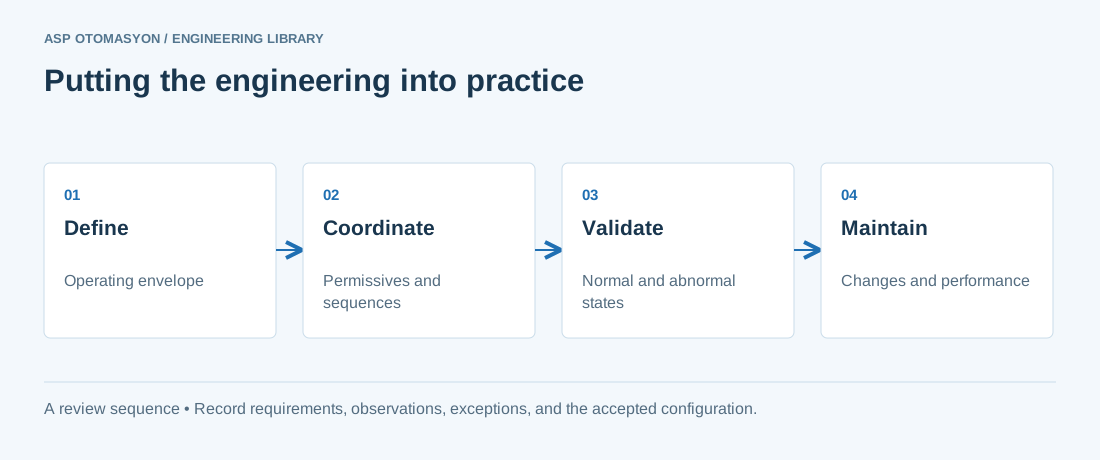
- Record process boundaries, required operating states, and interactions with independent protective systems.
- Check instrument quality, control authority, permissives, and operator responsibilities during state changes.
- Agree how tests, deviations, and configuration changes will be recorded within the facility's engineering procedures.
Follow an ASP project guide to connect the fundamentals with implementation and acceptance.
Primary references and further reading
Use the original specifications and product documentation for implementation details. The examples in this guide are illustrative engineering scenarios, not published project results.