
The food and beverage industry presents unique automation challenges: hygienic design requirements, washdown environments, batch recipe management, traceability, and compliance with food safety regulations such as FSMA and ISO 22000.
Hygienic Design Requirements for Food & Beverage Automation
Automation equipment in food and beverage processing must withstand rigorous sanitation procedures while preventing product contamination. Key design considerations include:
IP69K Protection Rating
IP69K, defined in IEC 60529 (extended by DIN 40050-9), specifies protection against close-range high-pressure (80–100 bar / 1160–1450 psi) and high-temperature (80°C / 176°F) washdown. Unlike the standard IP67 test, IP69K uses a nozzle spraying water at 14–16 L/min from 10–15 cm distance at four angles (0°, 30°, 60°, 90°) for 30 seconds each. Enclosures rated IP69K typically use double-sealed gaskets, compression latches, and smooth stainless steel surfaces. Applications include: HMI panels on filling machines, valve islands in wet areas, and sensor housings on washdown conveyors.
Stainless Steel and Material Selection
Automation components in food areas should be fabricated from 304 stainless steel (general use) or 316L stainless steel (corrosive environments with chlorinated cleaners or acidic products). Surface finish should be better than Ra ≤ 0.8 μm (32 μin) for product-contact surfaces and Ra ≤ 1.6 μm (63 μin) for non-contact surfaces to prevent bacterial adhesion and facilitate cleaning. Enclosures must be sloped (typically 15° minimum) to prevent liquid pooling, with no exposed threads, crevices, or horizontal ledges. All fasteners should be stainless steel with hex socket or torx heads to resist cam-out during repeated removal for cleaning.
Food-Grade Lubricants and Seals
Lubricants used in food processing equipment — gearboxes, bearings, actuators — must be NSF H1 or ISO 21469 certified, meaning they are safe for incidental food contact (< 10 ppm). All seals (O-rings, gaskets, shaft seals) must be FDA-compliant elastomers (EPDM, silicone, Viton) chosen for compatibility with CIP chemicals and temperature exposure.
CIP (Clean-in-Place) Automation
CIP automation is a critical process in food and beverage plants that cleans the interior surfaces of process vessels, piping, and equipment without disassembly. A typical CIP cycle consists of five phases:
- Pre-rinse — Ambient or warm water flush to remove gross product residues. Duration: 3–10 minutes. The rinse water is typically sent to drain. Conductivity drops sharply as product residue is removed.
- Caustic wash — Hot (65–80°C) caustic solution (1–3% NaOH) circulated at high velocity (1.5–3 m/s in pipes) to dissolve fats, proteins, and organic soils. Duration: 10–30 minutes. Caustic is recovered and reused (topping up concentration as needed) until its soil load exceeds a threshold.
- Intermediate rinse — Fresh or recycled water to remove residual caustic. Duration: 3–10 minutes. Conductivity monitoring detects when caustic concentration drops below a threshold (typically < 100 μS/cm).
- Acid wash — Warm (50–70°C) acid solution (0.5–2% nitric or phosphoric acid) to remove mineral scale (milkstone, beerstone) and neutralise residual caustic. Duration: 10–20 minutes. Acid is also recovered and reused.
- Final rinse — Fresh, filtered water to remove all chemical residues. Duration: 3–10 minutes. Conductivity and pH must return to within specification (typically pH 6–8, conductivity < 30 μS/cm) for the equipment to be declared clean and ready for production.
CIP automation sequences control: valve manifolds to route cleaning solutions through specific circuits, pump speeds for flow rate control, temperature control via plate heat exchangers and steam injection, and conductivity/pH sensors for solution strength monitoring and phase transitions. A well-designed CIP system records a full cleaning report per circuit: flow rate profile, temperature profile, chemical concentration (conductivity), and phase durations. These records are essential for HACCP and FSMA compliance.
SIP (Sterilize-in-Place) Automation
SIP uses saturated steam at 121–134°C to achieve sterility, required for aseptic processing of shelf-stable products (e.g., UHT milk, juices, liquid egg). The SIP sequence includes:
- Heating phase — Steam is introduced to raise the equipment temperature to the sterilisation setpoint. Condensate is removed via steam traps and temperature-sensing drains.
- Hold phase — The equipment is held at the sterilisation temperature for the required dwell time (typically 15–30 minutes at 121°C, or 3–5 minutes at 134°C). Every point in the system must achieve the minimum temperature; temperature sensors at the coldest spots (e.g., valve cavities, instrument tees) provide time-at-temperature verification. A deviation below the minimum temperature resets the hold timer.
- Cooling phase — Sterile air or filtered water is introduced to cool the equipment to production temperature while maintaining positive pressure to prevent recontamination.
Automation must log the sterilisation profile per cycle: minimum temperature, time above threshold, and any deviations. SIP cycles are validated per the FDA's Aseptic Processing Guideline using biological indicators (e.g., Geobacillus stearothermophilus spore strips).
Recipe Management for Food & Beverage
Recipe management in food and beverage goes beyond simple batching. Typical functionality includes:
- Ingredient management — Scales, flow meters, and load cells measure each ingredient with defined tolerances. Minor ingredients (flavours, colours, enzymes) may use gravimetric batching with high-precision load cells (±0.1% accuracy). Variable-speed augers or dosing pumps control the feed rate to avoid overshoot.
- Blending sequences — The order and timing of ingredient addition is critical to product quality (e.g., emulsification requires the oil phase to be added slowly to the water phase while at high shear). The recipe defines interlock conditions: "Add sweetener only after pH < 6.0" or "Start homogeniser 30 seconds before oil addition."
- Hold times and ageing — Many products require a minimum hold time for hydration (dough development, protein hydration) or ageing (cheese, beer, cured meats). The recipe defines the hold duration and may include time-temperature integration (pasteurisation units).
- Version control and audit trail — Recipe changes must be controlled: only authorised personnel (QA manager, process engineer) can modify a master recipe, and all revisions are tracked with date, user, and change reason. Electronic signatures per 21 CFR Part 11 apply if the product is a dietary supplement or pharmaceutical intermediary.
Metal Detection and Checkweighing Integration
In-line inspection systems — metal detectors, checkweighers, X-ray systems — are integrated with rejection mechanisms to remove non-conforming product automatically:
- Metal detectors — Detect ferrous, non-ferrous, and stainless steel contaminants using balanced-coil or multi-spectrum technology. Sensitivity is product-dependent and must be validated per HACCP plan (e.g., detect ≥ 1.0 mm ferrous in a 500 g block of cheese). Rejection: pneumatic pusher, drop flap, or air blast to divert contaminated product to a locked reject bin. All reject events are logged with product ID, date/time, and reject confirmation sensor.
- Checkweighers — In-line weighing at speeds up to 600 packs/min with accuracy of ±0.5 g. Feedback loops adjust filler settings (servo-driven auger, piston filler) to minimise giveaway while staying above the minimum fill weight (per NIST Handbook 133 or EU Weights and Measures Directive).
- Data integration — Reject data (metal detector hits, checkweigher deviations) is transmitted to the MES or SCADA system for trend analysis (e.g., "increasing metal detection hits from supplier X" triggers a supplier quality alert).
Traceability Systems and Mock Recall
Food safety regulations (FSMA, EU Regulation 178/2002) require one-step-forward/one-step-back traceability: each processor must track what materials came in and what products went out. Key implementation elements:
- Lot tracking — Each raw material lot is recorded upon receipt with supplier, date, quantity, and COA (Certificate of Analysis). During batching, the lot numbers of all components are linked to the batch/lot of the finished product. This creates a traceability chain from raw material → intermediate → finished product → customer.
- Production tracking — Every intermediate and finished product container receives a unique identifier (barcode, RFID tag, or GS1-128 label) with link to the parent batch. SCADA/MES records which equipment trains, CIP cycles, and operators touched each batch.
- Mock recall — Traceability systems must be tested at least annually by executing a mock recall: start from a finished product lot and trace backwards to all raw material lots within 4 hours (FDA target) or 1 hour (EU target). Conversely, start from a suspect raw material lot and trace forward to all finished product lots that used it. Automation systems should support these queries through a traceability dashboard.
FSMA Compliance — Preventive Controls
The US FDA Food Safety Modernization Act (FSMA) shifts focus from reactive to preventive food safety. Key automation-relevant provisions:
- Hazard Analysis and Risk-Based Preventive Controls (HARPC) — Every facility must conduct a hazard analysis (biological, chemical, physical) and implement preventive controls. Automation supports: CCP monitoring (cook temperature, metal detector, CIP conductivity), corrective action triggers, and verification records.
- Food Defense — The facility must have a food defense plan addressing intentional adulteration. Automation contributes through: access control to recipe systems, tamper-evident process logs, and video surveillance of critical processing areas.
- Supply Chain Verification — Receiving automation can verify inbound raw material temperature (temperature sensors at receiving bay) and documentation (digital COA against supplier spec) before allowing the lot to be accepted into inventory.
ASP OTOMASYON A.Ş. and its subsidiaries OPCTurkey and ASP Dijital provide end-to-end industrial engineering solutions for process automation, data operations and AI.
References & Further Reading
- FDA FSMA — Food Safety Modernization Act — Official US FDA regulation transforming the food safety system from reactive to preventive, requiring comprehensive hazard analysis and risk-based preventive controls.
- ISO 22000:2018 — Food Safety Management Systems — International standard for food safety management systems, integrating the HACCP principles and prerequisite programmes for the food supply chain.
- IEC 60529 — Degrees of Protection Provided by Enclosures (IP Code) — International standard defining IP ratings including IP69K for high-pressure, high-temperature washdown environments common in food and beverage processing.
- ISA-88 / IEC 61512 — Batch Control Standards for Food Production — International standard for batch process control applied to food and beverage recipe management, batch tracking, and CIP/SIP automation.
- ISO 14159 — Safety of Machinery — Hygiene Requirements — International standard for hygiene requirements in machinery design for food processing, covering materials, surface finish, cleanability, and drainage.
Apply this to your project
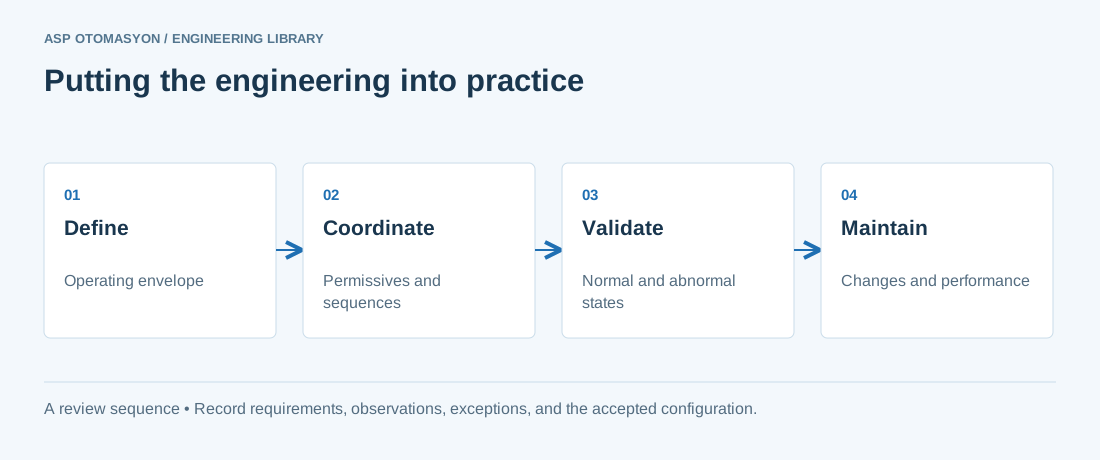
- Record process boundaries, required operating states, and interactions with independent protective systems.
- Check instrument quality, control authority, permissives, and operator responsibilities during state changes.
- Agree how tests, deviations, and configuration changes will be recorded within the facility's engineering procedures.
Follow an ASP project guide to connect the fundamentals with implementation and acceptance.
Primary references and further reading
Use the original specifications and product documentation for implementation details. The examples in this guide are illustrative engineering scenarios, not published project results.