
Integrating industrial sensors into an Industrial Internet of Things (IIoT) architecture requires careful selection of sensor technologies, communication protocols, and data processing patterns. This article covers the most common integration patterns used in modern smart manufacturing deployments.
Sensor Types and Applications
Industrial IIoT deployments typically involve four primary sensor categories:
- Temperature Sensors — Thermocouples (Type J, K, T, E), RTDs (Pt100, Pt1000), and infrared pyrometers. Used for process monitoring, equipment health (bearing temperature), and environmental monitoring. Typical ranges: Type J: −210°C to 760°C, Type K: −270°C to 1260°C, Type T: −270°C to 370°C, Type E: −270°C to 900°C.
- Pressure Sensors — Piezoresistive, capacitive, and strain-gauge transmitters. Measure gauge, absolute, and differential pressure in pipes, vessels, and hydraulic systems. Standard output: 4–20 mA or HART protocol.
- Flow Sensors — Electromagnetic, ultrasonic, Coriolis, vortex, and differential pressure flow meters. Critical for material balance, custody transfer, and process optimization. Accuracy ranges from 0.1% (Coriolis) to 2% (vortex).
- Vibration Sensors — Accelerometers (MEMS and piezoelectric), velocity transducers, and proximity probes. Used for predictive maintenance of rotating equipment (motors, pumps, fans, compressors).
Communication Protocols
Selecting the right protocol depends on distance, data rate, power budget, and existing infrastructure:
| Protocol | Type | Distance | Data Rate | Best For |
|---|---|---|---|---|
| MQTT | Publish/Subscribe (TCP/IP) | Unlimited (network) | Network-dependent | Cloud/edge telemetry, event-driven data |
| Modbus TCP | Client/Server (TCP/IP) | Unlimited (network) | 10/100 Mbps | PLC integration, existing infrastructure |
| Modbus RTU | Master/Slave (Serial) | Up to 1200 m (RS-485) | 9600–115200 baud | Simple sensor networks, legacy equipment |
| HART | Master/Slave (4–20 mA overlay) | Up to 3000 m | 1200 baud | Existing 4–20 mA instruments, diagnostics |
| OPC UA | Client/Server + Pub/Sub | Unlimited (network) | Network-dependent | IT/OT integration, semantic data models |
| IO-Link | Point-to-point (24 VDC) | Up to 20 m | 4.8–230.4 kbaud | Smart sensors, actuators, tool identification |
Edge Computing Architecture
Edge computing brings data processing closer to the sensor source, reducing latency and bandwidth requirements:
- Sensor/Field Tier — Raw sensor data is collected via fieldbus protocols (HART, Modbus RTU, IO-Link) or direct analog/digital I/O.
- Edge Gateway Tier — Industrial edge gateways (e.g., Siemens Industrial Edge, AWS IoT Greengrass, Azure IoT Edge) perform protocol translation, data filtering, aggregation, and local analytics.
- Cloud/Platform Tier — Centralized data platforms receive processed data from edge gateways for long-term storage, advanced analytics, machine learning training, and enterprise dashboards.
Data Flow Pattern
Sensor (Raw Data) --> Edge Gateway
    |-- Filter: Remove noise, outliers, duplicates
    |-- Aggregate: Calculate min/max/avg over windows
    |-- Normalize: Convert to engineering units
    |-- Contextualize: Add metadata (equipment ID, area, timestamp)
    |-- Detect: Run threshold alarms and anomaly detection
    +-- Publish: Send processed data to cloud via MQTT/OPC UA
Data Normalization and Contextualization
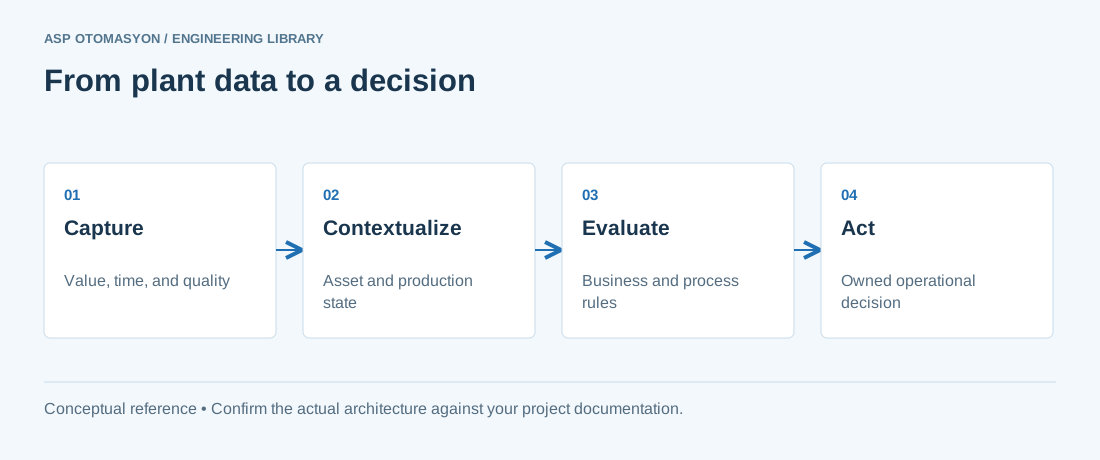
Raw sensor data is rarely useful without context. The data contextualization process transforms measurements into actionable information:
- Normalization — Convert raw values (counts, mA, voltage) to engineering units (degrees C, bar, m3/h) using calibration curves and sensor range parameters.
- Timestamping — Apply accurate timestamps using NTP synchronization. For high-speed applications (vibration analysis), use PTP (IEEE 1588) for microsecond precision.
- Asset Contextualization — Associate each data point with its physical asset (equipment ID, location, process area) and the ISA-95 equipment hierarchy.
- Quality Codes — Attach data quality indicators: Good (valid), Uncertain (near range limits), Bad (communication failure or sensor fault).
- Engineering Unit Metadata — Store the unit of measurement alongside the value to enable meaningful cross-system data exchange.
Integration Pattern: MQTT Sparkplug B
For IIoT deployments, the Sparkplug B specification provides a standardized MQTT topic namespace and payload format for industrial data:
- A hierarchical topic structure:
spBv1.0/{group_id}/{message_type}/{edge_node_id}/{device_id} - Google Protocol Buffer (Protobuf) encoded messages for efficient serialization
- Birth and Death certificates (BDATA/NDATA/DDATA) for state management
- Metric naming conventions that align with ISA-95 equipment models
Using Sparkplug B ensures interoperability between edge devices, MQTT brokers, and consuming applications from different vendors.
ASP OTOMASYON A.Ş. and its subsidiaries OPCTurkey and ASP Dijital provide end-to-end industrial engineering solutions for process automation, data operations and AI.
References & Further Reading
- FieldComm Group — HART Protocol (IEC 62591) — Official HART protocol specification and technology overview, covering the 4-20 mA digital overlay communication standard for smart instruments.
- IO-Link Consortium — IO-Link Communication Interface — Official specification for the IO-Link point-to-point communication standard for smart sensors and actuators in industrial automation.
- Modbus Organization — Modbus Application Protocol Specification — Official Modbus protocol specifications for both TCP/IP and RTU/ASCII serial variants used extensively in sensor networks.
- MQTT.org — OASIS MQTT Standard — Official MQTT protocol specification and documentation, the leading publish-subscribe protocol for IIoT and edge-to-cloud telemetry.
- Eclipse Tahu — Sparkplug Specification — Official Eclipse Foundation specification for Sparkplug B, defining MQTT topic namespaces and payload formats for industrial IoT data.
- IEEE 1588 — Precision Time Protocol (PTP) — Official IEEE standard for precision clock synchronisation in networked measurement and control systems, achieving microsecond accuracy.
Keep measurement meaning through the pipeline
Preserve device identity, unit, timestamp, and diagnostic state from the sensor to the consuming application. Define what happens when the sensor battery is low, the gateway restarts, or the upstream link is unavailable. If data is buffered, distinguish replay from current state and reconcile gaps and duplicates. Select sampling and retention from the physical phenomenon and decision being supported.
Continue with the related practical guide.
Apply this to your project
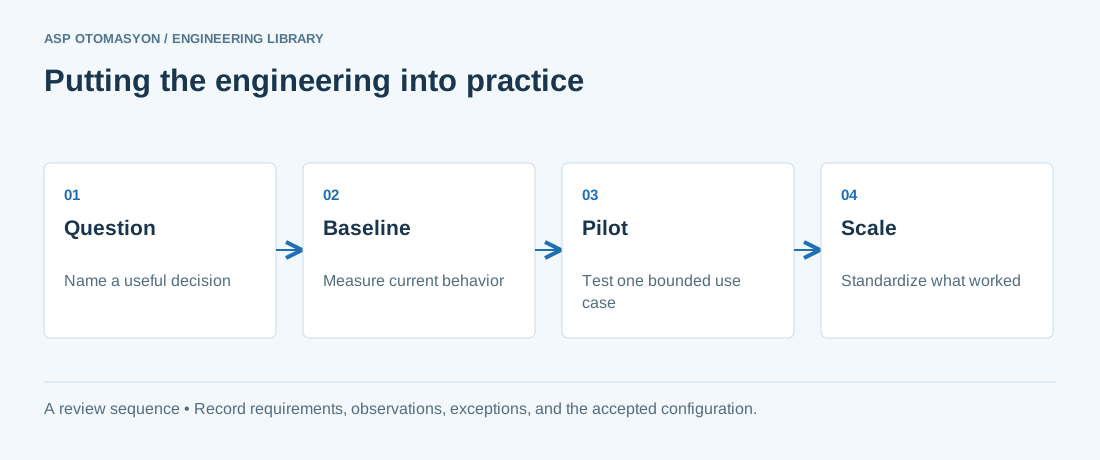
- Name the operational decision, its owner, and the evidence required to judge whether it improved.
- Document asset identifiers, units, timestamps, quality rules, and definitions shared between OT and business applications.
- Compare the pilot against a recorded baseline before extending it to other machines or sites.
Follow an ASP project guide to connect the fundamentals with implementation and acceptance.
Primary references and further reading
Use the original specifications and product documentation for implementation details. The examples in this guide are illustrative engineering scenarios, not published project results.