
Industrial organizations face a persistent and expensive data challenge: manufacturing operations generate massive volumes of data from PLCs, DCS systems, sensors, historians, and MES platforms — but this data is trapped in proprietary formats, isolated in OT networks, and structured in ways that analytics platforms cannot consume directly. The gap between operational technology (OT) data sources and information technology (IT) analytics platforms has been a fundamental barrier to Industry 4.0 success for over a decade. HighByte Intelligence Hub addresses this challenge as the industry first purpose-built Industrial DataOps platform — a no-code/low-code solution designed specifically to connect, model, contextualize, and orchestrate industrial data from OT sources to IT destinations.
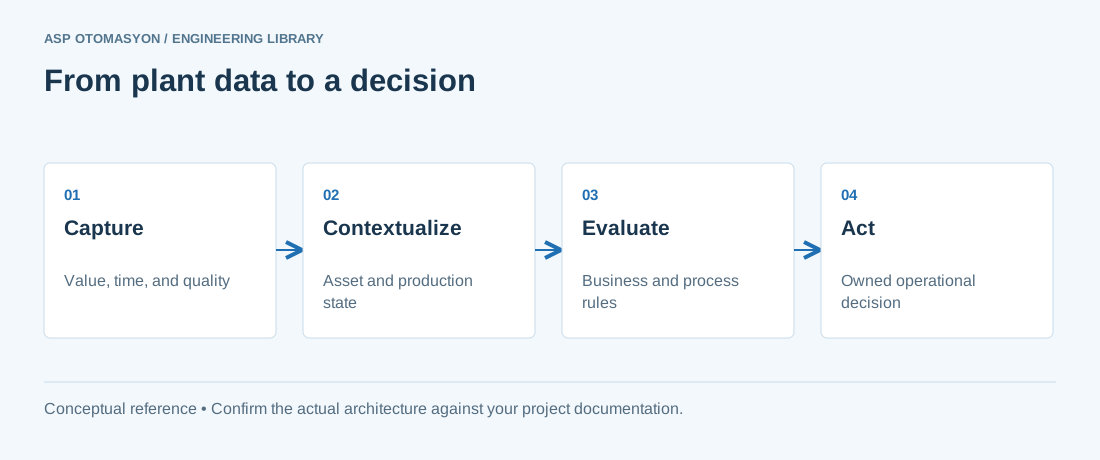
What Is Industrial DataOps?
Industrial DataOps extends the DataOps methodology — which applies DevOps principles of automation, continuous integration, monitoring, and governance to data pipelines — into the specific context of industrial manufacturing. While traditional DataOps focuses on business intelligence data, Industrial DataOps addresses the unique challenges of operational technology data:
- Protocol heterogeneity — Industrial data lives behind hundreds of communication protocols: OPC UA, MQTT, Modbus TCP/RTU, PROFINET, EtherNet/IP, BACnet, IEC 61850, Siemens S7, Allen-Bradley CIP, and dozens more. An Industrial DataOps platform must speak all of these languages natively without requiring custom drivers or scripting.
- Data contextualization — Raw PLC tags ("Tank01_Level_PV", "PID003_SP", "VFD104_Speed") are meaningless in a cloud analytics or AI platform. Industrial DataOps enriches raw operational data with equipment hierarchy, product information, batch context, engineering units, and quality codes — transforming data into information that machines and humans can interpret.
- Semantic standardization — The same physical measurement (e.g., vessel temperature) may be named "TT-101.PV" in the DCS, "Temp_Vessel01_Process" in the historian, and "TIC101" on the P&ID. Industrial DataOps normalizes these into a consistent, standards-based information model (ISA-95, MIMOSA, or custom).
- Edge-to-cloud orchestration — Industrial data pipelines must span from edge devices on the plant floor to cloud platforms hundreds or thousands of kilometers away, with store-and-forward reliability during network interruptions, bandwidth optimization for large datasets, and end-to-end security.
Intelligence Hub Architecture
  OT Sources                INTELLIGENCE HUB                 IT Destinations
  ==========              ====================              ================
  PLCs (S7, AB)    --->  +---------------+    +-----------+  AWS IoT SiteWise
  DCS (800xA)      --->  |  CONNECTIONS  |--->|  MODELS   |  AWS S3
  Sensors (HART)   --->  | OPC UA, MQTT, |    | JSON      |  Azure Blob / Event Hubs
  Historians (PI)  --->  | Modbus, S7,   |    | Schema    |  Databricks SQL / Lakehouse
  MES / Batch      --->  | AB CIP, SQL,  |    | ISA-95    |  Snowflake
  LIMS             --->  | REST, Files   |    | Hierarchy |  Microsoft Fabric / OneLake
  CMMS             --->  | Ignition, PI  |    | Relations |  InfluxDB / Timestream
                         +-------+-------+    +-----+-----+  PI System / OPC UA
                                 |                    |       REST API (Custom)
                                 v                    v
                          +------------------------------+
                          |         PIPELINES            |
                          |  Input | Model | Transform   |
                          |  Filter | Route | Loop       |
                          |  JSONata | Delay | Output     |
                          +------------------------------+
                                     |
                                     v
                          +------------------------------+
                          |       GOVERNANCE LAYER       |
                          | High Availability (PostgreSQL)|
                          | MCP Services (AI Agents)     |
                          | RBAC + Secrets Management    |
                          | Audit Logging + System Health |
                          +------------------------------+
Connections Library
The Intelligence Hub provides pre-built connectors for over 30 industrial and enterprise systems, eliminating the need for custom integration development:
| Category | Connections | Use Case |
|---|---|---|
| Industrial Protocols | OPC UA (Client/Server), MQTT (Sparkplug A/B), Modbus TCP, Siemens S7, Allen-Bradley CIP, BACnet/IP, IEC 61850 | Real-time data acquisition from control systems, drives, and field devices |
| Systems & Databases | OSIsoft PI System, CSV/JSON files, Oracle Database, Microsoft SQL Server, PostgreSQL, SAP OData, Excel | Data from existing infrastructure, batch records, laboratory systems |
| Cloud Platforms | AWS IoT SiteWise, AWS S3, Azure Blob Storage, Azure Event Hubs, Databricks SQL, Snowflake, Microsoft Fabric OneLake | Cloud ingestion for advanced analytics, AI/ML training, and enterprise reporting |
| Time-Series Databases | InfluxDB, OSIsoft PI System, AWS Timestream | High-performance operational data storage and retrieval |
| SCADA Integration | Ignition Module (native Inductive Automation) | Direct data exchange with Ignition SCADA without intermediate drivers |
Data Modeling with ISA-95
The Models layer is the core differentiator of the Intelligence Hub. Rather than passing raw PLC tags through pipelines, users define structured data models — JSON Schema documents — that describe the semantic meaning of the data. These models align naturally with the ISA-95 equipment hierarchy (Enterprise → Site → Area → Work Center → Work Unit) or any user-defined hierarchy.
Each model definition includes:
- Properties — The actual data attributes: tag names, values, engineering units, timestamps, quality codes (Good/Uncertain/Bad per OPC UA).
- Relationships — How this asset connects to others in the hierarchy (hasParent, hasChild, belongsTo, feedsTo).
- Metadata — Asset attributes: manufacturer, model number, installation date, physical location, criticality rating.
- Operational context — Product being produced, batch/lot number, shift ID, operator name, recipe version.
Models can be imported from existing standards (OPC UA companion specifications for specific industries, MIMOSA for asset management, CFIHOS for process industries) or created from scratch using the graphical model builder.
Pipeline Orchestration
Pipelines define the complete data flow from source to destination. The visual flow editor enables non-programmers to build sophisticated data processing chains:
- Input Stage — Select a connection and define which data items (tags, variables, SQL tables, files) to ingest.
- Model Stage — Map input data fields to the target model structure. The system provides automatic mapping suggestions based on name similarity and data type compatibility.
- Transform Stage — Apply data transformations: engineering unit conversion, mathematical expressions, conditional logic, string formatting, and aggregation functions (min/max/avg over time windows).
- Filter Stage — Remove out-of-range values, suppress redundant data (only publish on change), apply quality gates (discard data with Bad quality code).
- Routing Stage — Conditionally route data to different destinations based on content (alarm data → notification service, process data → historian, quality data → analytics database).
- Output Stage — Write the transformed, contextualized data to the target destination.
Version 4.3 Pipeline Enhancements
- For Each and While looping stages — Iterate through arrayed data structures and loop until conditions are satisfied, enabling complex multi-step API integrations and pagination handling.
- JSONata expression stage — Advanced JSON transformation using the JSONata query and transformation language for reshaping, filtering, and mapping complex nested datasets.
- Delay stage — Introduce configurable pauses within pipeline execution, allowing external processes to complete or orchestration systems to catch up.
Enterprise Governance
- High Availability (HA) mode — Active/standby runtime pairs continuously synchronizing both configuration and state through a common PostgreSQL database. Seamless failover with minimal data loss for mission-critical operations.
- Role-Based Access Control (RBAC) — Granular permissions: View-only, Pipeline Developer, Administrator. Integrates with LDAP/Active Directory for enterprise user management.
- Secrets Management — Securely store and reference credentials, API keys, certificates, and tokens without exposing them in pipeline configurations.
- Audit Logging — Complete change history for all configuration modifications, user access events, and pipeline executions. Supports compliance and forensic analysis.
- System Dashboard — Real-time monitoring of hub health: connection status, pipeline throughput (records/second), error rates, resource utilization (CPU, memory, disk).
MCP Services and Agentic AI
HighByte Intelligence Hub version 4.3 introduced the industry first Industrial Model Context Protocol (MCP) Server, enabling AI agents (Claude, GPT, Gemini, Llama) to interact with industrial data through natural language. This is a transformative capability:
MCP Tools for AI Agents
- OPC UA browse and read — AI agents can browse the OPC UA address space and read real-time process values on demand using natural language queries.
- MQTT topic subscription — Agents can subscribe to specific MQTT topics and receive live data streams through the AI chat interface.
- Pipeline configuration — AI agents can create, modify, and deploy data pipelines using natural language. An engineer can say: "Create a pipeline that reads motor temperature from PLC-01 every 10 seconds and writes it to InfluxDB."
- MCP Client — Aggregate multiple third-party MCP Servers into a single governed interface, controlling which AI agents can access which OT systems and data.
AI Readiness
By providing clean, contextualized, governed data through standardized MCP interfaces, the Intelligence Hub addresses the fundamental challenge limiting AI adoption in manufacturing: poor data quality. Without Industrial DataOps, AI/ML models are trained on incomplete, inconsistent, or incorrectly contextualized data, leading to unreliable predictions and low trust from operations teams.
Use Case: Digital Yield Optimization
In a food and beverage production line, first-pass yield optimization requires data from multiple sources integrated in real time:
- Production line PLCs — Temperatures, pressures, flow rates, line speeds (via OPC UA).
- Quality lab results — Moisture content, viscosity, pH (from LIMS via REST API).
- Batch records — Raw material lots, recipe versions (from MES via SQL).
- Equipment status — Last maintenance date, calibration status (from CMMS via API).
The Intelligence Hub ingests all four data sources, contextualizes them into unified ISA-95 batch record models, and publishes the results to InfluxDB for real-time trending and to Databricks for ML model training. The trained model predicts yield in real time and suggests process adjustments, which are fed back to the control system through an OPC UA write pipeline. This closed-loop optimization typically improves first-pass yield by 2–5% and reduces energy consumption by 3–8%.
ASP OTOMASYON A.Ş. and its subsidiaries OPCTurkey and ASP Dijital provide end-to-end industrial engineering solutions for process automation, data operations and AI.
References & Further Reading
- HighByte Intelligence Hub — Industrial DataOps Platform — Official HighByte product documentation for the Intelligence Hub, including connections library, data modelling, pipeline orchestration, and MCP services.
- ISA-95 / IEC 62264 — Enterprise-Control System Integration — International standard providing the equipment hierarchy model used by the Intelligence Hub for industrial data contextualization and semantic standardisation.
- OPC Foundation — OPC UA for Industrial Data Integration — Official OPC UA specification documentation covering the address space model, companion specifications, and data access services used by the Intelligence Hub for OT connectivity.
- OASIS MQTT — Standard for IIoT Data Transport — Official MQTT specification for publish-subscribe messaging, supporting the Intelligence Hub's MQTT and Sparkplug B connectivity options for edge-to-cloud data pipelines.
- InfluxDB — Time-Series Database for Industrial Data — Official InfluxDB documentation for the time-series data platform commonly used as a destination in Intelligence Hub data pipelines for operational analytics.
Apply this to your project
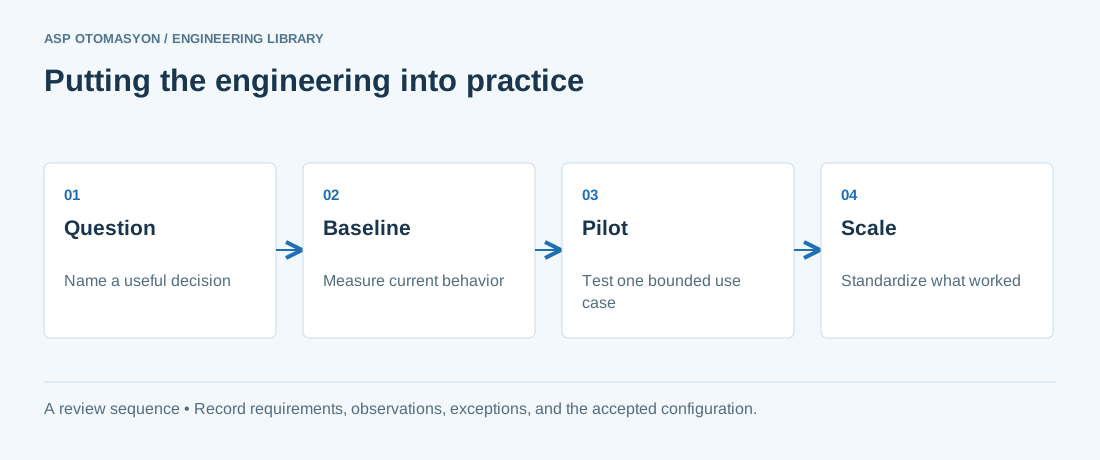
- Name the operational decision, its owner, and the evidence required to judge whether it improved.
- Document asset identifiers, units, timestamps, quality rules, and definitions shared between OT and business applications.
- Compare the pilot against a recorded baseline before extending it to other machines or sites.
Follow an ASP project guide to connect the fundamentals with implementation and acceptance.
Primary references and further reading
Use the original specifications and product documentation for implementation details. The examples in this guide are illustrative engineering scenarios, not published project results.