
Implementing Industry 4.0 is not a single project — it is a multi-year transformation journey that requires strategic planning, cross-functional alignment, and disciplined execution. This roadmap provides a structured approach based on real-world deployments in manufacturing and process industries.
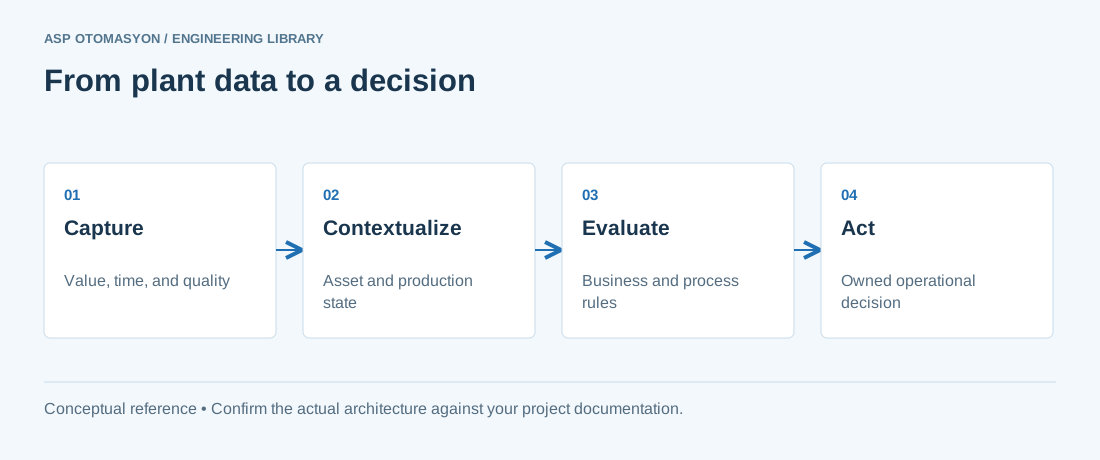
Phase 1: Assessment and Strategy (Months 1–3)
Before investing in technology, you must understand your current state and define clear objectives:
- Digital Maturity Assessment — Evaluate your organization across five dimensions: automation level, data availability, connectivity, analytics capability, and workforce readiness. Use frameworks such as the Acatech Industrie 4.0 Maturity Index.
- Pain Point Identification — Interview operators, engineers, and managers to identify the top 3–5 operational challenges that digitalization could address (e.g., unplanned downtime, quality defects, energy waste).
- Business Case Development — Quantify the expected impact. A typical Industry 4.0 business case targets 10–20% reduction in unplanned downtime, 5–15% improvement in OEE, and 5–10% reduction in energy consumption.
- Governance Structure — Establish a cross-functional steering committee with representatives from operations, IT, engineering, and finance.
Phase 2: Infrastructure Planning (Months 3–6)
Industry 4.0 requires a solid digital infrastructure foundation:
- Network Architecture — Design a converged IT/OT network using the Purdue Model as a reference. Implement DMZ between enterprise (Level 4) and control (Level 3) networks.
- Connectivity Layer — Deploy OPC UA servers and MQTT brokers to collect data from PLCs, DCS, and field instruments. Standardize on a common data format.
- Edge Computing — Install edge gateways at the plant level for local data processing, protocol translation, and store-and-forward capabilities.
- Data Platform — Select and deploy a time-series database (e.g., InfluxDB, TimescaleDB, or OSIsoft PI) for historical data storage and retrieval.
- Cybersecurity — Implement IEC 62443-compliant security measures: network segmentation, endpoint protection, access control, and monitoring.
Phase 3: Pilot Project (Months 6–12)
Select a pilot project that is scoped small enough to deliver results within 6 months but impactful enough to demonstrate value:
- Good Pilot Candidates — Predictive maintenance for a critical asset, real-time OEE monitoring for a production line, energy monitoring for a utility system, or quality prediction using process data.
- Technology Selection — Choose proven, vendor-supported platforms. Avoid custom-built solutions for the pilot — speed of deployment matters more than perfection.
- Data Pipeline — Establish the complete data flow: sensor to edge gateway to data platform to dashboard. Validate data quality at each stage.
- User Adoption — Involve end users from day one. The best analytics dashboard is worthless if operators do not trust or use it.
Phase 4: Scaling (Months 12–24)
After a successful pilot, scale the solution across the organization:
- Standardize — Document the architecture, data models, and integration patterns from the pilot as reusable templates.
- Replicate — Deploy to additional production lines, plants, or business units using the standardized templates.
- Integrate — Connect the digital platform to ERP, MES, and supply chain systems for end-to-end visibility.
- Automate — Move from descriptive analytics (what happened) to predictive (what will happen) and prescriptive (what should we do).
Implementation Timeline
| Phase | Duration | Key Deliverables | Success Criteria |
|---|---|---|---|
| Assessment and Strategy | Months 1–3 | Maturity report, business case, governance charter | Executive sponsorship secured |
| Infrastructure | Months 3–6 | Network design, connectivity platform, data platform | Data flowing from pilot area to dashboard |
| Pilot Project | Months 6–12 | Working solution, user training, documented ROI | Measurable KPI improvement in pilot area |
| Scaling | Months 12–24 | Standardized templates, multi-site deployment | 3+ production areas with active digital solutions |
| Optimization | Months 24+ | Predictive/prescriptive analytics, AI/ML models | Continuous improvement in OEE and cost metrics |
ROI Measurement — Key Performance Indicators
Track these KPIs to measure the success of your Industry 4.0 initiatives:
- Overall Equipment Effectiveness (OEE) — Target improvement: 5–15%. Combines availability, performance, and quality.
- Unplanned Downtime — Target reduction: 10–25%. Measure hours of unplanned stoppage per month.
- Mean Time to Repair (MTTR) — Target reduction: 20–40%. Faster diagnosis through real-time data.
- Energy Cost per Unit — Target reduction: 5–10%. Monitor and optimize energy consumption patterns.
- Scrap Rate — Target reduction: 10–20%. Early detection of quality deviations through SPC.
- Inventory Turns — Target improvement: 10–15%. Better demand forecasting through integrated data.
- Time to Market — Target reduction: 10–20%. Faster recipe changes and production scheduling.
Common Pitfalls to Avoid
- Technology-First Thinking — Do not start with "we need IoT sensors." Start with the business problem you are solving.
- Big Bang Approach — Attempting to digitize the entire plant at once leads to scope creep and budget overruns.
- Neglecting Cybersecurity — Connecting OT systems to IT networks without proper security creates unacceptable risk.
- Ignoring Change Management — Technology adoption requires training, communication, and cultural alignment.
ASP OTOMASYON A.Ş. and its subsidiaries OPCTurkey and ASP Dijital provide end-to-end industrial engineering solutions for process automation, data operations and AI.
References & Further Reading
- Acatech Industrie 4.0 Maturity Index — Official German National Academy of Science and Engineering framework for assessing digital maturity across four stages: computerisation, connectivity, visibility, transparency, predictability, and adaptability.
- IEC 62443 — Industrial Communication Network Security Standards — International standard series for securing industrial automation and control systems, essential for Industry 4.0 cybersecurity architecture.
- ISA-95 (IEC 62264) — Enterprise-Control System Integration — International standard defining the functional hierarchy, data flows, and information models between enterprise systems and manufacturing operations.
- InfluxDB — Time-Series Data Platform — Official documentation for the InfluxDB time-series database, widely deployed in Industry 4.0 architectures for sensor data and operational analytics.
- AVEVA PI System (formerly OSIsoft PI) — Operational Data Management — Official documentation for the PI System historian platform, the industry standard for time-series operational data storage and analysis.
Define a pilot that can be accepted
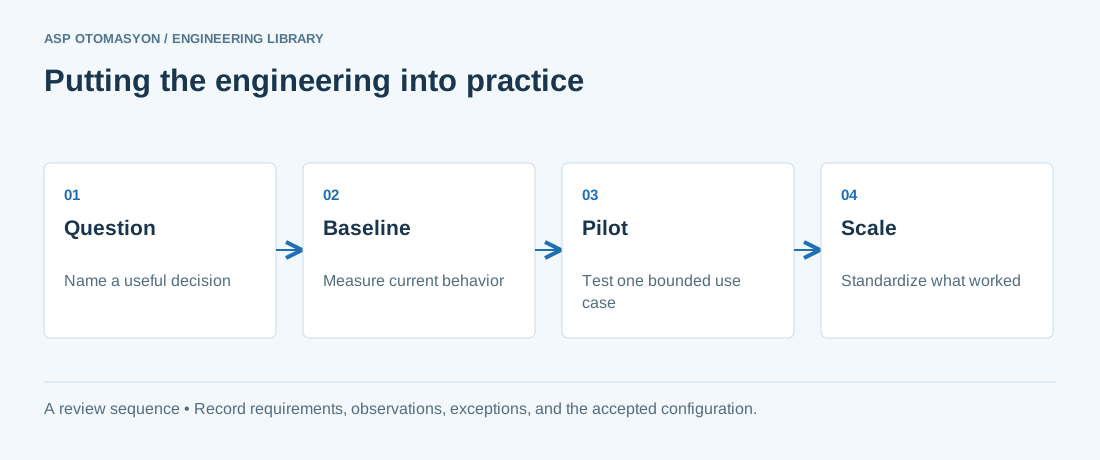
Choose one production decision and its owner before expanding data collection. Record the current workflow, baseline measure, required data quality, and acceptance criteria. Include the cost of integration, ongoing ownership, and change management. A pilot is ready to scale when operators can use its output and the team can support it—not merely when the dashboard connects to live tags.
Continue with the related practical guide.
Apply this to your project
- Name the operational decision, its owner, and the evidence required to judge whether it improved.
- Document asset identifiers, units, timestamps, quality rules, and definitions shared between OT and business applications.
- Compare the pilot against a recorded baseline before extending it to other machines or sites.
Follow an ASP project guide to connect the fundamentals with implementation and acceptance.
Primary references and further reading
Use the original specifications and product documentation for implementation details. The examples in this guide are illustrative engineering scenarios, not published project results.