
OPC Unified Architecture (OPC UA), defined by IEC 62541, is the platform-independent, service-oriented architecture for secure, reliable data exchange in industrial automation. It is the successor to OPC Classic (OPC DA, OPC HDA, OPC A&E) and has become the foundational communication standard for Industry 4.0 and IIoT initiatives worldwide.
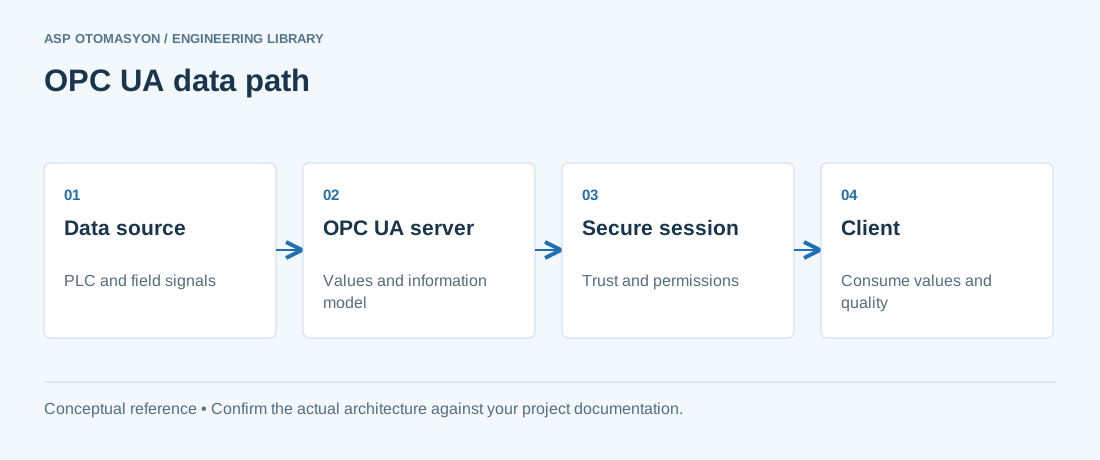
Architecture Overview
OPC UA follows a layered architecture that separates transport, security, and application concerns:
- Transport Layer — Supports multiple transport mappings including OPC TCP (opc.tcp://), HTTPS, and WebSocket. The native binary protocol provides efficient real-time data exchange with minimal overhead.
- Security Layer — Implements authentication, authorization, encryption, and integrity signing using X.509 certificates and configurable security policies (None, Basic128Rsa15, Basic256, Basic256Sha256).
- Application Layer — Defines the OPC UA Services (Read, Write, Subscribe, Browse, Method Call) and the Information Model that structures process data.
Layered Architecture
  +-------------------------------------------+
  |        OPC UA Client Application          |
  |  (HMI, MES, Historian, Analytics)         |
  +-------------------------------------------+
  |        OPC UA Client SDK                  |
  +-------------------------------------------+
  |  Security (X.509 Certs + Encryption)      |
  +-------------------------------------------+
  |  Transport (TCP / HTTPS / WebSocket)      |
  +===========================================+
  |  Transport (TCP / HTTPS / WebSocket)      |
  +-------------------------------------------+
  |  Security (X.509 Certs + Encryption)      |
  +-------------------------------------------+
  |        OPC UA Server SDK                  |
  +-------------------------------------------+
  |        OPC UA Server Application          |
  |  (PLC, DCS, Gateway, Kepware)             |
  +-------------------------------------------+
Information Model
The OPC UA Information Model is a graph-based structure of Nodes connected by References. This is a fundamental departure from the tag-based flat namespace of OPC Classic:
- Object Nodes — Represent physical or logical entities (e.g., a pump, a production line, a tank).
- Variable Nodes — Hold data values with timestamps and quality codes. Two types: Properties (metadata) and DataVariables (process data).
- Method Nodes — Callable functions exposed by the server (e.g.,
StartMotor(),CalibrateSensor()). - Reference Types — Define relationships:
HasComponent,HasProperty,Organizes,HasTypeDefinition.
Security Model
OPC UA provides comprehensive, application-level security independent of the transport protocol:
- Authentication — X.509 certificate-based or username/password authentication. Servers validate client identity before granting access.
- Authorization — Role-based access control (RBAC) per node. Administrators can restrict read, write, or browse permissions.
- Encryption — AES-128 or AES-256 with RSA-OAEP key exchange protects all communication.
- Integrity — Messages are signed to detect tampering. Every message includes a signature verified by the recipient.
- Auditing — Security-relevant events are logged for compliance and forensic analysis.
OPC UA vs. OPC Classic
| Feature | OPC UA (IEC 62541) | OPC Classic (DA/HDA) |
|---|---|---|
| Platform | Cross-platform (Windows, Linux, embedded) | Windows only (DCOM-dependent) |
| Security | Built-in (X.509, encryption, RBAC) | DCOM security (complex, fragile) |
| Data Model | Rich object-oriented information model | Flat tag namespace |
| Firewall Friendly | Single port, no DCOM | Requires DCOM port range (135 + dynamic) |
| Scalability | Thousands of sessions and subscriptions | Limited by DCOM overhead |
| Discovery | LDS (Local Discovery Server) | Manual configuration or OPCEnum |
| Subscriptions | Native pub/sub with configurable intervals | Group-based polling |
| Cloud Ready | Yes (MQTT, AMQP, HTTPS transports) | No |
Benefits for Industry 4.0
OPC UA is a key enabler of Industry 4.0 because it solves the interoperability challenge that has plagued industrial automation for decades:
- Vendor-Neutral — Equipment from different manufacturers can expose a standardized information model, enabling plug-and-produce scenarios.
- Edge-to-Cloud — OPC UA runs on resource-constrained edge devices and scales up to cloud platforms. The OPC UA over TSN extension (IEC/IEEE 60802) is an emerging standard that brings deterministic communication to Ethernet networks. While still in early deployment, it is gaining traction for time-sensitive applications.
- Semantic Interoperability — Companion specifications (EUROMAP for plastics, ISA-95 for MES, PackML for packaging) define standardized models for specific industries.
- IT/OT Convergence — OPC UA bridges operations technology and information technology with a common, secure protocol both domains understand.
ASP OTOMASYON A.Ş. and its subsidiaries OPCTurkey and ASP Dijital provide end-to-end industrial engineering solutions for process automation, data operations and AI.
References & Further Reading
- OPC Foundation — OPC UA Specification (IEC 62541) — Official specification for OPC Unified Architecture, including address space model, services, security, and Pub/Sub.
- OPC UA Security Architecture — Official OPC Foundation documentation on security policies, X.509 certificate management, encryption, and authentication for OPC UA.
- OPC UA Part 14: PubSub — IEC 62541-14 — Official specification for OPC UA publish-subscribe communication pattern with MQTT and AMQP transport mappings.
- IEC 62541: OPC Unified Architecture — Multi-Part Standard — International standard for OPC UA, covering all parts from data access through alarms, history, and Pub/Sub.
- OPC Foundation Companion Specifications — Official directory of industry-specific OPC UA information models for Euromap, ISA-95, PackML, MDIS, and more.
What a successful connection does not prove
Browsing the address space confirms only part of an integration. Verify user permissions, engineering units, data types, StatusCodes, timestamps, and subscription behavior at the final consumer. Disconnect the source during a controlled test and observe whether the client clearly distinguishes last-known data from current observations. OPC UA supplies mechanisms for interoperability and security; the configured applications still need acceptance testing.
Continue with the related practical guide.
Apply this to your project
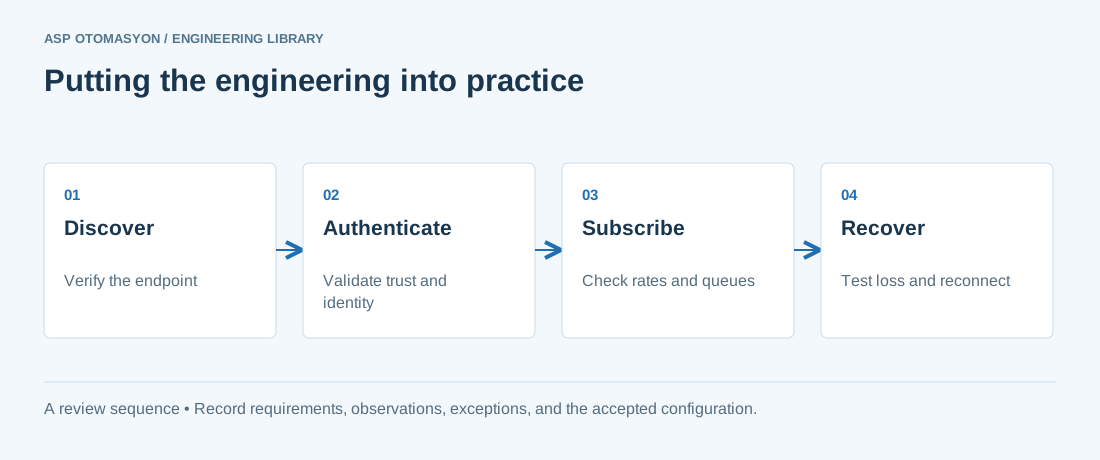
- Record the endpoint, supported security policies, application identity, certificate expiry, and user permissions.
- Verify the value, engineering unit, StatusCode, and source timestamp together at the receiving application.
- Test disconnection and recovery with representative subscriptions; preserve evidence of any data gaps or repeated values.
Follow an ASP project guide to connect the fundamentals with implementation and acceptance.
Primary references and further reading
Use the original specifications and product documentation for implementation details. The examples in this guide are illustrative engineering scenarios, not published project results.