
OPC UA Companion Specifications define standardized information models for specific industries and application domains. They enable semantic interoperability between devices and software from different vendors, ensuring that a "pump" or "temperature sensor" from one manufacturer is understood identically by systems from another.
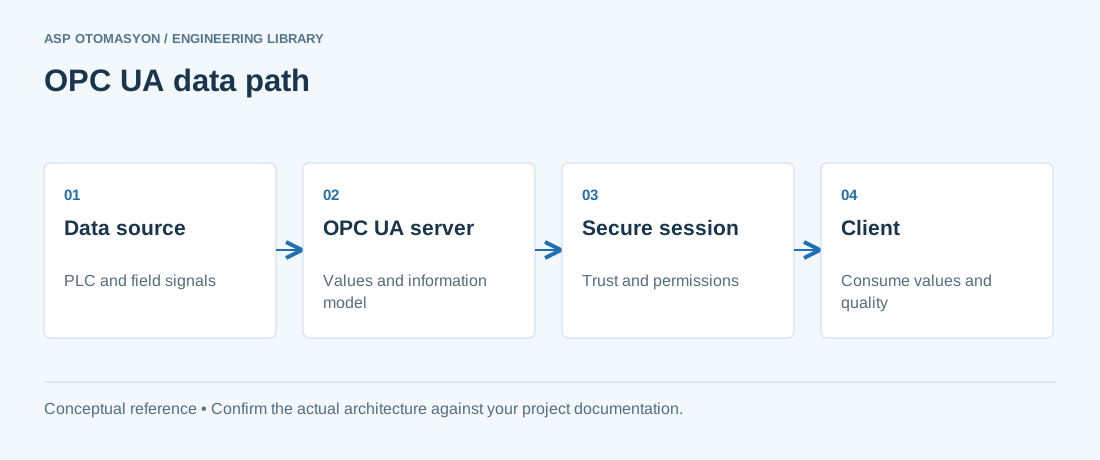
How Companion Specifications Extend the OPC UA Base Model
The base OPC UA specification provides a generic object-oriented address space with nodes, references, and services. It defines fundamental types (BaseObjectType, BaseVariableType) and built-in services (Read, Write, Browse, Subscribe). However, a generic "pump" node carries no semantic meaning about pump-specific parameters, states, or methods. Companion specifications build on this foundation by:
- Defining domain-specific ObjectTypes (e.g., InjectionMouldingMachineType, PackagingMachineType)
- Standardising Variable names and data types (e.g., MoldTemperature has EURange of 0–400 °C)
- Specifying state machines with standardised states and transitions
- Defining Methods for domain operations (e.g., StartCycle, EjectPart, ChangeMold)
This layered approach ensures that any OPC UA client can discover and interact with devices from any vendor at a semantically meaningful level without prior knowledge of proprietary protocols.
EUROMAP 83/84 — Injection Moulding Machines
EUROMAP 83 defines the OPC UA information model for injection moulding machines, while EUROMAP 84 covers the interface between injection moulding machines and handling robots (auxiliary equipment). Together they standardise:
- Process parameters: Injection pressure, screw speed, barrel zone temperatures, back pressure, clamping force, and cycle time. Each parameter is published as a typed Variable with engineering units and range metadata.
- Machine states: A standardised state machine (Idle, Setup, Production, Alarm, Stopped, etc.) with defined transitions. An MES can query any EUROMAP 83-compliant machine and know exactly what state it is in.
- Alarms and events: Standardised alarm categories and severity levels. Alarms include a machine-readable Cause and RemedialAction, enabling automated response workflows.
For a plastics manufacturer with 20 machines from five vendors, EUROMAP 83/84 eliminates the need for five different data-mapping drivers. A single OPC UA client can read cycle counts, alarm histories, and quality data from every machine identically.
ISA-95 Companion Specification — MES Integration
The ISA-95 companion specification maps the standard equipment hierarchy to OPC UA object types:
- Enterprise → EnterpriseType (top-level organisational unit)
- Site → SiteType (a geographic location, e.g., a factory)
- Area → AreaType (a production area, e.g., Batch Processing Area)
- Production Line / Cell → WorkCenterType (a physical grouping of equipment)
- Unit / Machine → EquipmentModuleType (individual process units or machines)
Each object carries ISA-95 attributes such as equipment status, personnel assignments, and material consumption. This allows an MES to navigate the OPC UA address space from Enterprise down to individual sensors, exactly mirroring the ISA-95 hierarchy used in ERP and MES databases.
PackML (OMAC) — Packaging Machine Language
PackML standardises the state model and tag naming convention for packaging machinery. Its OPC UA companion specification represents the PackML state machine as an OPC UA FiniteStateMachineType with the following standard states:
Idle → Starting → Execute → Idle (normal cycle) with additional states: Held, Suspended, Aborted, Stopped, Resetting, Completing, Complete. Transitions are clearly defined: e.g., from Execute, a "hold" command transitions to Held; from Held, a "resume" command returns to Execute.
The tag naming convention (e.g., .Machine.StateCurrent, .Machine.ProductionRate, .Machine.AlarmActive) is encoded as standardised OPC UA Variables. Any OPC UA-enabled SCADA or MES can consume PackML data from any compliant packaging machine without custom engineering.
MDIS — Maritime Device Integration Standard
MDIS addresses the maritime industry's need for interoperable shipboard systems. It defines an OPC UA object model for:
- Main engines and auxiliary engines: Speed, load, exhaust temperature, fuel consumption, vibration
- Navigation equipment: GPS, gyrocompass, radar, AIS, echo sounder
- Auxiliary systems: Ballast water treatment, fire detection, HVAC, power generation
By standardising these data models, MDIS enables a single integrated bridge system to monitor and control equipment from multiple vendors. Classification societies (DNV, Lloyds, Bureau Veritas) increasingly require MDIS compliance for new-build vessels.
FDI — Field Device Integration
The Field Device Integration (FDI) standard (IEC 62769) packages device configuration, diagnostics, and calibration data into a consistent OPC UA information model. An FDI package contains the device's full electronic device description (EDD) and user interface components. When integrated via OPC UA:
- HART, FOUNDATION Fieldbus, and PROFIBUS devices appear as OPC UA objects with standardised parameters
- Configuration software from any vendor can commission and calibrate any FDI-compliant device
- Diagnostic data (e.g., electronics temperature, sensor drift, communication errors) is exposed uniformly
Enabling Plug-and-Produce Interoperability
Companion specifications are the key enabler of plug-and-produce interoperability in Industry 4.0. When a new device is connected to the network, an OPC UA discovery client can:
- Browse the device's address space to determine its supported companion specifications
- Instantiate the standardised ObjectTypes and state machines
- Map device signals directly to the MES, SCADA, or digital twin without manual configuration
This reduces engineering effort from days to minutes for device integration and lays the foundation for truly interoperable, multi-vendor automation architectures.
ASP OTOMASYON A.Ş. and its subsidiaries OPCTurkey and ASP Dijital provide end-to-end industrial engineering solutions for process automation, data operations and AI.
References & Further Reading
- OPC Foundation — Companion Specifications Directory — Official listing of all OPC UA companion specifications, including EUROMAP 83/84, ISA-95, PackML, MDIS, and FDI information models.
- EUROMAP — European Plastics and Rubber Machinery Association — Official EUROMAP 83/84 specifications for OPC UA information models in plastics injection moulding machine integration.
- ISA-95 / IEC 62264 — Enterprise-Control System Integration — International standard for which the OPC UA companion specification defines standardised information models mapping the ISA-95 equipment hierarchy.
- OMAC — PackML Packaging Machine Language — Official OMAC guidelines for PackML, the industry standard state model and tag naming convention for packaging machinery with OPC UA companion specification.
- FieldComm Group — FDI (Field Device Integration) Standard — Official FDI specification (IEC 62769) for universal device integration and configuration across HART, FOUNDATION Fieldbus, and PROFIBUS protocols.
- MDIS — Maritime Device Integration Standard — Official MDIS specification for OPC UA-based interoperability of maritime and offshore systems, covering engines, navigation, and auxiliary equipment.
Apply this to your project
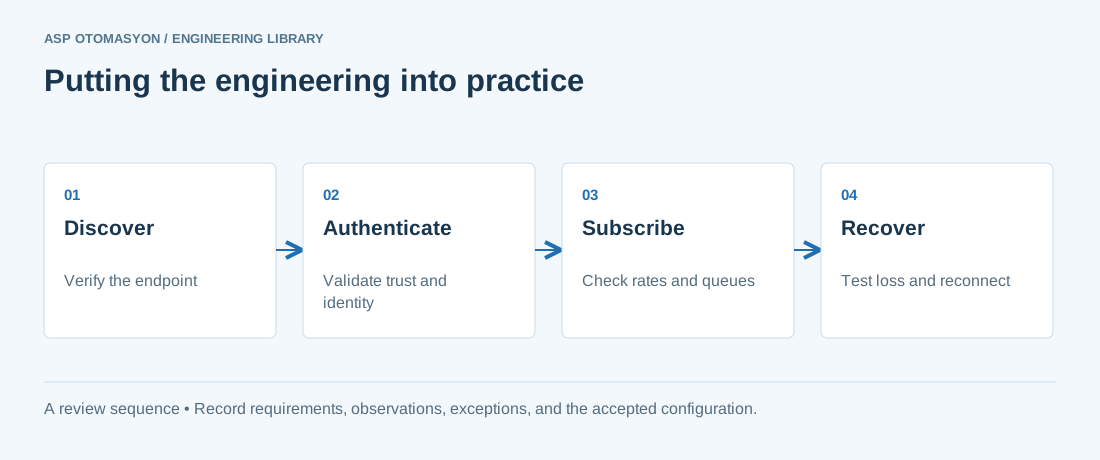
- Record the endpoint, supported security policies, application identity, certificate expiry, and user permissions.
- Verify the value, engineering unit, StatusCode, and source timestamp together at the receiving application.
- Test disconnection and recovery with representative subscriptions; preserve evidence of any data gaps or repeated values.
Follow an ASP project guide to connect the fundamentals with implementation and acceptance.
Primary references and further reading
Use the original specifications and product documentation for implementation details. The examples in this guide are illustrative engineering scenarios, not published project results.