
A Digital Twin is a virtual representation of a physical asset, process, or system that is continuously synchronized with its real-world counterpart through real-time data. Digital twins enable simulation, predictive analytics, and what-if analysis without risking production operations.
Digital Twin Maturity Framework
Digital twin maturity is commonly described across four levels, each adding analytical capability and business value.
Level 1 — Descriptive Twin (What Happened?)
A descriptive twin is a virtual replica that mirrors the real asset in real time. It visualises current conditions (temperature, pressure, speed, position) and records historical data. At this level, the twin answers "what is happening now?" and "what happened in the past?" Implementation typically involves OPC UA data streaming to a 3D visualisation or dashboard. Most industrial digital twins start here. Example: a pumping station digital twin showing live flow, pressure, and motor current with a 3D model.
Level 2 — Diagnostic Twin (Why Did It Happen?)
A diagnostic twin adds root-cause analysis capabilities. By correlating data streams with known failure modes, operational events, and maintenance logs, it identifies the underlying causes of deviations or faults. Rules engines, statistical process control (SPC) charts, and alarm analytics drive diagnostics. Example: when a compressor discharge temperature exceeds threshold, the diagnostic twin correlates it with ambient temperature, cooling water flow, and vibration data to distinguish between fouling, bearing wear, and cooling failure.
Level 3 — Predictive Twin (What Will Happen?)
A predictive twin uses physics-based models, machine learning, or hybrid approaches to forecast future states. It answers questions such as "when will this bearing need replacement?" or "what will the product quality be in 30 minutes if the feed composition changes?" Predictive maintenance, remaining useful life (RUL) estimation, and quality prediction are common use cases. Accuracy depends heavily on model fidelity and data quality. Example: a predictive twin for a heat exchanger forecasts fouling factor progression and recommends cleaning 14 days before efficiency drops below target.
Level 4 — Prescriptive Twin (How to Optimize?)
A prescriptive twin recommends actions and automates decision-making. It combines prediction with optimisation algorithms to determine the best course of action given current conditions and business objectives (cost, throughput, energy, quality). Prescriptive twins are rare in practice because they require validated models, closed-loop control authority, and rigorous safety validation. Example: a prescriptive twin for a distillation column optimises reflux ratio and feed preheat temperature in real time to maximise yield while minimising energy consumption, automatically downloading setpoint adjustments to the DCS.
Asset vs Process vs System Twins
| Twin Type | Scope | Example | Data Sources |
|---|---|---|---|
| Asset Twin | Single piece of equipment | Pump, motor, compressor, valve | Vibration, temperature, pressure, current sensors |
| Process Twin | Unit operation or production step | Distillation column, reactor, conveyor line | Multiple asset twins + process analytics (flow, composition, level) |
| System Twin | Entire plant or production site | Refinery, power plant, bottling line | All process twins + MES, scheduling, ERP data |
Organisations typically start with asset twins for critical equipment, then aggregate into process twins, and finally build system twins that span the entire production value chain. Each level increases data volume, model complexity, and business value.
Data Synchronisation Patterns
Keeping a digital twin synchronised with its physical counterpart requires a well-architected data pipeline:
- OPC UA (Client-Server and Pub/Sub): The primary channel for real-time process data. OPC UA provides deterministic sampling, alarm/event subscription, and historical data access. Pub/Sub (MQTT transport) is preferred for edge-to-cloud synchronisation.
- MQTT Sparkplug: Designed for industrial IoT edge-to-cloud architectures. Sparkplug adds state management (birth/death certificates) and a standardised topic namespace that simplifies device-to-twin mapping.
- REST APIs: Used for batch synchronisation of non-real-time data such as maintenance records, inspection results, laboratory quality data, and ERP production orders. REST is typically called on a periodic schedule (hourly, daily) or event-triggered.
Simulation Engine Integration
Digital twins derive predictive and prescriptive power from simulation models. Integration patterns include:
- Ansys Twin Builder: Physics-based simulation models (CFD, FEA) that can be exported as reduced-order models (ROMs) for real-time execution. The ROM runs on an edge device or server, consuming live OPC UA data and outputting predicted states.
- Simulink / MATLAB: Control system and dynamic process models. Simulink models can be deployed via Simulink PLC Coder or as standalone executables that communicate via OPC UA.
- Functional Mock-up Interface (FMI / FMU): An open standard for model exchange. An FMU package contains a compiled simulation model that can be imported into any FMI-compatible co-simulation environment. This allows mixing models from different tools (e.g., an Ansys ROM for heat transfer + a Simulink model for control logic).
ROI Case Studies
Case 1 — Predictive Maintenance on Centrifugal Pumps: A petrochemical plant deployed descriptive and predictive twins for 35 critical centrifugal pumps. Vibration and temperature data were fed to a machine learning model that predicted bearing failures 3–7 days in advance. Result: unplanned downtime reduced by 42%, maintenance costs reduced by 28%, and the predictive twin paid for itself within 11 months.
Case 2 — Energy Optimisation in a Steel Reheating Furnace: A prescriptive twin optimised the furnace zone temperature setpoints based on incoming billet temperature, steel grade, and production schedule. Result: natural gas consumption reduced by 6.3%, saving approximately $380,000 annually for a mid-sized mill.
Case 3 — Process Twin for a Pharmaceutical Batch Reactor: A diagnostic/predictive twin monitored reaction progress using real-time temperature, pressure, and spectroscopic data. The twin predicted batch endpoint within 2% accuracy, enabling the operator to shorten batch cycle time by 12% while maintaining quality specifications.
ASP OTOMASYON A.Ş. and its subsidiaries OPCTurkey and ASP Dijital provide end-to-end industrial engineering solutions for process automation, data operations and AI.
References & Further Reading
- ISO 23247 — Digital Twin Framework for Manufacturing — International standard series establishing a framework for digital twin development, including entities, reference architecture, and information exchange requirements.
- IEC 62832 — Industrial-Process Measurement, Control and Automation — Digital Factory Framework — International standard defining the digital factory framework and asset administration shell concepts for industrial digital twins.
- ISA-95 / IEC 62264 — Enterprise-Control System Integration — Standard providing the equipment hierarchy model essential for structuring digital twin data models across enterprise and control levels.
- OPC Foundation — OPC UA for Digital Twin Connectivity — Official OPC UA technical documentation on using the address space model and companion specifications for digital twin data integration.
- Ansys — Digital Twin Simulation and Modelling Platform — Official documentation for simulation-driven digital twin solutions, covering physics-based models, data reconciliation, and predictive analytics.
Apply this to your project
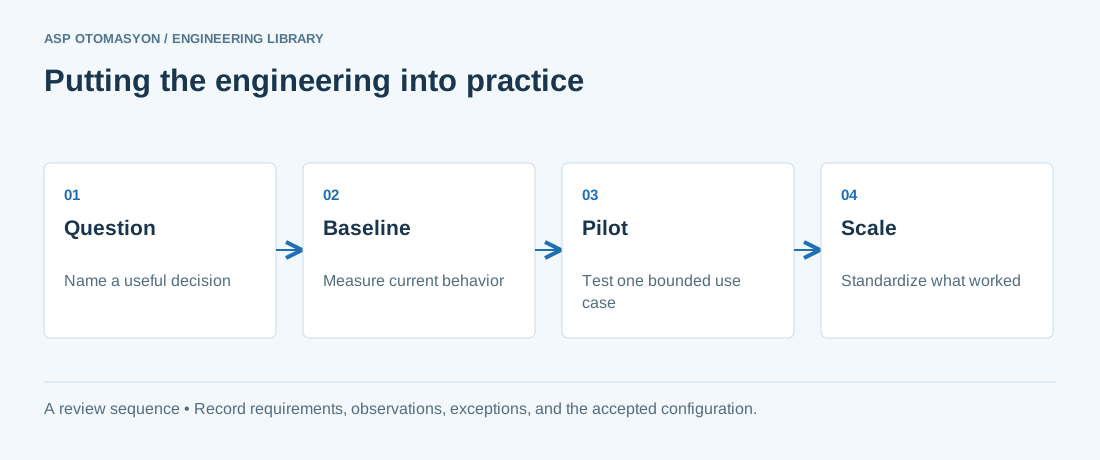
- Name the operational decision, its owner, and the evidence required to judge whether it improved.
- Document asset identifiers, units, timestamps, quality rules, and definitions shared between OT and business applications.
- Compare the pilot against a recorded baseline before extending it to other machines or sites.
Follow an ASP project guide to connect the fundamentals with implementation and acceptance.
Primary references and further reading
Use the original specifications and product documentation for implementation details. The examples in this guide are illustrative engineering scenarios, not published project results.