
Pharmaceutical manufacturing requires precise, repeatable, and fully documented batch control processes. Regulatory compliance with 21 CFR Part 11 (FDA regulations for electronic records and signatures) imposes stringent requirements on the automation systems used in drug production.
ISA-88 Recipe Model — A Four-Level Framework
The ISA-88 (IEC 61512) standard defines a hierarchical recipe model that separates recipe content from equipment control, enabling recipe portability across similar equipment configurations. The four recipe types are:
- General Recipe — Company-wide standard. Contains the chemical and physical processing instructions independent of specific equipment. Defines raw materials, reaction conditions, and product specifications at an abstract level.
- Site Recipe — Adapts the general recipe to the capabilities and constraints of a particular manufacturing site. Incorporates locally available raw material grades, utility capacities, and environmental limits.
- Master Recipe — The equipment-specific recipe that defines the process procedure, formula parameters (setpoints, ratios), and equipment requirements for a specific process cell. This is the recipe managed and downloaded from the MES.
- Control Recipe — The execution-time instance of the master recipe, tied to a specific batch and containing actual values, operator entries, and production data for that individual batch.
Procedural Control Model
ISA-88 procedural control decomposes batch processing into four hierarchical levels:
- Procedure — The highest level; defines the overall strategy for making a batch (e.g., "Produce 500 kg of Active Pharmaceutical Ingredient").
- Unit Procedure — A major processing step executed within a single unit (e.g., "Reaction", "Crystallisation", "Drying"). Unit procedures execute sequentially or in parallel depending on the recipe.
- Operation — An ordered set of phases that accomplishes a specific processing activity within a unit procedure (e.g., "Heat to 60°C", "Dispense Solvent"). Each operation has defined start conditions, end conditions, and exception handling.
- Phase — The lowest element of procedural control that causes a basic action by an equipment entity. Phases are the atomic, reusable building blocks: Charge, Heat, Mix, Hold, Sample, Transfer, CIP. Phases acquire equipment modules and control modules to perform their function.
Equipment Model
The ISA-88 equipment model mirrors the procedural hierarchy:
- Process Cell — A collection of equipment (units, equipment modules, control modules) capable of producing one or more batches. A pharmaceutical plant may have multiple process cells for different products.
- Unit — A major piece of processing equipment that performs one or more processing activities (e.g., a reactor vessel, a dryer, a centrifuge). Units typically operate independently and do not share equipment modules simultaneously.
- Equipment Module — A functional group of devices that performs a specific task (e.g., a heating jacket with temperature probe, valve, and controller). Equipment modules can be owned by a unit temporarily during phase execution.
- Control Module — The lowest level: a single control loop or discrete device (e.g., a PID loop, a motor start/stop, an on/off valve).
Batch Phases in Pharmaceutical Processing — Detailed Examples
- Charge — Adds a specified quantity of raw material to the vessel. May use loss-in-weight feeders, flow meters with totalisers, or weigh cells. The phase monitors the added quantity against the recipe target and generates an alarm on deviation beyond preset tolerance.
- Heat — Ramp the vessel temperature to a target setpoint at a defined rate. The phase controls a heating/cooling utility (steam, hot water, brine) via the jacket/coll, typically using a cascade PID loop (jacket temperature → vessel temperature). Ramp rate limits prevent thermal shock to the product.
- Mix — Agitate the vessel contents at a specified speed for a defined duration. The phase monitors agitator speed, motor current, and may include a mixing energy calculation (G × t) for consistency scaling.
- Hold — Maintain the vessel at current conditions for a specified time or until an operator release. Used for quality hold points, incubation, or waiting for lab analysis results.
- Sample — Triggers a sample request to the operator or an automated sample system. The phase pauses the batch until the sample result is received and meets specification. In MES-integrated systems, the phase sends a LIMS sample request and waits for the result message.
- Transfer — Move material from one unit to another (e.g., reactor to centrifuge). May involve pump start/stop, valve sequencing, and flow totalisation. The phase confirms transfer completion by weight or flow.
- CIP (Clean-in-Place) — Automated cleaning sequence between batches or campaigns. See the CIP/SIP section in Article 24 for detailed phase structure.
Electronic Batch Recording (EBR)
Electronic batch recording captures every parameter, event, and operator action for each batch in a secure, reviewable format. An EBR system typically records:
- Phase execution timeline: start time, end time, duration of each phase
- Setpoints and actual process values (temperature, pressure, pH, RPM) at a defined logging interval (e.g., every 10 seconds)
- Alarm events: tag name, time, condition, and acknowledgement
- Operator actions: parameter changes, phase holds/restarts, manual overrides, comments
- Material additions: lot numbers, quantities, timestamps for each ingredient
- Sample results: LIMS integration populates the batch record with analytical test results
The batch record is compiled automatically at batch completion and stored in a tamper-evident format (e.g., XML with digital signature or PDF/A). Regulatory inspectors review the EBR as part of every facility inspection.
21 CFR Part 11 Compliance — Audit Trails and Electronic Signatures
Audit Trails
FDA 21 CFR Part 11 requires that the system generates a secure, computer-generated, time-stamped audit trail that independently records operator entries and actions. Every create, read, update, or delete (CRUD) operation on regulated data must be logged with:
- User identification (who)
- Date and time stamp (when) — must be synchronised to a trusted time source
- Action performed (what)
- Previous and new value (before/after)
- Reason for the change (why) — the operator must enter a justification for any change to regulated data
The audit trail must be retained for the record retention period (typically at least as long as the batch record) and must be readily retrievable in a human-readable form. Audit trails are reviewed during batch release as part of the quality assurance process.
Electronic Signatures
An electronic signature consists of at least two distinct identification components:
- User ID — Unique to each individual, non-shareable
- Password — Known only to the user
Each signing event must clearly indicate the meaning of the signature (e.g., "Reviewed Batch Record", "Approved for Release", "Performed Testing"). The signature must apply to the entire set of data being signed and cannot be repudiated. Systems must enforce periodic password changes, account lockout after failed attempts, and the inability to delete signed records.
Validation Protocols per GAMP 5
The GAMP 5 (Good Automated Manufacturing Practice) risk-based approach categorises software into five categories that determine the validation effort:
- Category 1 — Infrastructure software: operating systems, databases. Validation: record the version, verify installation.
- Category 2 — Firmware: embedded software in instruments and drives. Validation: supplier audit, configure per specification.
- Category 3 — Standard software packages (e.g., Wonderware Batch, Rockwell PlantPAx). Validation: risk assessment, configure and test against user requirements.
- Category 4 — Configurable software packages. Validation: detailed functional testing of configured functionality.
- Category 5 — Custom applications. Validation: full lifecycle including unit testing, integration testing, and user acceptance testing.
Validation deliverables include: User Requirements Specification (URS), Functional Specification (FS), Design Specification (DS), IQ (Installation Qualification — verify installed components), OQ (Operational Qualification — verify functions operate within limits), and PQ (Performance Qualification — verify the system performs as intended under real-world conditions).
MES/LIMS Integration
Integration between batch control systems, MES (Manufacturing Execution System), and LIMS (Laboratory Information Management System) is essential for paperless pharmaceutical manufacturing:
- MES → Batch Control: MES downloads the master recipe, production order, material lot numbers, and equipment assignments to the batch control system. It may also enforce electronic work instructions for manual steps.
- Batch Control → MES: The batch system reports phase status, process values, alarm summaries, and material consumption back to the MES for real-time production tracking.
- LIMS Integration: When a Sample phase executes, the batch system sends a sample request to LIMS, including: product, batch ID, sample point, and test specification. LIMS returns the analytical result, and the batch system compares it against the in-process specification (upper/lower limits). If the result passes, the batch proceeds; if out-of-specification, the batch triggers an exception and may enter a "Hold" or "Quarantine" state pending operator review.
Data Integrity — ALCOA+ Principles
Data integrity is a regulatory imperative for pharmaceutical manufacturing. The ALCOA+ framework defines the attributes of high-quality data:
- A — Attributable: who performed the action and when
- L — Legible: permanently readable and understandable
- C — Contemporaneous: recorded at the time of the activity
- O — Original: the first recorded data, or a certified true copy
- A — Accurate: free from errors, with defined precision
- + Complete: all data including repeats, reanalyses, and failed results
- + Consistent: chronological sequence with date/time stamps in order
- + Enduring: recorded on durable media for the required retention period
- + Available: accessible and retrievable throughout the retention period
Automation systems must enforce ALCOA+ principles through system design: preventing data modification, maintaining complete audit trails, enforcing electronic signatures, and producing tamper-evident batch records.
ASP OTOMASYON A.Ş. and its subsidiaries OPCTurkey and ASP Dijital provide end-to-end industrial engineering solutions for process automation, data operations and AI.
References & Further Reading
- FDA 21 CFR Part 11 — Electronic Records and Electronic Signatures — Official US FDA regulation defining the requirements for electronic records, electronic signatures, and audit trails in pharmaceutical manufacturing automation systems.
- ISA-88 / IEC 61512 — Batch Control Standards — International standard for batch process control defining recipe management, equipment models, procedural control, and state machines for pharmaceutical manufacturing.
- ISPE GAMP 5 — Good Automated Manufacturing Practice — ISPE guidance document providing a risk-based approach to the validation of automated systems in pharmaceutical manufacturing, including batch control systems.
- FDA — Pharmaceutical Quality and Manufacturing Standards — Official FDA guidance on current Good Manufacturing Practice (cGMP) for pharmaceutical manufacturing, including process validation and data integrity requirements.
- IEC 61511 — Safety Instrumented Systems for the Process Industry Sector — International standard for functional safety applied to safety instrumented systems in pharmaceutical batch processes, including SIL determination and verification.
Apply this to your project
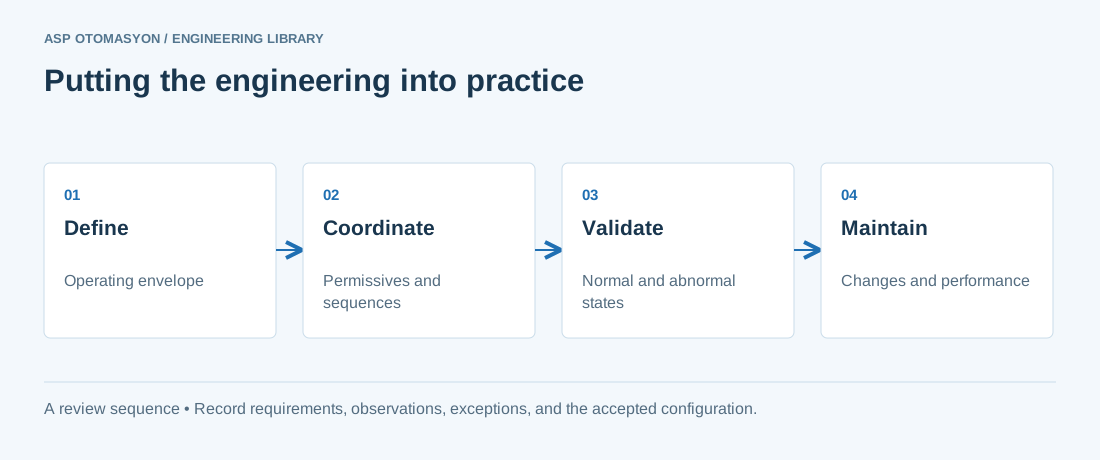
- Record process boundaries, required operating states, and interactions with independent protective systems.
- Check instrument quality, control authority, permissives, and operator responsibilities during state changes.
- Agree how tests, deviations, and configuration changes will be recorded within the facility's engineering procedures.
Follow an ASP project guide to connect the fundamentals with implementation and acceptance.
Primary references and further reading
Use the original specifications and product documentation for implementation details. The examples in this guide are illustrative engineering scenarios, not published project results.