
Cement manufacturing is one of the most energy-intensive industrial processes, consuming approximately 3–4 GJ of thermal energy and 90–120 kWh of electrical energy per ton of cement produced. In a typical cement plant, energy accounts for 30–40% of total production costs. Effective automation of the key process units — raw mill, rotary kiln, clinker cooler, and finish mill — is therefore essential for maintaining product quality, minimizing energy consumption, and maximizing throughput. This article provides a detailed technical overview of cement plant automation with a focus on DCS-based control strategies implemented by ASP OTOMASYON across major Turkish cement producers.
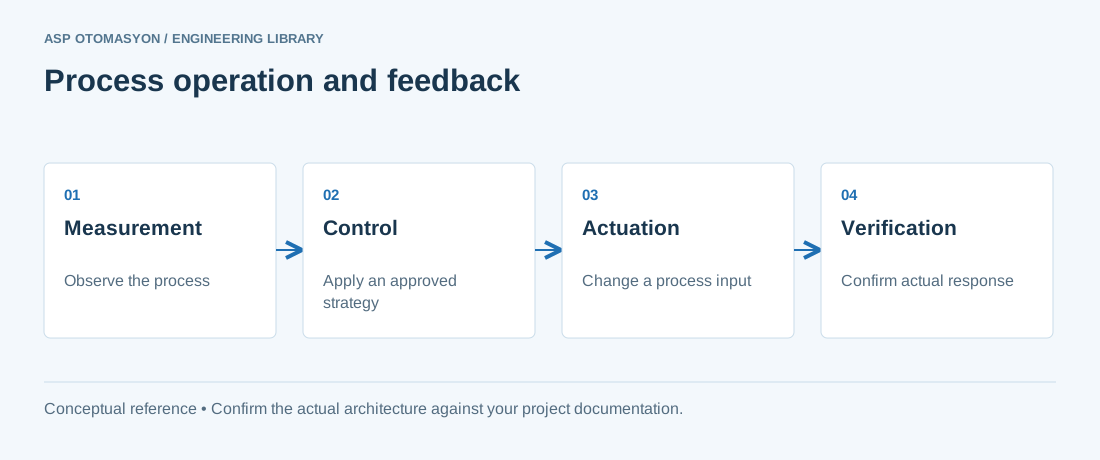
Cement Manufacturing Process Overview
The cement manufacturing process follows a well-defined sequence of physical and chemical transformations that begins with raw material extraction and ends with finished cement dispatch. The core process units are connected in a continuous flow:
  Raw Materials (Limestone ~80%, Clay ~15%, Iron Ore ~5%)
         |
         v
  +------------------+      +--------------------+      +-------------------+
  |   CRUSHER         | ---> |   RAW MILL (VRM)   | ---> | HOMOGENIZATION    |
  | Primary &         |      | Grinding + Drying  |      | SILO (Blending)   |
  | Secondary Crushing|      | Fineness: 12–16%   |      | Chemistry Control |
  +------------------+      | Residue on 90µm    |      +--------+----------+
                            +--------------------+               |
                                                                  |
  +------------------+      +--------------------+               |
  |   FINISH MILL     |      |   CLINKER COOLER   |      +--------v----------+
  | Cement Grinding + | <--- | 3rd Gen Grate      | <--- | ROTARY KILN       |
  | Gypsum + Slag     |      | 80–150°C Exit      |      | Preheater (4–6    |
  | Blaine: 3000–5000 |      | Recuperation ~70%  |      | Stage) + Calciner |
  +------------------+      +--------------------+      | + Rotary Kiln    |
                                                        | 1450°C Burning   |
                                                        +------------------+
         |
         v
  +------------------+
  |   CEMENT SILOS    |
  | Packing + Bulk    |
  | Dispatch          |
  +------------------+
Raw Mill Control
The raw mill grinds limestone, clay, and corrective materials (iron ore, bauxite, sand) into a fine raw meal with controlled chemical composition and particle size distribution. Most modern cement plants use vertical roller mills (VRM) for raw grinding due to their higher energy efficiency and better drying capacity compared to ball mills.
Control Objectives
- Product fineness — Typically 12–16% residue on 90 µm sieve and 1.0–2.5% on 212 µm. Controlled by separator rotor speed and mill airflow rate. Fineness directly affects kiln burnability and fuel consumption.
- Moisture content — Raw meal moisture must be below 0.5% for efficient preheater operation. Controlled by mill inlet temperature (typically 250–350°C) through regulation of the hot gas generator fuel rate and gas recirculation dampers.
- Chemical composition — The key moduli are lime saturation factor (LSF: 92–98), silica ratio (SR: 2.0–2.8), and alumina ratio (AR: 1.2–1.8). These are controlled by the feed proportions from the raw material blending system. Some plants use on-line PGNAA (Prompt Gamma Neutron Activation Analysis) analyzers for real-time chemistry control.
- Mill differential pressure — Indicates grinding bed thickness. Optimal range: 300–600 mm WG depending on mill type and capacity. Excessive ΔP indicates bed buildup; low ΔP indicates insufficient material for efficient grinding.
Key Control Loops
- Feed rate control — Cascaded with mill power draw or differential pressure. Maintains optimum mill load. Mill power is a more responsive indicator than ΔP for VRM control.
- Separator speed — Controls product fineness via cascade from on-line particle size analyzer (laser diffraction or orthogonally rotating sieve).
- Mill inlet temperature — Maintained by regulating hot gas generator fuel rate or mixing dampers (hot gas / ambient air / kiln exhaust gas).
- Mill vibration protection — Protective interlock reduces feed rate or initiates mill trip when housing vibration exceeds safe limits (typically >3 mm/s for VRM).
- Roller pressure (VRM) — Maintains grinding pressure within design limits. Excessive pressure causes bearing damage; insufficient pressure reduces grinding efficiency.
Rotary Kiln Control
The rotary kiln is the heart of the cement plant — a 3–7 m diameter, 40–120 m long refractory-lined steel cylinder rotating at 1.5–4.0 RPM, inclined at 2–4° from horizontal. Inside the kiln, raw meal undergoes four sequential transformations:
- Drying and preheating (50–800°C) — Free water and chemically bound water are driven off.
- Calcination (800–950°C) — CaCO₃ → CaO + CO₂, the most energy-intensive step, accounting for ~60% of total kiln fuel consumption.
- Solid-state reactions (900–1200°C) — Formation of C₂S (belite), C₃A, and C₄AF.
- Clinkerization (1300–1450°C) — Formation of C₃S (alite) in the liquid phase (25–30% melt). Final clinker quality is determined in this zone.
Temperature Profile Control
Maintaining the correct temperature profile along the kiln is critical for both clinker quality and refractory life. The key measurement and control points are:
| Zone | Temperature Range | Measurement Method | Control Variable |
|---|---|---|---|
| Preheater exit gas | 280–350°C | Type K thermocouple | ID fan speed, raw meal feed rate |
| Calciner | 850–950°C | Type R/S thermocouple | Calciner fuel rate, tertiary air damper, feed rate |
| Kiln inlet (gas) | 1000–1100°C | Type R/S thermocouple | Kiln fuel rate, kiln speed, secondary air |
| Burning zone (material) | 1350–1500°C | Infrared two-color pyrometer | Kiln fuel rate, kiln speed, secondary air damper |
| Kiln shell | 200–400°C | Thermal camera / scanner | Refractory monitoring, coating detection, hot spot alarm |
| Clinker cooler outlet | 80–150°C | Type K thermocouple (burdened) | Cooler grate speed, cooling air fans (VFDs) |
| Kiln drive current | — | Motor current transducer | Kiln torque indicator, material bed profile |
Advanced Kiln Control Strategies
- Feed-forward control — Preheater towers with online analyzers (XRF or PGNAA on raw meal) measure chemistry before the kiln and adjust fuel rate and kiln speed to compensate for variations in burnability (B₀ index). This anticipates disturbances before they affect clinker quality.
- Cascade control — Kiln burning zone temperature (master controller) cascades to kiln fuel flow (slave controller). The master setpoint is automatically adjusted based on free lime analysis or quality targets. This structure rejects fuel pressure variations much faster than a single-loop controller.
- Expert systems / Model Predictive Control (MPC) — Systems such as ABB Ability™ Expert Optimizer continuously optimize the kiln operating envelope for minimum fuel consumption while maintaining quality. MPC uses a dynamic process model to predict future process behavior and calculates optimal control actions. Typical fuel savings: 2–5% with payback under 12 months.
- Kiln drive torque control — Maintains consistent material bed profile by adjusting the kiln speed versus feed rate ratio. Kiln torque is proportional to the mechanical power needed to rotate the kiln and is directly related to the material load. Consistent torque prevents ring formation and coating instability.
Clinker Cooler Optimization
The clinker cooler rapidly quenches hot clinker from 1400°C to 80–150°C, simultaneously recovering up to 70% of the sensible heat for return to the kiln as preheated secondary air. Modern reciprocating grate coolers (3rd generation and later) use multiple independently controlled grate sections:
- Cooling air distribution — Under-grate pressure is zoned (typically 3–6 zones from inlet to outlet) and controlled by variable-speed fan drives. The fixed inlet zone (high pressure) receives the hottest clinker and requires the most cooling air.
- Grate speed control — Maintains consistent clinker bed depth (500–800 mm). Speed is cascaded from cooler under-grate pressure measurement. The control objective is to minimize clinker exit temperature while maintaining complete cooling across all grate sections.
- Vent air handling — Excess hot air (tertiary air) is ducted to the coal mill and raw mill for drying. Damper control maintains system draft balance. The remaining air goes to the baghouse for particulate removal before stack discharge.
Finish Mill Automation
The finish mill (cement mill) grinds clinker with gypsum (3–5%) and additives (slag, fly ash, limestone, pozzolana, up to 35%) to produce cement meeting EN 197-1 or ASTM C150 standards. Finish mill automation addresses:
- Fineness control — Closed-loop Blaine target (2800–5000 cm²/g) or particle size distribution (PSD) target. Cascaded from on-line Blaine analyzer or laser diffraction particle size analyzer.
- Gypsum optimization — SO₃ content in cement controlled by gypsum feed rate. Typical target 2.0–3.5% SO₃ depending on cement type. SO₃ deficiency causes flash set; excess causes false set and expansion.
- Mill ventilation — Air velocity through the mill (0.8–1.5 m/s for ball mills) removes fines and prevents over-grinding. Controlled by mill fan speed or separator bleed damper.
- Temperature control — Mill outlet temperature must stay below 120°C to prevent gypsum dehydration (to hemihydrate or anhydrite). Controlled by water injection into the mill or by reducing grinding feed rate.
ASP OTOMASYON Cement References
ASP OTOMASYON A.Ş. has completed numerous DCS automation projects for leading Turkish cement manufacturers:
- Medcem Çimento (Mersin) — 1st Line DCS automation using ABB System 800xA with AC 800M controllers. Complete greenfield installation including raw mill, kiln, cooler, and finish mill control.
- Limak Çimento (Ankara) — 1st Line DCS automation with ABB Freelance DCS and AC 800F controllers. Full line programming and commissioning.
- Göltaş Çimento (Isparta) — Dual-line installation: Line 1 on legacy Advant DCS (AC 410/450), Line 2 upgraded to System 800xA with AC 800M. Migration engineering for both platforms.
- Aşkale Çimento (Erzurum) — Two-line automation on Advant DCS (AC 410/450). Full PPA (Process Portal A) upgrade for operator interface modernization.
- Kipaş Çimento (Kahramanmaraş) — 1st Line DCS automation with ABB Freelance (AC 800F). Complete installation, programming, and commissioning.
ASP OTOMASYON A.Ş. and its subsidiaries OPCTurkey and ASP Dijital provide end-to-end industrial engineering solutions for process automation, data operations and AI.
References & Further Reading
- ABB — Cement Industry Automation Solutions — Official ABB documentation for cement plant automation, including DCS-based kiln control, raw mill optimisation, and finish mill control strategies.
- ABB Ability System 800xA — Process Control for Cement — Official ABB product page for the 800xA DCS platform as deployed in cement manufacturing, including AC 800M controller configuration and CHMI operator interface.
- ISA-88 / IEC 61512 — Batch Control Standards for Cement Blending — International standard for batch process control applied to cement raw material blending and quality control recipe management.
- IEC 61131-3 — PLC Programming Standards for Cement Control Logic — International standard for the programming languages used in cement plant DCS and PLC control logic development across all process units.
- ABB Automation Builder — Cement Plant Engineering Tool — Official ABB documentation for the Automation Builder engineering environment used for AC500 PLC programming in cement plant applications.
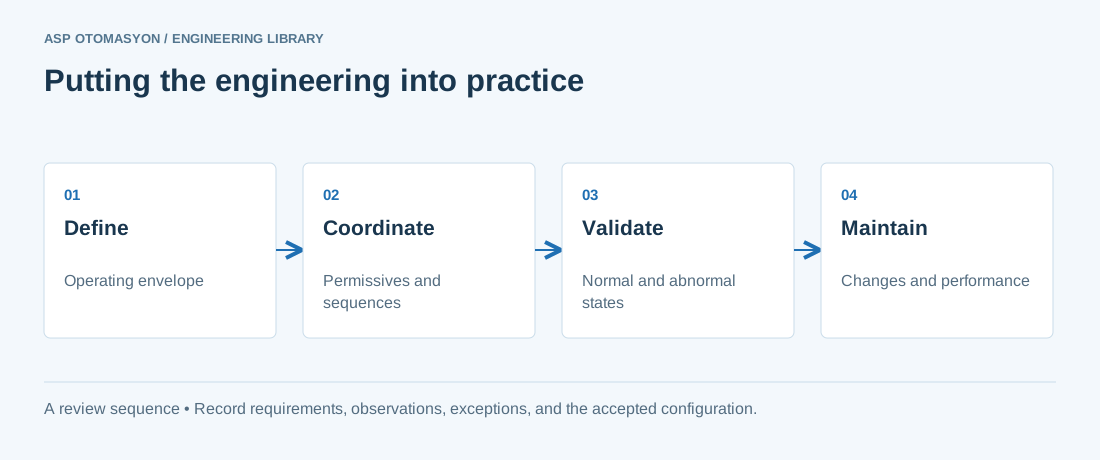
Apply this to your project
- Record process boundaries, required operating states, and interactions with independent protective systems.
- Check instrument quality, control authority, permissives, and operator responsibilities during state changes.
- Agree how tests, deviations, and configuration changes will be recorded within the facility's engineering procedures.
Follow an ASP project guide to connect the fundamentals with implementation and acceptance.
Primary references and further reading
Use the original specifications and product documentation for implementation details. The examples in this guide are illustrative engineering scenarios, not published project results.