
Smart transmitters represent the dominant technology in modern process instrumentation across oil and gas, chemical, pharmaceutical, power generation, and water treatment industries. These microprocessor-based devices — measuring pressure, temperature, level, and flow — offer significantly better accuracy (typically 0.04–0.075% of span), broader turndown ratios (>50:1), and advanced diagnostic capabilities compared to conventional analog transmitters. The key distinguishing feature of smart transmitters is the ability to communicate digitally, with HART (Highway Addressable Remote Transducer) protocol (IEC 62591) being the most widely deployed — present in over 40 million installed devices worldwide.
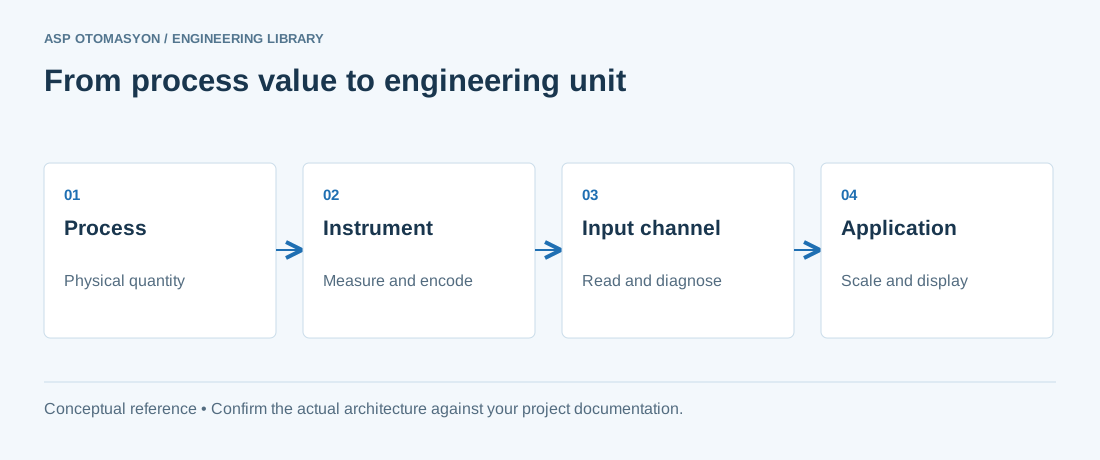
HART Protocol Technical Overview
The HART protocol superimposes a digital Frequency Shift Keying (FSK) signal on the standard 4–20 mA analog current loop. The digital signal operates at 1200 baud using Bell 202 standard tones: 1200 Hz (logical "1") and 2200 Hz (logical "0"). Because the digital signal is at a much higher frequency than the process signal (which changes slowly), both signals can coexist without interference. Key features include:
- Analog + Digital Simultaneous — The 4–20 mA signal carries the primary variable (PV) in real time for the control system. Simultaneously, digital communication provides access to secondary variables (SV, TV, QV), configuration parameters, and comprehensive diagnostic data without interrupting the analog signal.
- Multi-drop mode — Up to 15 devices can share a single 4–20 mA loop in digital-only mode. All devices operate at a fixed reduced current (typically 4 mA or lower), communicating digitally using unique polling addresses. This is useful for remote monitoring applications where wiring costs are significant.
- Universal Command Set — Mandatory commands implemented in all HART devices: Read PV (Command #1), Read Current and Percent of Range (#2), Read Dynamic Variables (#3), Read Device Identification (#0), Read Tag/Descriptor (#13, #14).
- Common Practice Commands — Optional but widely implemented: Write PV Range (#35), Perform Self-Test (#41), Trim DAC (#40), Write Damping Time (#34), Write Transfer Function (#25).
- Device-Specific Commands — Vendor-specific commands accessible via Device Descriptions (DD) or Device Type Managers (DTM). These provide access to advanced features: sensor calibration, custom linearization tables, and specialized diagnostics.
Configuration Tools
Handheld Field Communicators
Dedicated handheld devices remain the most common tool for field configuration and basic troubleshooting:
- Trex™ Unit (Emerson/Rosemount) — Modern touchscreen communicator with wireless connectivity, built-in HART + FOUNDATION Fieldbus support. Features Device Dashboards for vendor-specific DD-based configuration and guided procedures.
- Fluke 754/754PLUS Documenting Process Calibrator — Combines pressure, temperature, and electrical measurement with HART digital communication. Generates full calibration certificates with as-found/as-left data. The industry standard for field calibration.
- Beamex MC6 — Advanced field calibrator supporting HART, PROFIBUS PA, and FOUNDATION Fieldbus. Integrated with Beamex CMX calibration management software for end-to-end documentation.
PC-Based Software and Asset Management Systems
Laptop-based tools offer more comprehensive configuration capabilities and are preferred for detailed setup, batch operations, and ongoing asset management:
- AMS Device Manager (Emerson) — The most widely deployed asset management platform. Provides continuous device health monitoring, configuration management, calibration scheduling and documentation, and predictive diagnostics (plugged impulse lines, electronics degradation, sensor drift).
- FieldMate (Yokogawa) — Device configuration wizard with a comprehensive DD library. Supports HART, FOUNDATION Fieldbus, and PROFIBUS PA.
- PDM (Siemens) — Process Device Manager integrated with SIMATIC PCS 7 and TIA Portal for centralized device configuration and diagnosis.
- FDT/DTM Framework — Open standard container application (PACTware, FieldCare, etc.) that hosts device-specific DTMs from any vendor. Provides full access to all device parameters, including vendor-specific features not exposed through generic DD-based communicators.
Configuration Parameters Reference
| Parameter | Description | Typical Values | HART Command |
|---|---|---|---|
| Tag | Unique device identifier in the plant P&ID | PT-101, TT-203, LT-045 | #13 |
| Descriptor | Text description of the measurement point | "Reactor Pressure," "Boiler Feed Water Flow" | #14 |
| PV Unit | Engineering unit for the primary variable | bar, kPa, °C, m, m³/h, kg/h | #15 |
| Range Upper (URV) | Upper range value corresponding to 20 mA output | 100 bar, 500°C, 10 m | #35 |
| Range Lower (LRV) | Lower range value corresponding to 4 mA output | 0 bar, 0°C, 0 m | #35 |
| Damping | First-order filter time constant | 0.0–60.0 s (typical 0.5–2.0 s) | #34 |
| Transfer Function | Output-to-input relationship | Linear, Square Root, Special | #25 |
| Alarm Direction | Output level on device failure | High (≥21.75 mA), Low (≤3.6 mA) | #77 |
| Write Protect | Lock parameter writes | Enabled / Disabled (hardware switch) | Hardware |
| Poll Address | Multi-drop network address | 0 (point-to-point), 1–15 (multi-drop) | #11 |
Calibration Procedures
A common point of confusion with smart transmitters is the distinction between sensor trim (adjusting the digital characterization curve) and analog output trim (adjusting the DAC for accurate 4–20 mA output). These are separate procedures affecting different parts of the measurement chain.
1. Sensor Trim (Characterization Adjustment)
Sensor trim adjusts the internal digital curve that maps the sensor physical output (strain gauge resistance, thermocouple EMF, RTD resistance) to the digital PV value. This compensates for sensor aging, thermal cycling drift, and manufacturing tolerances.
- Zero trim — Single-point adjustment at 0% of sensor span (atmospheric pressure for gauge pressure, 0°C for RTD). Only valid when the applied input is exactly zero. Does not require a reference standard — the device knows the zero point.
- Full sensor trim — Two-point or multi-point adjustment across the full sensor span using precision reference standards. Corrects both zero offset and span errors. Traceability to national standards is maintained through the reference standard calibration.
2. Analog Output Trim (DAC Trim)
DAC trim adjusts the digital-to-analog converter so that the analog current output is exactly correct. This compensates for DAC component tolerances and does not affect the digital PV value.
- 4 mA trim (DAC zero) — Set device to output 4 mA. Adjust until measured current = 4.000 mA ± 0.001 mA using a precision ammeter (6.5 digit DMM recommended).
- 20 mA trim (DAC span) — Set device to output 20 mA. Adjust until measured current = 20.000 mA ± 0.001 mA.
Complete Calibration Checklist
| # | Task | Tools / Equipment | Acceptance Criteria |
|---|---|---|---|
| 1 | Obtain work permit, isolate transmitter from process, depressurize and drain line | Isolation valves, lockout/tagout | Line isolated, safe for work |
| 2 | Verify tag number matches P&ID and instrument datasheet | P&ID, loop drawing, datasheet | Tag, range, type consistent |
| 3 | Clean process connection threads and diaphragm | Cleaning tools, soft brush | No debris, no coating, sealing surfaces intact |
| 4 | Connect reference standard (0.025% accuracy or better) and HART communicator | Calibrator, communicator, test leads | Stable electrical connection, device recognized |
| 5 | Record as-found values at 0%, 25%, 50%, 75%, 100%, and 0% return (hysteresis check) | Reference standard, communicator | All values documented, deviation noted |
| 6 | Apply LRV (0%). Perform zero trim if deviation > half of required accuracy | Reference standard | PV within 0.04% of applied value |
| 7 | Apply URV (100%). Perform full sensor trim if span deviation exceeds tolerance | Reference standard | PV within 0.04% of applied value |
| 8 | DAC trim at 4 mA: adjust until measured = 4.000 mA | Precision DMM (6.5 digit) | 4.000 mA ± 0.001 mA |
| 9 | DAC trim at 20 mA: adjust until measured = 20.000 mA | Precision DMM (6.5 digit) | 20.000 mA ± 0.001 mA |
| 10 | Verify as-left values at 0%, 25%, 50%, 75%, 100%, 0% return | Reference standard, DMM | All points within required accuracy |
| 11 | Configure damping, range, alarm direction, write protection | HART communicator | Per instrument datasheet |
| 12 | Generate ISO 17025-compliant calibration certificate | Calibration software | Traceability chain documented |
| 13 | Re-install transmitter, open valves, verify loop on HMI/DCS | HMI or DCS workstation | PV stable and reasonable |
Advanced Configuration Topics
Linearization
- Square root extraction — Required for differential pressure flow meters (orifice plates, venturi tubes, averaging pitot tubes) where flow is proportional to the square root of the differential pressure. Without square root extraction, flow indication is highly non-linear.
- Special linearization — Custom 16–32 point lookup tables for non-linear storage tanks (spherical, horizontal cylindrical with dished ends, odd geometries). The table is derived from tank strapping tables (tank calibration charts).
- Temperature compensation — For gas flow measurement: built-in compensation for density changes with temperature using equation of state calculations (AGA-3, ISO 5167).
Temperature Measurement Considerations
- 3-wire vs 4-wire RTD — 4-wire connection provides the highest accuracy by eliminating lead wire resistance entirely. 3-wire is the industrial standard (balances accuracy with wiring cost). 2-wire connections should be avoided for precision measurements.
- Cold junction compensation (CJC) — For thermocouple inputs, the transmitter measures terminal temperature using an internal or external CJC sensor. CJC accuracy directly affects overall measurement accuracy. Thermocouple extension wire quality is frequently overlooked but critical.
- Sensor slope adjustment — Fine-tuning of the RTD/temperature characterization curve based on manufacturer ITS-90 calibration data. This is a sensor trim variant specific to temperature transmitters.
ISO 17025 Calibration Standards
ISO/IEC 17025:2017 specifies general requirements for calibration laboratory competence. Key concepts:
- Traceability — Every calibration must be traceable to national or international standards (TÜBİTAK UME in Turkey, NIST in the US). Reference standards must have valid calibration certificates with an unbroken traceability chain.
- Uncertainty budget — Combined measurement uncertainty (k=2, 95% confidence) must account for all contributors: reference standard accuracy, device repeatability, ambient temperature and humidity, and operator technique.
- Test Accuracy Ratio (TAR) — Reference standard accuracy should be at least 4:1 better than device tolerance (1:1 minimum accepted for HART field devices).
- Environmental conditions — Calibration performed at 23°C ± 2°C, <80% relative humidity. Conditions must be recorded on the calibration certificate.
ASP OTOMASYON A.Ş. and its subsidiaries OPCTurkey and ASP Dijital provide end-to-end industrial engineering solutions for process automation, data operations and AI.
References & Further Reading
- FieldComm Group — HART Protocol (IEC 62591) Specification — Official HART protocol documentation covering the 4-20 mA digital overlay, universal/common practice commands, multi-drop mode, and DD/DTM integration.
- Emerson AMS Device Manager — Asset Management Platform — Official product documentation for the industry-standard device management platform, covering HART device configuration, calibration management, and predictive diagnostics.
- ISO/IEC 17025:2017 — Calibration Laboratory Competence — International standard for calibration laboratory quality management, defining traceability, uncertainty budgets, and TAR/TUR requirements for transmitter calibration.
- FieldComm Group — FDI (Field Device Integration) Standard IEC 62769 — Official FDI specification for universal device integration, combining the capabilities of EDDL and FDT/DTM into a single technology for smart transmitter configuration.
- Emerson Trex Unit — Handheld Device Communicator — Official product documentation for the Trex handheld communicator, the primary field tool for HART device configuration, loop diagnosis, and transmitter calibration.
Apply this to your project
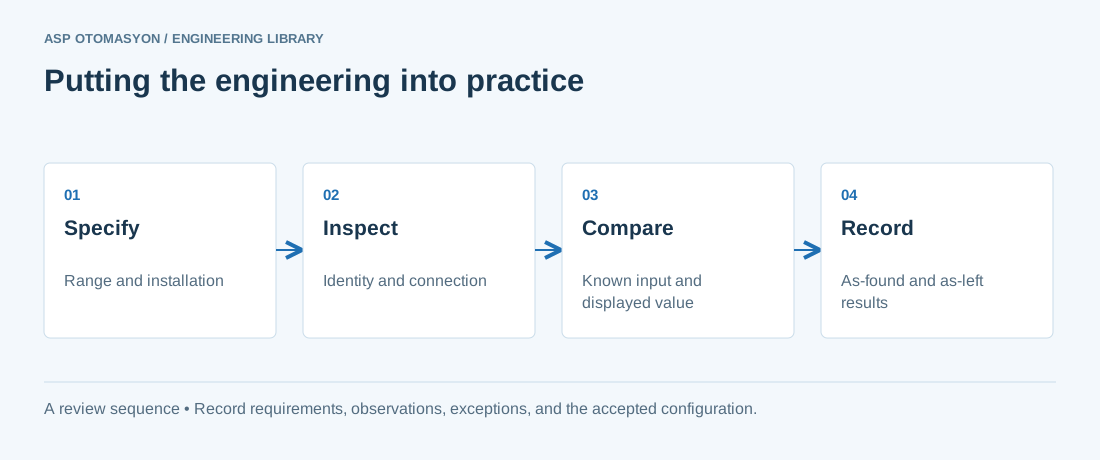
- Confirm the instrument tag, range, engineering unit, process connection, and environmental suitability against approved documents.
- Check the complete measurement chain, including sensor configuration, channel scaling, quality indication, and display units.
- Record reference equipment, uncertainty where relevant, test points, deviations, and the final configuration.
Follow an ASP project guide to connect the fundamentals with implementation and acceptance.
Primary references and further reading
Use the original specifications and product documentation for implementation details. The examples in this guide are illustrative engineering scenarios, not published project results.