
Industrial Ethernet protocols have replaced legacy fieldbus systems (PROFIBUS, DeviceNet, ControlNet, Modbus RTU) as the dominant communication technology in both discrete and process manufacturing. Two protocols dominate the global market: PROFINET (driven by Siemens and the PROFIBUS & PROFINET International — PI organization) and EtherNet/IP (driven by Rockwell Automation and ODVA). Combined, these two protocols account for over 60% of new industrial Ethernet node installations worldwide. Choosing between them requires a thorough understanding of their technical architecture, performance characteristics, ecosystem strengths, and regional market preferences.
PROFINET: Architecture and Key Features
PROFINET (Process Field Net) is an industrial Ethernet standard defined by IEC 61158 and IEC 61784. It uses EtherType 0x8892 to distinguish PROFINET frames from standard IP traffic (0x0800) on the same physical network. This allows PROFINET and standard TCP/IP traffic to coexist on the same cable, but PROFINET frames receive priority handling through VLAN tagging (IEEE 802.1Q) and dedicated frame processing paths in the controller hardware or software stack.
PROFINET NRT (Non-Real-Time)
Standard TCP/IP or UDP/IP communication used for configuration, diagnostics, parameterization, and acyclic data exchange. Uses the same protocol stack as office Ethernet without any real-time enhancements. Cycle times are greater than 100 ms. Suitable for commissioning tasks, firmware updates, device parameterization, and HMI communication where sub-second timing is not required.
PROFINET RT (Real-Time)
Cyclic process data exchange using prioritized Ethernet frames with VLAN tagging per IEEE 802.1Q. RT frames bypass the TCP/IP stack entirely — they are intercepted at the data link layer and processed directly by the PROFINET stack in the controller firmware or hardware. This bypass eliminates protocol stack latency and jitter. Cycle times: 1–10 ms depending on network load and device count. Suitable for most factory automation applications: conveyor systems, packaging machinery, material handling, general discrete manufacturing, and most process I/O applications.
PROFINET IRT (Isochronous Real-Time)
Deterministic communication that requires specialized ASICs (application-specific integrated circuits) in all network devices including controllers and field devices. IRT uses a time-slot mechanism where the network schedule is pre-calculated during system configuration and loaded into all devices. The schedule divides time into repeating cycles: a "red phase" where only PROFINET IRT frames are transmitted with guaranteed timing, and a "green phase" where standard TCP/IP traffic is allowed. This avoids any possibility of collision or delay for time-critical data. Cycle times: down to 31.25 µs with jitter below 1 µs. Required for high-performance motion control: multi-axis servo drives, electronic camming, printing presses, packaging machines with synchronized axes, and CNC machine tools.
PROFINET Conformance Classes
| Class | RT Level | Key Features | Typical Applications |
|---|---|---|---|
| CC-A | RT | Basic cyclic I/O exchange, device identification (I&M records 1–3), topology detection via LLDP | Simple I/O blocks, sensors, valves, actuators, basic drives |
| CC-B | RT | All CC-A plus: network diagnostics, system redundancy (S2), media redundancy (MRP ring protocol with <200 ms recovery), neighbor detection, SNMP support | Modular machines, process islands, medium-complexity systems with diagnostics requirements |
| CC-C | IRT | All CC-B plus: IRT communication with hardware-based synchronization, <1 µs jitter, equidistant cycle, MRPD (seamless redundancy) support | High-speed motion control, servo drives, synchronized multi-axis systems |
EtherNet/IP: Architecture and Key Features
EtherNet/IP (Ethernet Industrial Protocol) implements the Common Industrial Protocol (CIP) over standard Ethernet (IEEE 802.3 and TCP/UDP/IP). Unlike PROFINET which uses a proprietary EtherType, EtherNet/IP uses standard IP traffic (EtherType 0x0800), making it fully compatible with standard IT networking infrastructure, switches, routers, and diagnostic tools. This can be advantageous for IT team acceptance and simplifies integration with enterprise networks.
CIP Communication Classes
- Class 0 (Unconnected) — UDP-based multicast for implicit (I/O) messaging. One-to-many data distribution without connection establishment overhead. No acknowledgment. Highest performance with lowest processing overhead. Best for time-critical I/O data where loss of individual packets can be tolerated.
- Class 1 (Connected I/O) — UDP-based cyclic data exchange with a forward-open connection establishment sequence. Uses the producer-consumer model where data producers broadcast to multiple subscribers simultaneously without requiring multiple transmissions. Typical cycle times: <1 ms to 50 ms.
- Class 3 (Connected Explicit) — TCP-based request/response messaging used for configuration, diagnostics, program upload/download, and acyclic data. Lower priority. Uses established TCP connections with guaranteed delivery.
Producer-Consumer Model
EtherNet/IP uniquely uses a producer-consumer communication model where any device can produce data onto the network, and multiple devices can simultaneously consume the same data packet. This differs fundamentally from master-slave models. The producer-consumer approach is particularly efficient for multi-drive systems where multiple drives need the same speed reference, or for distributed I/O where multiple controllers need to monitor the same sensor value without separate point-to-point connections. Network bandwidth is reduced by transmitting data once regardless of the number of consumers.
Protocol Comparison Table
| Characteristic | PROFINET | EtherNet/IP |
|---|---|---|
| Standardization | IEC 61158, IEC 61784 | IEC 61158, IEC 61784 |
| EtherType | 0x8892 (proprietary) | 0x0800 (standard IP) |
| Application Layer | PROFINET IO application layer | CIP (Common Industrial Protocol) |
| Communication Model | Provider-Consumer (RT/IRT), Client-Server (NRT) | Producer-Consumer (I/O), Client-Server (Explicit) |
| Minimum Cycle Time | 31.25 µs with IRT + specialized ASICs | ~100 µs with high-performance Class 1 |
| Jitter | <1 µs (IRT, hardware-based) | ~10–50 µs (Class 0/1, software-based) |
| Topology Support | Line, star, ring (MRP, MRPD), tree | Star, ring (DLR), tree, daisy-chain |
| Safety Protocol | PROFIsafe (IEC 61784-3-3), SIL 3 | CIP Safety (IEC 61784-3-2), SIL 3 |
| Motion Profile | PROFIdrive (IEC 61800-7) | CIP Motion |
| Primary Vendor | Siemens (PI organization) | Rockwell Automation (ODVA) |
| Turkey Market Share | ~65–70% | ~15–20% |
Selection Criteria
The choice between PROFINET and EtherNet/IP is typically driven primarily by the installed controller base and regional market standards:
Choose PROFINET when:
- Your primary PLC vendor is Siemens (S7-1200, S7-1500, ET200SP).
- High-performance motion control with multi-axis synchronization is required (packaging, printing, CNC, robotics).
- European or Turkish market standards apply (Turkey overwhelmingly uses Siemens controllers).
- Ring topology with fast redundancy (MRP, <200 ms restoration) is needed for high availability.
- Integrated safety on a single cable (PROFIsafe) is required for space-constrained machinery.
- Advanced built-in diagnostics are critical for maintenance teams to quickly identify and resolve network faults.
Choose EtherNet/IP when:
- Your primary PLC vendor is Rockwell/Allen-Bradley (CompactLogix, ControlLogix).
- Producer-consumer multicast distribution provides clear advantages for your application architecture (multiple drives or HMIs consuming the same data).
- Migrating an existing DeviceNet or ControlNet installation to Ethernet.
- CIP Motion synchronized drive systems are specified by your machine builder.
- North American market standards apply.
- Integration with standard IT tools and monitoring systems (Wireshark, PRTG) without specialized decoders is preferred.
Topology Considerations
PROFINET offers flexible network topologies through integrated 2-port switches in all devices. The most common topology is line (daisy-chain) which requires no external switches for small-to-medium networks. Star topology uses central industrial switches. Ring topology with MRP (Media Redundancy Protocol) provides self-healing with maximum 200 ms recovery time and is standard in CC-B devices. For IRT systems requiring maximum availability, MRPD (Media Redundancy for Planned Duplication) provides seamless (<0 ms) recovery using redundant cabling paths.
EtherNet/IP supports star topology as the standard approach using industrial Ethernet switches. For ring topologies, DLR (Device Level Ring) provides fast recovery (<3 ms per hop, typically <50 ms for a full ring) without requiring special switches — the DLR protocol is implemented in the end devices themselves. Daisy-chain connections through devices with embedded switches are also supported.
Safety Variants
PROFIsafe (IEC 61784-3-3) operates as a safety communication layer over PROFINET RT or IRT. Safety-related data is encapsulated in standard PROFINET telegrams with additional headers including CRC, sequence numbering, and watchdog timers. PROFIsafe uses the black channel principle — safety function is independent of and transparent to the underlying communication channel. Achieves SIL 3 (IEC 61508) and PL e (ISO 13849-1). A single cable carries both standard and safety data.
CIP Safety (IEC 61784-3-2) extends CIP with safety functionality for EtherNet/IP. Also uses the black channel principle. Achieves SIL 3. Safety data is embedded in standard CIP messages with safety CRC. Supports both I/O (Class 1) and explicit (Class 3) safety connections.
Network Diagnostics
Both protocols offer comprehensive diagnostic capabilities, but their approaches differ. PROFINET provides highly standardized channel diagnostics (alerts per module and sub-module), topology diagnostics via LLDP (Link Layer Discovery Protocol) neighbor detection, mandatory I&M (Identification & Maintenance) records containing manufacturer ID, device type, serial number, hardware and software version, and full SNMP integration. These diagnostics are consistent across all PROFINET vendors, making troubleshooting predictable regardless of device brand. EtherNet/IP uses CIP object-based diagnostics (Identity Object, Connection Manager Object) where the diagnostic depth and consistency vary by device manufacturer implementation, embedded web servers for device-level diagnostics, and ACD (Address Conflict Detection) for duplicate IP address detection.
ASP OTOMASYON A.Ş. and its subsidiaries OPCTurkey and ASP Dijital provide end-to-end industrial engineering solutions for process automation, data operations and AI.
References & Further Reading
- PROFIBUS & PROFINET International (PI) — PROFINET Specification IEC 61158 — Official PI organisation documentation for PROFINET, including RT/IRT communication classes, conformance classes (CC-A, CC-B, CC-C), and MRP ring redundancy.
- ODVA — EtherNet/IP and CIP Protocol Specifications — Official ODVA specifications for EtherNet/IP, including the Common Industrial Protocol (CIP), producer-consumer model, and Device Level Ring (DLR) topology.
- IEC 61158 — Industrial Communication Networks — Fieldbus Specifications — International standard that includes both PROFINET and EtherNet/IP as recognised Type 10 and Type 2 communication profiles within the fieldbus standardisation framework.
- IEC 61784-1 — Industrial Communication Networks — Profiles (CPF 3 and CPF 16) — International standard defining the communication profile families for PROFINET (CPF 3) and EtherNet/IP (CPF 16), including performance classes and protocol stacks.
- IEC 61784-3 — Industrial Communication Networks — Functional Safety Fieldbuses — International standard covering PROFIsafe and CIP Safety protocols for functional safety communication over PROFINET and EtherNet/IP networks.
Apply this to your project
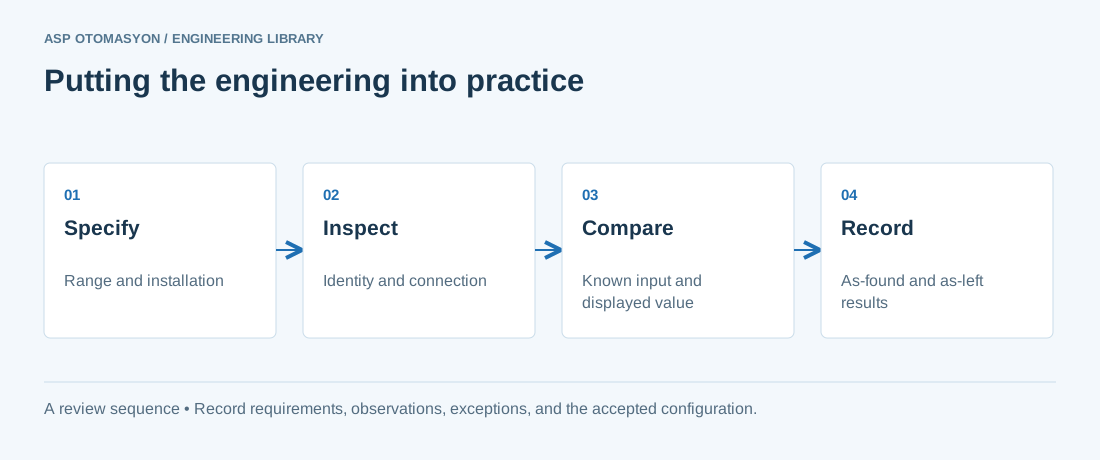
- Confirm the instrument tag, range, engineering unit, process connection, and environmental suitability against approved documents.
- Check the complete measurement chain, including sensor configuration, channel scaling, quality indication, and display units.
- Record reference equipment, uncertainty where relevant, test points, deviations, and the final configuration.
Follow an ASP project guide to connect the fundamentals with implementation and acceptance.
Primary references and further reading
Use the original specifications and product documentation for implementation details. The examples in this guide are illustrative engineering scenarios, not published project results.