
Accurate sensor calibration is essential for process control quality, regulatory compliance, and operational safety. This article covers the fundamental principles of industrial instrument calibration, including traceability, uncertainty analysis, calibration intervals, and documentation requirements per ISO 9001, IEC 17025, and industry-specific standards.
Calibration Standards Hierarchy — Maintaining Traceability to SI Units
Measurement traceability is the property of a measurement result whereby the result can be related to a stated reference (typically SI units — the International System of Units) through an unbroken chain of calibrations, each with a stated measurement uncertainty. The calibration standards hierarchy follows a pyramid structure:
- Primary Standards (Level 0) — The highest-level realisation of a measurement unit, maintained by national metrology institutes: NIST (USA), BIPM (France), PTB (Germany), TÜBİTAK UME (Turkey). Primary standards are the ultimate reference to which all other measurements trace back. They are never used for field calibrations.
- Reference Standards (Level 1) — Owned and maintained by accredited calibration laboratories (per ISO/IEC 17025). These standards are calibrated directly against primary standards at a national metrology institute at defined intervals (typically 1–3 years). Reference standards are used to calibrate the working standards that leave the lab.
- Working Standards (Level 2) — Used by field technicians and plant calibration shops to calibrate the actual process instruments. Working standards include: pressure calibrators (e.g., Fluke 729, Druck DPI 610), temperature dry blocks and baths, electrical calibrators (mA, V, RTD simulation), and mass/weight sets. Working standards are calibrated against reference standards on a schedule determined by frequency of use and drift characteristics (typically 6–12 months).
- Device Under Test (DUT / Level 3) — The process instrument being calibrated (pressure transmitter, temperature sensor, flow meter, analyser). The DUT's calibration is verified against the working standard, and the results are documented with traceability to the working standard's certificate number.
The traceability chain is documented through calibration certificates: each certificate includes the unique serial number of the standard used, its calibration due date, the measurement results with uncertainty, and the environmental conditions during calibration. An auditor should be able to trace any field device back to the primary standard at NIST through this chain of certificates.
Field Calibration vs. Bench Calibration
Field Calibration
Field calibration is performed with the instrument installed in the process, using portable calibrators that connect to the instrument without removing it from service (or during a brief process outage). Advantages include: minimal disruption to operations (the device remains in its process location with the same impulse lines and ambient conditions), faster turnaround (no removal/transport/reinstallation), and the ability to perform "as-found" checks under actual process conditions (impulse line effects, ambient temperature effects, vibration effects are included in the measurement). Limitations: field conditions may limit accuracy (temperature extremes, humidity, vibration, limited stabilisation time), and not all calibration points may be achievable (cannot simulate all range points without a bench setup).
Bench Calibration
Bench calibration requires removing the instrument from the process and bringing it to a calibration lab or workshop. The lab provides a controlled environment (20°C ± 1°C, 45% ± 10% RH, no vibration), high-accuracy reference standards, and sufficient time for thermal stabilisation. Bench calibration offers: the highest accuracy and repeatability, the ability to perform multi-point calibrations and full characterization (including as-found and as-left data at 5–11 points across the range), and the ability to calibrate functions not testable in the field (e.g., totalizer pulse output, HART digital trim). The trade-off is significant: the device must be isolated from the process (sometimes requiring a process tag-out and blinding), removed, transported, calibrated, reinstalled, and re-commissioned — a process that may take days per instrument.
Calibration Documentation and Tags
Proper documentation is as important as the calibration itself. A complete calibration record includes:
- Calibration certificate — Documented on paper or in an electronic calibration management system. Contains: instrument identification (tag number, manufacturer, model, serial number), calibration date, technician name, ambient conditions (temperature, humidity), calibration procedure used (including revision), reference standards used (with serial number, calibration due date, and traceability), as-found data (what the instrument read before adjustment), as-left data (what the instrument reads after adjustment), calculated errors (at each test point), pass/fail determination based on acceptance criteria (typically ±0.1% to ±2% of span depending on the instrument's required accuracy), measurement uncertainty statement, and signature of the technician and reviewer.
- Calibration tags/labels — A weatherproof tag is affixed to each calibrated instrument, visible without opening any enclosure. The tag shows: calibration status (PASS or FAIL), calibration date, next calibration due date, and technician ID. Colour coding is common: GREEN = current, YELLOW = due within 30 days, RED = overdue or failed. Barcode or QR code linking to the digital calibration record in the CMMS is increasingly standard.
Calibration Frequency Determination
Setting the right calibration interval is a balance between measurement risk (undetected drift causing poor quality or safety incidents) and calibration cost (labour, process downtime, standard recalibration). Common approaches include:
- Manufacturer recommendations — A starting point for new instruments. Most transmitter manufacturers recommend 12-month intervals for initial calibration.
- Regulatory requirements — Some industries mandate fixed intervals: pharmaceutical (typically 6–12 months per site SOP), custody transfer (3–6 months per weights and measures regulations), safety instrumented systems (proof test intervals per IEC 61511, which may be 1–5 years depending on SIL level).
- OPRED (Optimized Prediction of Required Calibration Intervals) — A statistical method that analyses historical calibration data to determine the optimal interval. The method calculates the drift rate of each instrument and extrapolates to the time when the drift is expected to exceed the tolerance. OPRED allows intervals to be extended for stable instruments and shortened for drift-prone ones, reducing cost while maintaining confidence.
- Historical analysis (drift trending) — Plotting as-found calibration errors over successive calibrations to visualise drift direction and magnitude. An instrument with consistently low drift (< 20% of tolerance) may have its interval extended (e.g., from 12 to 24 months). An instrument showing accelerating drift should have its interval shortened for closer monitoring.
- Criticality-based intervals — Instruments are categorised by their impact on safety, quality, or operations: safety-critical (SIL-rated, ESD) may be calibrated every 3–6 months; quality-critical (batch release, custody transfer) every 6–12 months; general process indication every 12–36 months; reference-only (indicators with no control function) may be "calibrated on failure" or never calibrated if no regulatory requirement exists.
Automated Calibration Management Systems
Modern calibration management software (e.g., Beamex CMX, Fluke DPCTrack 2, Siemens Sitrans SM) integrates with the CMMS (Computerised Maintenance Management System) to automate the entire calibration lifecycle:
- Calibration scheduling — The system generates a daily/weekly/monthly list of instruments due for calibration, prioritised by criticality and overdue status. Schedules are sent to technician mobile devices.
- Procedure assignment — Each instrument has an associated calibration procedure (procedure ID, test points, acceptance criteria, required standards). The procedure is pushed to the technician's calibrator or mobile device.
- Data collection — The technician performs the calibration using a documenting process calibrator (e.g., Beamex MC6, Fluke 754). The calibrator records as-found and as-left values automatically, eliminating transcription errors. If using a non-documenting calibrator, the technician enters data into the mobile application.
- Automated pass/fail evaluation — The system compares as-found errors against the acceptance criteria and marks the instrument as passed, adjusted (as-left within tolerance after adjustment), or failed (cannot be brought into tolerance — requires replacement).
- Certification generation — Upon completion, the system generates the calibration certificate, updates the instrument's calibration status and due date, and sends the certificate to the document management system (or for printing and manual filing if paper records are still required).
- Dashboard and KPIs — Management can view key performance indicators: % of instruments calibrated on time, % overdue, % failed during calibration, average drift by instrument type, interval extension/reduction recommendations based on OPRED analysis.
Smart Transmitter Calibration — HART Sensor Trim vs. DAC Trim
Modern smart pressure, temperature, and level transmitters (HART, Foundation Fieldbus, Profibus PA) offer two distinct levels of calibration adjustment, which are often confused:
- Sensor Trim (Digital Trim) — Adjusts the digital sensor reading to correct for sensor element errors (e.g., the pressure sensor itself has a small offset or gain error). When a sensor trim is performed, the raw sensor A/D conversion is corrected mathematically by applying an offset and/or gain correction factor. The correction is stored in the transmitter's non-volatile memory. Sensor trim is typically performed at two points: zero (low) and span (high) using a precision pressure source or temperature reference. After sensor trim, the HART digital value (read via HART command 1 or DPVariable PV) is accurate. Sensor trim should only be performed using a reference standard that is 4–10× more accurate than the transmitter's specification.
- DAC Trim (Analog Output Trim) — Adjusts the 4–20 mA analogue output to match the transmitter's digital value. The DAC (Digital-to-Analogue Converter) in the transmitter converts the digital process value to a 4–20 mA current signal. Over time, the DAC may drift, causing the analogue output to be slightly off (e.g., the digital value reads 100% but the output is 20.08 mA). A DAC trim corrects this by adjusting the DAC reference. DAC trim is performed by connecting a precision milliammeter in series with the output loop and trimming the 4 mA and 20 mA endpoints. After DAC trim, the analogue current matches the digital value.
Important distinction: A sensor trim corrects the measurement; a DAC trim corrects only the analogue output. If the digital HART value reads accurately but the 4–20 mA output is wrong, the DAC needs trimming. If both the digital value and the analogue output are wrong by the same proportion, a sensor trim is needed. Many smart transmitters also support "full calibration" which combines both trim operations, and "factory reset" to restore the original factory calibration if a field trim has been applied incorrectly.
ASP OTOMASYON A.Ş. and its subsidiaries OPCTurkey and ASP Dijital provide end-to-end industrial engineering solutions for process automation, data operations and AI.
References & Further Reading
- ISO/IEC 17025:2017 — General Requirements for the Competence of Testing and Calibration Laboratories — International standard specifying the competence, impartiality, and consistent operation of calibration laboratories, including traceability and measurement uncertainty requirements.
- ISO 9001:2015 — Quality Management Systems — International standard for quality management systems, defining the calibration and measurement traceability requirements for organisations using measuring equipment.
- NIST — National Institute of Standards and Technology Calibration Services — Official NIST reference for measurement standards traceability, calibration services, and the SI unit realisation hierarchy for industrial instrumentation.
- FieldComm Group — HART Smart Transmitter Calibration Guide — Official HART protocol documentation covering sensor trim, DAC trim, and calibration procedures for HART-compatible smart transmitters.
- ISO 10012:2003 — Measurement Management Systems — International standard for measurement management systems, providing requirements for measurement processes and metrological confirmation of measuring equipment.
Distinguish calibration from a complete loop check
A calibration establishes a relationship between an instrument indication and a reference under stated conditions. A loop check verifies the connected signal path and displayed result. Neither alone proves that the installed measurement represents the process adequately. Retain as-found and as-left results, reference information, test conditions, and the approved acceptance tolerance for each relevant activity.
Continue with the related practical guide.
Apply this to your project
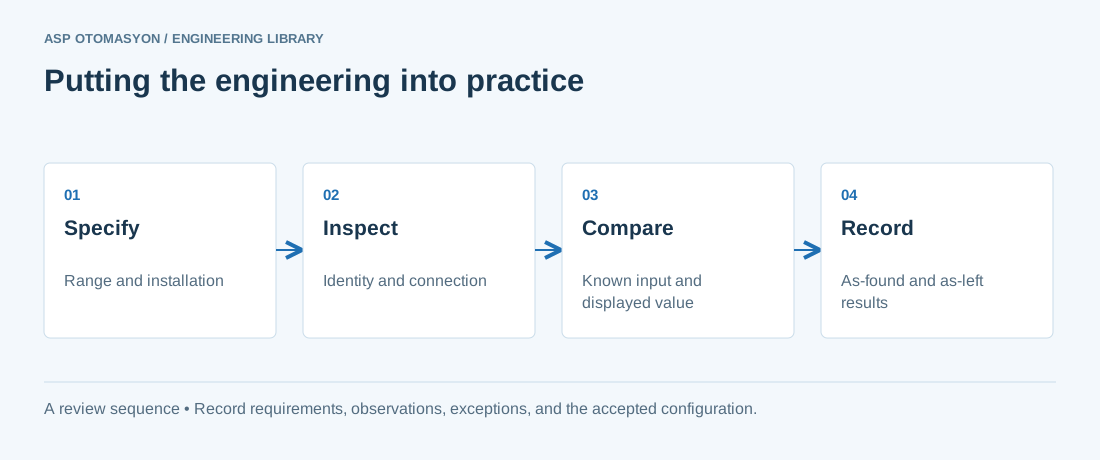
- Confirm the instrument tag, range, engineering unit, process connection, and environmental suitability against approved documents.
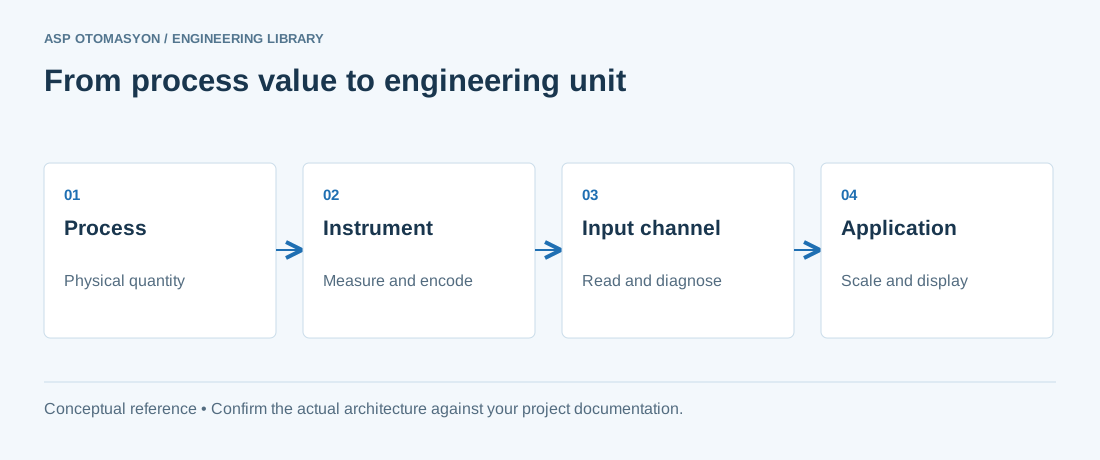
- Check the complete measurement chain, including sensor configuration, channel scaling, quality indication, and display units.
- Record reference equipment, uncertainty where relevant, test points, deviations, and the final configuration.
Follow an ASP project guide to connect the fundamentals with implementation and acceptance.
Primary references and further reading
Use the original specifications and product documentation for implementation details. The examples in this guide are illustrative engineering scenarios, not published project results.