
Flow measurement is one of the most critical process variables in industrial automation. Selecting the right flow meter technology for a specific application requires understanding the physical principles of each technology, the properties of the fluid being measured, and the installation constraints.
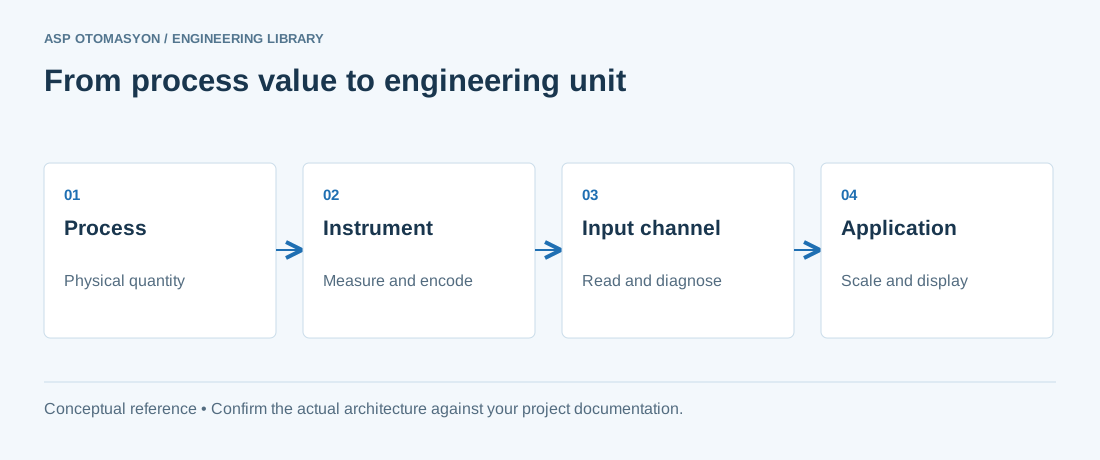
Differential Pressure (DP) Flow Meters
Operating principle: DP meters operate on Bernoulli's principle — a restriction in the pipe creates a pressure drop (ΔP) proportional to the square of the flow rate. The three most common primary elements are the orifice plate (a thin plate with a concentric, eccentric, or segmental bore), the venturi tube (a converging-diverging section), and the flow nozzle (a smooth converging section with a cylindrical throat). Flow rate is calculated as Q = C × A × √(2ΔP / ρ), where C is the discharge coefficient, A is the cross-sectional area, and ρ is the fluid density.
- Accuracy: Orifice plate ±1–2% of full scale (uncalibrated), ±0.5% (calibrated). Venturi ±0.5–1%. Flow nozzle ±1–1.5%.
- Applicable fluids: Clean and cleanish liquids, gases, and steam. Orifice plates are also available for slurry service with eccentric bores.
- Strengths: Well-established technology, no moving parts, wide range of sizes (25 mm to 1000 mm+), suitable for high temperatures and pressures, low initial cost (especially orifice plate).
- Limitations: Permanent pressure loss (especially orifice plate — 40–80% of ΔP), square-root relationship limits turndown (typically 3:1 to 5:1), impulse lines require maintenance (plugging, freezing), accuracy degrades with wear (orifice plate edge sharpness), requires straight upstream pipe runs (10–40 diameters depending on β ratio and upstream disturbances).
- Installation requirements: Straight pipe upstream (10D–40D) and downstream (5D) of the primary element. Properly sized impulse lines (sloped to avoid gas trapping in liquid service, or liquid trapping in gas service). Manifold valve assembly for transmitter isolation and zero verify. Temperature sensor for density compensation in gas/steam applications.
Magnetic (Electromagnetic) Flow Meters
Operating principle: Based on Faraday's law of electromagnetic induction: a conductive fluid flowing through a magnetic field generates a voltage proportional to the flow velocity. The meter consists of a non-magnetic, electrically insulating flow tube with a pair of magnetic coils (generating the magnetic field) and two electrodes (measuring the induced voltage). The voltage signal is directly proportional to the average flow velocity: V = B × L × v, where B is the magnetic field strength, L is the distance between electrodes, and v is the fluid velocity.
- Accuracy: ±0.2–1% of rate (high accuracy versions: ±0.15% of rate).
- Applicable fluids: Electrically conductive liquids only (minimum conductivity typically ≥ 5 μS/cm for standard meters, ≥ 0.05 μS/cm for special designs). Suitable for water, wastewater, slurries, acids, caustics, food products (milk, juice, beer), and mining slurries.
- Strengths: No pressure drop (full bore, no obstruction), no moving parts, bidirectional measurement, unaffected by viscosity, density, temperature, or pressure changes, excellent turndown (100:1 or greater), available in very large line sizes (up to 3000 mm).
- Limitations: Requires minimum fluid conductivity, not suitable for hydrocarbons or gases, electrodes may foul or coat with certain process fluids (electrode cleaning options available), relatively high cost in small sizes, heavy at large diameters.
- Installation requirements: Straight pipe upstream (≥5D for most designs, ≥10D for non-ideal piping configurations) and downstream (≥2D). The meter must remain full of liquid at all times (avoid partially filled pipes). Grounding rings or grounding electrodes are required to ensure the fluid is at ground potential. Avoid installation at the highest point of the pipe (air accumulation) or directly before a free-fall discharge.
Ultrasonic Flow Meters
Operating principle — Transit-Time (contrapropagating): Two ultrasonic transducers are mounted on the pipe, one upstream and one downstream. Each transducer alternately transmits and receives ultrasonic pulses. The transit time of the pulse travelling with the flow (downstream) is shorter than the pulse travelling against the flow (upstream). The time difference (Δt) is directly proportional to the average flow velocity: v = (Δt × c²) / (2 × L × cos θ), where c is the speed of sound in the fluid, L is the path length, and θ is the angle relative to the flow axis.
Operating principle — Doppler: A single transducer sends an ultrasonic beam into the pipe. The beam reflects off particles or bubbles in the fluid, and the frequency shift (Doppler effect) between the transmitted and reflected signal is proportional to flow velocity. Doppler meters require particulate or bubbles in the fluid to operate.
- Accuracy: Transit-time (inline) ±0.5–1% of rate; transit-time (clamp-on) ±1–2% of rate; Doppler ±1–5% of rate.
- Applicable fluids: Transit-time: clean liquids (water, hydrocarbons, chemicals). Doppler: dirty liquids with suspended solids or entrained gas bubbles (slurries, wastewater). Clamp-on versions work on most pipe materials (carbon steel, stainless steel, PVC, ductile iron).
- Strengths: Inline: no pressure drop, no moving parts. Clamp-on: non-invasive, no process penetration (no leak risk), portable units for survey applications, no pipe modification required. Excellent turndown (100:1 transit-time).
- Limitations: Clamp-on accuracy depends on pipe wall condition (corrosion, lining) and proper coupling. Transit-time requires clean fluids (air bubbles or solids scatter the signal). Doppler requires minimum particle concentration and velocity. Cost competitive with magnetic meters in some sizes.
- Installation requirements: Clamp-on requires clean outside pipe surface at the measurement location, application of acoustic coupling gel, and alignment according to the manufacturer's spacing formula. Inline (wetted transducer) requires straight pipe runs (10D upstream, 5D downstream). Transit-time meters are sensitive to flow profile disturbances; flow conditioners or longer straight runs may be needed.
Coriolis Mass Flow Meters
Operating principle: Fluid flows through one or more vibrating tubes (typically U-shape, Δ-shape, or straight). The tube oscillation is driven electromagnetically at its natural frequency. When fluid flows through the vibrating tubes, Coriolis forces cause a phase shift (or twist) between the inlet and outlet sections of the tube. This phase shift is directly proportional to the mass flow rate. Additionally, the natural frequency of the tube varies with fluid density, allowing simultaneous density measurement.
- Accuracy: ±0.1–0.5% of rate (high accuracy: ±0.05% of rate for mass flow, ±0.0005 g/cm³ for density).
- Applicable fluids: Liquids and gases (both single-phase). Widely used for: chemical injection (catalyst, additive), custody transfer (crude oil, LNG), food (syrup, honey, dairy), pharmaceutical (sterile ingredient metering), and high-value fluid batching.
- Strengths: Direct mass flow measurement (no temperature/pressure/compressibility compensation needed), simultaneous density measurement, extremely high accuracy and repeatability, bidirectional measurement, no moving parts — minimal maintenance, immune to upstream flow profile disturbances (no straight pipe required).
- Limitations: Highest pressure drop of all flow meter technologies (the fluid must pass through the vibrating tubes, which are narrower than the pipe), sensitive to pipe vibration (must be rigidly mounted), limited to smaller line sizes (typically ≤ 300 mm / DN300; larger sizes become prohibitively expensive and heavy), cost is significantly higher than alternative technologies.
- Installation requirements: Must be rigidly mounted to prevent external vibration affecting the measurement. No straight pipe requirements upstream or downstream (ideal for tight installations). For liquid applications with entrapped gas, install the meter at a low point and provide adequate back-pressure to prevent flashing/cavitation at the sensor. Supports should be close to the meter flanges to avoid pipe stress on the sensor housing.
Vortex Flow Meters
Operating principle: A bluff body (shedder) is placed in the flow stream. As fluid passes the bluff body, it creates alternating vortices (the Kármán vortex street) on the downstream side. The frequency of vortex shedding is directly proportional to the flow velocity: f = St × v / d, where St is the Strouhal number (approximately constant over a wide Reynolds number range), v is the flow velocity, and d is the width of the bluff body. A piezoelectric sensor, capacitive sensor, or ultrasonic beam detects the vortex frequency.
- Accuracy: ±0.5–1% of rate for liquids, ±1–1.5% of rate for gases and steam.
- Applicable fluids: Clean and cleanish liquids, gases, and saturated/superheated steam. Particularly popular for steam flow measurement (energy management, boiler efficiency).
- Strengths: No moving parts (unlike turbine meters), moderate turndown (10:1 to 20:1 for liquids, 8:1 to 15:1 for gases), medium cost, suitable for a wide temperature range (−200°C to +400°C), good for steam measurement without impulse lines (unlike DP).
- Limitations: Limited turndown at low Reynolds numbers (< 20,000 the Strouhal number becomes non-linear), performance degrades at low velocities, requires straight pipe runs (15D–35D upstream depending on disturbance type, 5D downstream), not suitable for low-flow or highly viscous fluids, the bluff body can collect debris or fibres.
- Installation requirements: The upstream straight pipe requirement is more stringent than for magnetic or Coriolis meters. A flow conditioner may be required if the available straight run is insufficient. The sensor should be installed in a pipe run that remains full (avoid vertical downflow with partial filling). For steam applications, proper condensate pot and impulse line routing for the transmitter must be provided.
Thermal Mass Flow Meters
Operating principle: Thermal mass flow meters use the principle of heat transfer. The meter incorporates a heated sensing element and a temperature reference element. The temperature difference between the two elements is maintained constant by varying the heating power, or the heating power is maintained constant and the temperature difference is measured. The electrical power required to maintain the temperature difference, or the temperature difference itself, is proportional to the mass flow rate. The relationship is based on King's Law for heat transfer from a heated cylinder in a fluid stream.
- Accuracy: ±1–2% of rate (higher accuracy ±0.5–1% for precision designs).
- Applicable fluids: Clean gases only (air, natural gas, nitrogen, oxygen, hydrogen, biogas, compressed air). Not suitable for liquids.
- Strengths: Direct mass flow measurement (no pressure/temperature compensation), excellent low-flow sensitivity (can measure down to very low velocities), no moving parts, low pressure drop (insertion style), good turndown (50:1 to 100:1), suitable for large pipe sizes (insertion style).
- Limitations: Sensitive to gas composition changes (different gases have different thermal conductivity and specific heat), not suitable for liquid service, in-line meters limited to smaller pipe sizes (typically ≤ 150 mm / DN150), insertion style accuracy depends on flow profile and insertion depth.
- Installation requirements: Straight pipe upstream (≥10D for inline, ≥20D for insertion). For insertion meters, the probe must be inserted at a position corresponding to the average flow velocity (typically at 1/8 of pipe diameter from the wall, or use a multipoint averaging probe). The sensor must be kept clean — buildup of particulates or moisture films on the sensing elements will shift the calibration.
Technology Comparison Summary
| Technology | Accuracy (% rate) | Applicable Fluids | Pipe Size Range | Pressure Drop | Relative Cost |
|---|---|---|---|---|---|
| DP (Orifice) | ±1–2% | Liquids, gases, steam | 25–1000+ mm | High | Low |
| Magnetic | ±0.2–1% | Conductive liquids only | 2–3000 mm | None | Medium–High |
| Ultrasonic (TT) | ±0.5–1% | Clean liquids | 15–4000 mm | None | Medium–High |
| Coriolis | ±0.1–0.5% | Liquids & gases | 1–300 mm | High | High |
| Vortex | ±0.5–1.5% | Liquids, gases, steam | 15–400 mm | Medium | Medium |
| Thermal Mass | ±1–2% | Gases only | 15–150 mm (inline) | Low | Medium |
Selection Criteria — A Systematic Approach
Choosing the right flow meter technology requires evaluating the following factors in order of priority:
- Fluid properties — Is the fluid clean or dirty? Liquid, gas, or steam? Conductive? Single-phase or multiphase? Viscosity? Corrosive? These answers immediately eliminate certain categories.
- Accuracy requirement — Custody transfer (±0.1–0.2%) demands Coriolis. General process control (±0.5–1%) can use magnetic, ultrasonic, DP (calibrated), or vortex. Indication only (±2–5%) can use lower-cost DP or insertion thermal mass.
- Turndown ratio — Applications with widely varying flow rates need magnetic or ultrasonic (100:1+). Constant-flow applications can tolerate the 3:1 turndown of an orifice plate.
- Installation constraints — Limited straight pipe? Choose Coriolis (none required) or clamp-on ultrasonic. Tight budget? Orifice plate with DP transmitter is the lowest cost. Need non-invasive measurement for hygienic or hazardous service? Clamp-on ultrasonic.
- Operating conditions — High temperature? DP (with remote transmitter) or vortex. High pressure? DP or Coriolis (high-pressure models). Abrasive slurry? Magnetic with ceramic liner or full-bore DP with abrasion-resistant orifice.
- Total cost of ownership — Include initial purchase price, installation labour (process piping modifications for inline meters), commissioning (flow verification and calibration), maintenance (impulse line cleaning for DP, electrode cleaning for magnetic), and energy cost (pumping cost from permanent pressure loss — DP meters can cost thousands of dollars per year in pumping energy for large lines).
ASP OTOMASYON A.Ş. and its subsidiaries OPCTurkey and ASP Dijital provide end-to-end industrial engineering solutions for process automation, data operations and AI.
References & Further Reading
- ISO 5167 — Measurement of Fluid Flow by Means of Pressure Differential Devices — International standard for differential pressure flow measurement using orifice plates, nozzles, and venturi tubes, including installation requirements and uncertainty calculations.
- ISO 20456 — Measurement of Fluid Flow in Closed Conduits — Coriolis Meters — International standard for Coriolis mass flow meters, covering performance requirements, installation effects, and calibration procedures.
- ISO 12242 — Measurement of Fluid Flow in Closed Conduits — Ultrasonic Transit-Time Meters — International standard for ultrasonic flow measurement, covering clamp-on and inline configurations, accuracy classes, and installation conditions.
- IEC 60751 — Industrial Platinum Resistance Thermometers and Temperature Measurement — International standard for RTD temperature sensors, critical for temperature compensation in flow measurement and the RTD sensors used in thermal mass flow meters.
- ISA-75.01 — Flow Equations for Sizing Control Valves — ISA standard providing flow equations for control valve sizing, essential for understanding flow characteristics in process control applications.
Apply this to your project
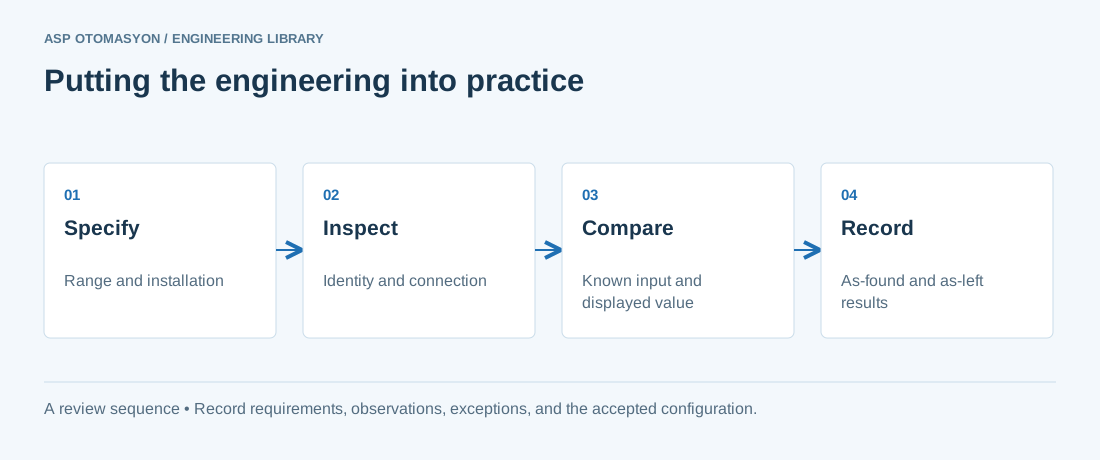
- Confirm the instrument tag, range, engineering unit, process connection, and environmental suitability against approved documents.
- Check the complete measurement chain, including sensor configuration, channel scaling, quality indication, and display units.
- Record reference equipment, uncertainty where relevant, test points, deviations, and the final configuration.
Follow an ASP project guide to connect the fundamentals with implementation and acceptance.
Primary references and further reading
Use the original specifications and product documentation for implementation details. The examples in this guide are illustrative engineering scenarios, not published project results.