
Water is the most used raw material in pharmaceutical manufacturing — and the most regulated. Purified Water (PW) and Water for Injection (WFI) systems must deliver a defined quality continuously, and that quality must be proven: monitored, recorded, and validated. Water system automation is therefore a specialist discipline combining continuous process control (generation), distribution control (loops, pressures, temperatures), and GMP data integrity (monitoring, alarms, audit trails) — with the understanding that a water system failure stops production.
Water Quality Grades
| Grade | Production method (typical) | Quality drivers |
|---|---|---|
| Purified Water (PW) | Reverse osmosis (RO) + electrodeionization (EDI), or distillation | Conductivity, TOC, bioburden, endotoxins (limit depends on use) |
| Water for Injection (WFI) | Distillation (multi-effect stills) or membrane-based systems (per EMA 2017 revision), stored hot (65–80 °C) | All PW plus endotoxins; storage at temperature prevents biofilm |
| Clean/hot water | Potable water polished as needed | Per local pharmacopoeia |
Generation quality is only half the story: the distribution system (storage tank, circulation loop, pumps, and the user points) is where contamination happens — the loop design (turbulent flow, no dead legs, hot storage) is the real engineering.
Automation Scope
- Generation control — RO train sequencing (membrane protection, pressure and flow control), EDI current control, still operation (feed, level, temperature, blowdown), and the quality interlocks: a train that cannot meet quality is switched out, not throttled down.
- Distribution control — storage tank level and temperature control, loop recirculation pump control (constant flow/turbulence), loop temperature (hot loops), and pressure maintenance; user-point flush and sampling sequences.
- Monitoring and alarm — continuous conductivity and temperature per USP/EP limits (online meters with alarm and automated rejection), TOC monitoring, and the alarm philosophy that a quality alarm is a process event: logged, visible, and recorded with the batch evidence.
- Sanitization — ozone generation/destruction for PW loops, hot-water sanitization sequences (temperature hold profiles with proof), and steam sanitization of WFI loops — all automated sequences with validated parameters and full records.
Data Integrity and Validation
The water system's data is GMP evidence: the batch uses the water, so the water quality at the time of use is part of the batch record. The automation must therefore satisfy the data integrity requirements (21 CFR Part 11 / Annex 11, ALCOA+):
- Continuous recording of quality parameters with timestamps, alarms and excursions logged with user accountability.
- Access control and audit trails on the control system itself (who changed the setpoint, when, why — with the change control record).
- Validation per GAMP: IQ/OQ/PQ covering the control functions, alarms, sequences, and the monitoring records; the PQ (typically 1–2 years of intensive monitoring) is the water system's acceptance.
- The monitoring data feeds the quality system: trend reviews, excursion investigations, and the annual quality review — the automation historian is the source.
Operational Discipline
- Alarm management as quality — water system alarms (conductivity, temperature, pressure) are GMP-relevant: their rationalization, priority, and response follow the same discipline as process alarms (see the alarm management article) — a conductivity alarm that nobody answers is a regulatory finding waiting.
- Preventive maintenance — RO membranes, EDI stacks, stills, and pumps have service lives; the automation records the run hours and the performance trends (membrane differential pressure, conductivity drift) that trigger the service — condition-based maintenance in its best form.
- Change control — any change to the water system (software, sequence, setpoint ranges, hardware) is a validated change; the automation engineer works within the pharmaceutical change process (see the pharma article).
- Utilities integration — the water system is part of the site utilities: the boiler feed, the clean steam, and the HVAC interplay; the energy monitoring follows the utility patterns (see the utilities article) — WFI is expensive to make and expensive to keep hot.
Summary
Pharmaceutical water systems are continuous control plus GMP evidence: generation and distribution automation with quality interlocks, validated sanitization sequences, continuous quality monitoring with proper alarm management, and full data integrity from sensor to batch record. The automation is the system's memory and its proof — designed, validated, and operated as such. Water is the invisible raw material; its automation is the invisible quality system behind every batch.
Apply this to your project
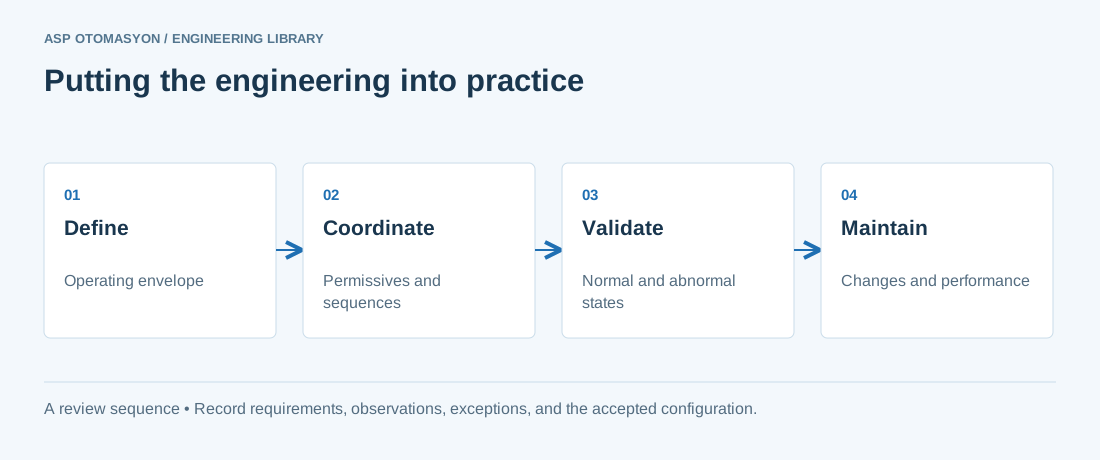
- Record process boundaries, required operating states, and interactions with independent protective systems.
- Check instrument quality, control authority, permissives, and operator responsibilities during state changes.
- Agree how tests, deviations, and configuration changes will be recorded within the facility's engineering procedures.
Follow an ASP project guide to connect the fundamentals with implementation and acceptance.
Primary references and further reading
Use the original specifications and product documentation for implementation details. The examples in this guide are illustrative engineering scenarios, not published project results.