
HART (Highway Addressable Remote Transducer) is the world's most widely deployed industrial fieldbus — and its genius is that it does not look like one: the digital communication rides on the 4–20 mA analog signal (frequency-shift keying on the loop, without disturbing it), so every existing analog installation becomes a digital network by adding a communicator. With over 40 million devices installed, HART is the process industry's diagnostic backbone: the 4–20 mA drives the control, and the digital layer carries the configuration, calibration, and health data. This article covers the protocol and the device management ecosystem (DD/EDDL, FDT/DTM, and the field device tools) that makes it usable.
How HART Works
- The physical layer — a 1 mA peak-to-peak FSK (Bell 202) sine wave superimposed on the 4–20 mA loop at 1,200/2,200 Hz; the control system sees a clean analog signal, the HART master sees the digital data. Both directions: the master addresses the device, the device responds — with the loop current unchanged.
- Masters — a primary master (the control system's HART interface or a dedicated multiplexer) and secondary masters (handheld communicators, USB modems); the protocol arbitrates between them (secondary masters yield).
- The data — the device's variables: the primary variable (PV) drives the loop, plus up to three secondary variables (SV, TV, QV); the device status (health, diagnostics), configuration parameters, and the device's tag and identity.
- Multidrop (rarely used) — up to 63 devices on one pair at fixed loop current; the classic analog signal is lost, so multidrop is used only where the digital data is everything.
What HART Delivers in Practice
- Configuration without opening the loop — range, units, damping, and linearization set digitally from the control room; no loop interruption, no calibration compromise.
- Diagnostics — the device's self-diagnostics (electronics, sensor, memory) reported as status: the transmitter tells you it is failing before the reading lies (see the smart transmitter article for the application).
- Digital calibration — trim procedures executed digitally (the analog output trim, the sensor trim) with the calibration record.
- Asset management — the device's condition, configuration, and history collected by a device management system — the raw material of predictive maintenance (see the maintenance strategies article).
The Device Description Ecosystem
The HART device's digital interface is described by its device description — the file that tells the host how to present the device's parameters. Three technologies coexist:
- DD (Device Description) / EDDL (Electronic Device Description Language, IEC 61804) — the classic, standardized description: parameters, menus, and validation rules rendered by the host; EDDL is the common denominator, supported by every major host and mandatory in many.
- FDT/DTM (IEC 62453) — the frame-and-module model: the host is the FDT frame; each device gets a DTM (a software module) providing the full vendor user interface — including wizards, graphics, and tools the EDDL cannot express. The DTM runs in the frame (PACTware, the asset management systems, or the calibration tools).
- FDI (Field Device Integration, IEC 62769) — the modern convergence of EDDL and FDT: one package (the FDI Device Package) that works in both worlds; the standard for new device integration across HART, PROFIBUS, FOUNDATION Fieldbus, and PROFINET.
The integration reality: the plant's hosts (the DCS's asset management, the AMS-style tool, the handheld) must support the device's description — the device's digital personality is only as good as the host's file library. Keep the descriptions updated (new device revisions ship new files) and validate the host support at procurement (see the OPC UA testing article for the same principle in the UA world).
Deploying HART in the Plant
- Decide the host architecture — a device management system (DMS) connected via the control system's HART multiplexers or fieldbus gateways, or via the plant's asset management integration; the DMS is the plant's device health console.
- Standardize the device configuration — a configuration standard per device type (range, damping, alarms, tag format) applied at commissioning; the device register (tag, serial, configuration, revision) is maintained (see the data sheet and asset inventory articles).
- Enable the diagnostics flow — device status and alarms routed to the maintenance workflow: the DMS's alert list is triaged like any alarm list (see the alarm management article), and the device health trends feed the maintenance planning.
- Protect the loop — the HART digital layer is part of the control loop's wiring: the loop integrity (see the wiring article) and the Ex i barrier compatibility (see the hazardous area article) apply unchanged.
- Security — device access (writing configuration) is controlled: the HART write-protect on the device, the DMS's user roles, and the audit trail — a field device is an endpoint on the plant's data network (see the cybersecurity articles).
Summary
HART turns every 4–20 mA loop into a digital asset: configuration, diagnostics, and calibration data ride on the analog signal, and the device management ecosystem (EDDL, FDT/DTM, FDI) makes the data usable across hosts. Deploy with a device management host, standardize the configuration, flow the diagnostics into maintenance, and protect the devices like the endpoints they are. The 4–20 mA loop is the plant's oldest network — HART made it the newest.
Apply this to your project
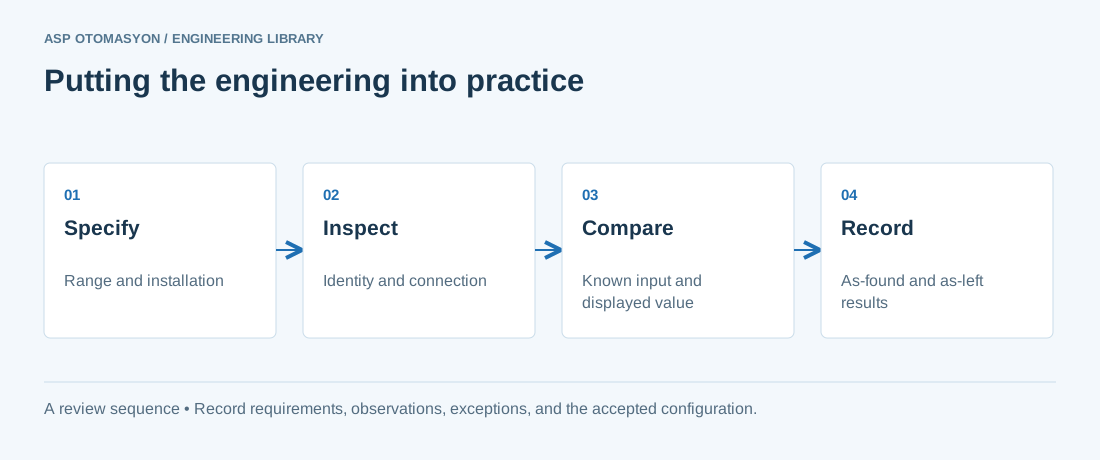
- Confirm the instrument tag, range, engineering unit, process connection, and environmental suitability against approved documents.
- Check the complete measurement chain, including sensor configuration, channel scaling, quality indication, and display units.
- Record reference equipment, uncertainty where relevant, test points, deviations, and the final configuration.
Follow an ASP project guide to connect the fundamentals with implementation and acceptance.
Primary references and further reading
Use the original specifications and product documentation for implementation details. The examples in this guide are illustrative engineering scenarios, not published project results.