
Brewing combines biology and engineering: a live fermentation that must be controlled, not commanded; a process where the quality is decided by temperature, time, and hygiene; and a packaging hall running at hundreds of containers per minute. Brewery automation spans the classic ISA-88 batch world (recipes, phases, electronic batch records) for the process side and high-speed machine automation for packaging — a combination that makes breweries a rich automation domain, from craft scale to industrial scale.
The Process Side: Brewhouse and Cellar
The brewhouse is batch automation in its purest form:
- Milling and mashing — grain handling (silo management, weighing), mash mixing with temperature steps (protein rest, saccharification) per recipe; the mashing profile is the recipe's first act.
- Lautering — the mash filtration: automated raking sequences and runoff control; wort clarity and extraction efficiency depend on the sequence discipline.
- Boiling and whirlpool — kettle boiling with hop additions at timed steps (the addition sequence is recipe-controlled), evaporation control, and the whirlpool rest.
- Cooling and fermentation — wort cooling (plate heat exchanger with exact temperature control to the pitching temperature), yeast pitching (dosing, propagation, viability monitoring), and fermentation: temperature profiles per beer style, pressure control (CCTs), and gravity tracking. The fermentation control is the quality center: a few degrees over the profile changes the beer.
- Maturation and filtration — cold storage, diacetyl rest scheduling, filtration (kieselguhr/membrane) with turbidity monitoring, and carbonation control.
The automation is ISA-88 throughout: recipes (per beer), equipment phases (fill, heat, rest, transfer), and complete batch records — the brew log that quality and regulatory reporting need.
Cellar and Utilities
- CIP (clean-in-place) — the hygiene backbone: automated CIP skids with recipe-driven sequences (pre-rinse, caustic, acid, sanitizer, final rinse) and proof parameters (temperature, conductivity, flow); a CIP sequence that completes without proof is a contamination risk (see the CIP article).
- Utilities — steam for the brewhouse, cooling (glycol) for fermentation and cellar, CO₂ recovery and management; the energy systems follow the utility automation patterns (see the utilities article) with brewery specifics (refrigeration is the biggest electricity consumer).
- Liquid transfer — the tank farm logic: tank allocation, product routing (dedicated lines vs shared), and the transfer validation that prevents mixing different beers.
Packaging: High-Speed Machine Automation
The packaging hall is machine automation at speed: bottle/can filling (the filler is the pacemaker), pasteurization (tunnel pasteurizer with PU (pasteurization unit) control — the process safety of beer), labelling, packing, and palletizing. Characteristics:
- Line integration — the filler, pasteurizer, labeller, and packer run as one coordinated line: speed matching, buffer control (accumulators), and changeover sequencing (the changeover from one format to another is a choreographed sequence).
- OEE discipline — packaging lines live by OEE (see the OEE article): the line's stop reasons, speeds, and quality losses are recorded automatically (filler stops, labeller jams, format changes) and reviewed daily.
- Vision and inspection — empty-bottle inspection, fill level, cap/closure verification, label inspection, and foreign-object detection (see the machine vision article).
- Tracking and traceability — batch/date coding, and the lot traceability connecting packaging to the cellar batch (see the traceability discussion in the supply chain article).
Automation Architecture
A modern brewery runs: DCS/PLC for process (batch-enabled), PLCs with motion for packaging, SCADA/MES at the supervision layer (batch records, OEE, reporting), and the ERP for planning. The integration follows ISA-95: recipes and orders down, batch records and performance up. The historian is the brewery's memory — every batch's temperature profile is retrievable years later (a quality complaint investigation is a historian query, not a memory).
Summary
Brewery automation is two disciplines in one plant: ISA-88 batch automation for brewhouse and cellar (recipes, phases, CIP, batch records — the quality is in the profile), and high-speed integrated machine automation for packaging (filler-paced lines, OEE, vision inspection). The connecting tissue is hygiene, traceability, and the historian. Brewing is biology under control — and control is what automation provides, from grain silo to palletizer.
Apply this to your project
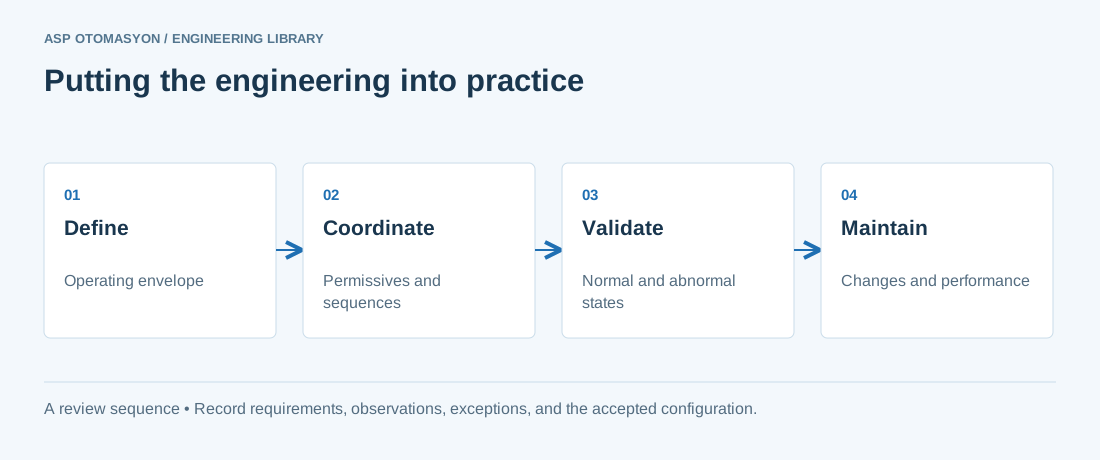
- Record process boundaries, required operating states, and interactions with independent protective systems.
- Check instrument quality, control authority, permissives, and operator responsibilities during state changes.
- Agree how tests, deviations, and configuration changes will be recorded within the facility's engineering procedures.
Follow an ASP project guide to connect the fundamentals with implementation and acceptance.
Primary references and further reading
Use the original specifications and product documentation for implementation details. The examples in this guide are illustrative engineering scenarios, not published project results.