
Packaging line automation integrates filling, closing, labeling, coding, and cartoning machines into one coordinated system that turns bulk product into shippable packages. Packaging is often the last step before revenue, which makes line reliability and changeover speed business-critical. This article covers the machine functions, the integration architecture, and the automation practices that make packaging lines fast, flexible, and dependable.
The Line Functions
A packaging line typically combines several machine types, each with its own controller:
| Station | Function | Typical automation |
|---|---|---|
| Unscrambler / de-palletizer | Feed containers into the line | Conveyor control, sensors, infeed gating |
| Filler / depositor | Dose product (liquid, powder, solid) | Servo-driven dosing, weight/level check |
| Sealer / capper / closer | Close the container | Torque control, temperature control (sealing) |
| Labeler / printer | Apply labels and codes | Registration control, code verification (OCR/OVR) |
| Checkweigher / metal detector | Quality verification | Reject logic, data logging |
| Cartoner / wrapper / case packer | Secondary packaging | Servo motion, machine synchronization |
| Palletizer | Build pallets | Pattern control, layer handling |
Line Integration Architecture
A modern line is a network of machines coordinated at three levels:
Line management (MES / line SCADA: recipes, OEE, traceability)
        │
        ▼
Line controller (line PLC / coordinator: sync, buffering, reject logic)
        │
        ▼
Machine controllers (PLC per machine: filling, capping, labeling, cartoning)
- Machine level: each machine runs its own PLC with motion control (servos, cam profiles) and its own operator panel.
- Line level: a line coordinator manages product flow — infeed/outfeed speeds, buffer sections, stop/restart logic, and reject decisions — so a brief stop at one machine does not stop the whole line.
- Management level: the line exchanges production data (counts, rejects, OEE, batch/lot, serials) with the MES or ERP (see the MES integration article).
Key Automation Concepts
Machine synchronization and buffering
Machines run at slightly different speeds; buffer conveyors absorb the difference. The coordinator modulates machine speeds to keep buffers within range — slowing the filler when the cartoner is momentarily slower, rather than stopping it. This "speed-based flow control" is what separates a smooth line from a stop-and-go line.
Changeover
Changeover (format change) is where productivity is won or lost. Modern approaches:
- Recipe-based changeover: servo positions, temperatures, and speeds load from a recipe per product/format.
- Automatic format adjustment: motorized guides and servo tooling that reposition without tools.
- Single-Minute Exchange of Die (SMED) methodology: move changeover work outside the stopped machine and parallelize tasks.
Reject and quality logic
Checkweighers, metal detectors, and vision systems send reject signals; the coordinator must track the exact product (via photo-eyes and encoder counts) so the right unit is rejected downstream — not its neighbor. Reject data feeds quality reports and OEE.
OEE as the line KPI
Overall Equipment Effectiveness (availability × performance × quality) is the standard line metric. The coordinator or MES computes OEE from line stops, actual speed vs. ideal, and good vs. total output. See the OEE implementation article for methodology.
Communication and Standards
- Machine-to-line: OPC UA is increasingly used for packaging machine data exchange; PackML (ISA-TR88.00.02) standardizes machine state models (Stopped, Starting, Idle, Execute, Held, etc.) and tag naming so different vendors' machines integrate uniformly.
- Line-to-MES: OPC UA, REST, or MQTT for production data; the information model should reflect the line structure (machines, stations, product).
- Safety: light curtains, interlocks, and e-stops on each machine, with safety-rated control; safe stop categories per ISO 13849 / IEC 62061.
Operational Practices
- Monitor and trend line stops: classify stops (machine fault, jam, changeover, material shortage) and attack the top causes; trend data beats opinions.
- Preventive maintenance on the bottleneck: the slowest machine governs line rate; schedule maintenance around it.
- Recipe and format control: version recipes; a wrong format load can crash machines or produce bad packs.
- Traceability data: record batch/lot, timestamps, and quality results per package or carton where required (food, pharma).
- Training: operators need quick fault recovery (jam clearing, sensor adjustment); engineers need changeover and recipe skills.
Common Pitfalls
- Islands of automation: machines with no line coordination produce buffers full, empty lines, and hidden downtime.
- No buffer design: the line is only as smooth as its buffer sections; design buffer capacity for the expected stop frequency.
- Reject tracking errors: mis-timed rejects cause good product in the reject bin and bad product in the case.
- Over-automating changeover: complex automatic changeover that is rarely reliable can be slower than a well-practiced manual one; validate the economics.
- Ignoring the human-machine interface: poor alarm and fault messages on machine panels convert recoverable jams into long stops.
Summary
Packaging line automation is about flow: synchronized machines, intelligent buffering, fast changeover, and reliable reject handling, all measured by OEE. Build the line architecture in three levels (machine, line, management), adopt standards like PackML and OPC UA for integration, and manage the line with stop classification and trend data. The reward is a line that runs at its design rate, changeover after changeover.
Apply this to your project
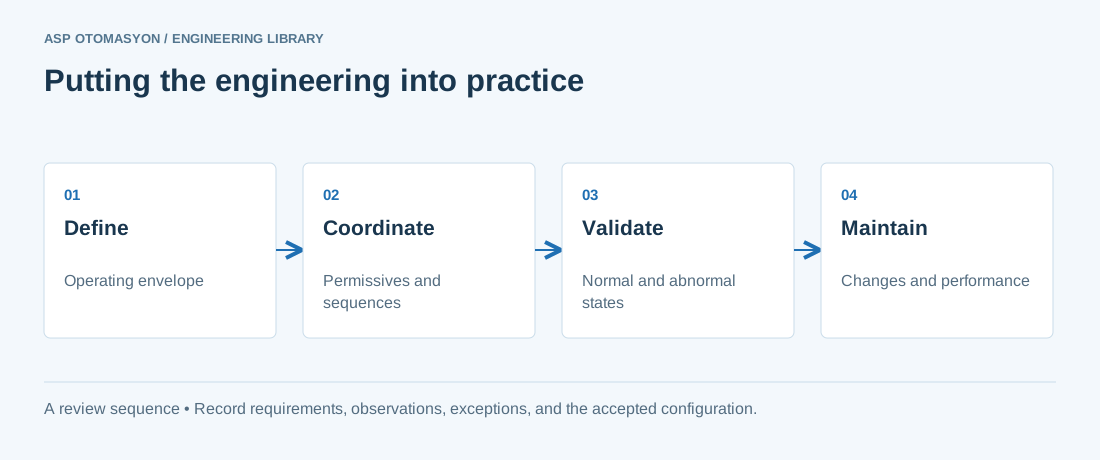
- Record process boundaries, required operating states, and interactions with independent protective systems.
- Check instrument quality, control authority, permissives, and operator responsibilities during state changes.
- Agree how tests, deviations, and configuration changes will be recorded within the facility's engineering procedures.
Follow an ASP project guide to connect the fundamentals with implementation and acceptance.
Primary references and further reading
Use the original specifications and product documentation for implementation details. The examples in this guide are illustrative engineering scenarios, not published project results.