
In atmospheres that can explode — refineries, chemical plants, gas facilities, fuel storage — the instruments themselves must not become the ignition source. Hazardous area instrumentation is the discipline of classifying the risk and selecting the equipment and wiring methods that make instrumentation safe: the zone/division classification, the protection concepts (Ex d, Ex i, Ex e, Ex n…), and the installation rules that keep them valid. It is a legal and safety-critical field — the markings on the nameplate are a certification, not a decoration.
Classification: Zones, Groups, Temperature Classes
The risk is classified in three dimensions:
- Zones (IEC/ATEX) or Divisions (NEC) — how often the explosive atmosphere is present: Zone 0/Div 1 (continuously or often), Zone 1 (occasionally in normal operation), Zone 2 (rarely, briefly); gases (Zone) and dusts (Zone 20/21/22) are classified separately.
- Gas groups — the ease of ignition: Group I (mining), IIA (propane-like), IIB (ethylene-like), IIC (hydrogen/acetylene — the easiest to ignite); the equipment's group must cover the atmosphere's group.
- Temperature class — the maximum surface temperature the equipment may reach: T1 (450 °C) through T6 (85 °C); the class must stay below the atmosphere's ignition temperature.
The zone drawings (the classification documents) are the starting point of every instrument selection — an instrument is chosen for its location, not for the plant in general.
The Protection Concepts
| Concept | Marking | Principle | Typical use |
|---|---|---|---|
| Flameproof | Ex d | The enclosure contains the explosion and quenches the flame through gap clearances. | Enclosures, junction boxes, motors in Zone 1; heavy, needs proper flame paths (no damage, no painting over). |
| Intrinsic safety | Ex i (ia, ib, ic) | The energy in the circuit is limited below the ignition threshold — by design, including fault conditions. | The dominant concept for instrumentation: transmitters, sensors, HART loops — light, safe, and live-maintainable (ia in Zone 0). |
| Increased safety | Ex e | No arcs/sparks by construction, with enhanced insulation and protection. | Terminals, junction boxes, some motors in Zone 1/2. |
| Non-sparking / restricted | Ex nA / Ex nC | No arcs in normal operation; limited energy variants. | Zone 2 equipment — the economic choice where the risk is rare. |
| Encapsulation, oil immersion, pressurization | Ex m, Ex o, Ex p | The ignition source is isolated (encapsulated, submerged, or pressurized). | Specific equipment: sensors (m), switches (o), large enclosures and analyzers (p). |
Each concept has its own installation rules: Ex d flame paths must never be damaged; Ex i circuits need the certified barriers/isolators and the wiring segregation; the concept is not just the device — it is the device plus its wiring per the standard (IEC 60079 series).
Intrinsic Safety in Practice
Intrinsic safety (Ex i) is the instrumentation workhorse, and its engineering is the loop: the field device (Ex i rated), the cable (with defined parameters: capacitance and inductance limits), and the barrier/isolator (the energy limiter at the safe-area side, or the isolator that also provides the galvanic separation). The rules:
- The loop's entity parameters (Ci, Li of the device; Cc, Lc of the cable) must be within the barrier's limits (Co, Lo) — the calculation is part of the loop documentation.
- Only certified Ex i components and certified combinations (where the standard requires) are used; the barrier's blue marking identifies the intrinsic-safety boundary.
- Ex i wiring is identified (blue) and segregated from non-Ex wiring; the installation inspection verifies it.
- HART and fieldbus operate through Ex i barriers/isolators — the digital communications (see the HART article) do not change the energy limit, they ride on it.
Installation, Inspection, and Documentation
Hazardous area installations are inspected (initial, periodic, and after modifications — per IEC 60079-17): the markings, the cable entries (glands with the right Ex rating, never drilled holes), the earthing, the segregation, and the flame paths. The documentation set — the area classification drawings, the equipment schedule (every device with its Ex marking and its loop), the barrier calculations, and the inspection records — is a legal record: the plant's hazardous area dossier is examined by the authorities and the insurers, and it is the first evidence in any incident investigation.
Summary
Hazardous area instrumentation is classification-driven selection and installation: the zones define the required protection concept (Ex d, Ex i, Ex e, Ex n), the gas group and temperature class define the equipment's marking, and the wiring rules make the concept real. Intrinsic safety with certified barriers is the instrumentation standard; the loop parameters, the segregation, and the inspection records are the discipline. The Ex marking is a promise to the plant — keep it valid, or the atmosphere will collect.
Apply this to your project
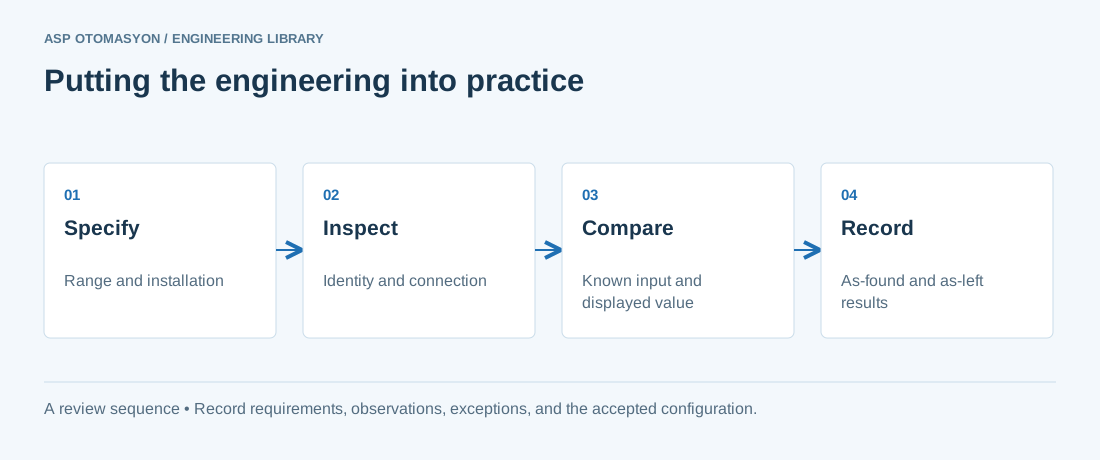
- Confirm the instrument tag, range, engineering unit, process connection, and environmental suitability against approved documents.
- Check the complete measurement chain, including sensor configuration, channel scaling, quality indication, and display units.
- Record reference equipment, uncertainty where relevant, test points, deviations, and the final configuration.
Follow an ASP project guide to connect the fundamentals with implementation and acceptance.
Primary references and further reading
Use the original specifications and product documentation for implementation details. The examples in this guide are illustrative engineering scenarios, not published project results.