
Manufacturing faces a triple pressure: customers and regulators demanding supply chain decarbonization, carbon pricing making emissions a cost, and energy prices making efficiency a profit. Net zero — balancing emissions with removals — is the far goal; the near goal is decarbonization: systematically reducing the plant's greenhouse gas (GHG) footprint along a credible, measured path. This article covers the strategy, the accounting, and the levers an industrial plant actually has.
The Accounting: Scope 1, 2, 3
GHG accounting (GHG Protocol / ISO 14064) structures the problem:
- Scope 1 — direct emissions from owned sources: fuel burned on site (boilers, furnaces, vehicles), process emissions (chemistry), refrigerant leaks.
- Scope 2 — indirect emissions from purchased energy: electricity, steam, heat bought from the grid (accounted at the grid's emission factor).
- Scope 3 — everything else in the value chain: purchased materials, logistics, product use, and end of life. For manufacturers, Scope 3 is usually the largest share — and the hardest to measure (it requires supplier data).
Decarbonization strategy starts with the inventory: the emissions baseline, by scope and by source, with the methodology documented. Most industrial programs start Scope 1+2 (the plant's own) and extend to Scope 3 as suppliers and customers demand it.
The Decarbonization Levers
The levers, in the order they are usually pulled:
| Lever | What it is | Notes |
|---|---|---|
| Energy efficiency | Reduce energy per unit of output (SEC) — every kWh saved is emissions saved. | The first and best lever: negative-cost emissions reduction; the entire energy management toolkit applies. |
| Electrification | Replace fossil-fired processes with electric alternatives (heat pumps, electric boilers, induction heating, electric vehicles). | Value depends on the grid's emission factor — electrification is decarbonization only if the grid is decarbonizing. |
| Renewables | On-site generation (solar, wind, CHP with renewable fuel) and green power purchase agreements (PPAs). | On-site solar is the common first step; PPAs shift the accounting without changing the physical flow. |
| Fuel switching | Natural gas → biogas/bioenergy, hydrogen-ready equipment, or electrification. | Technology-dependent; hydrogen for high-temperature industrial heat is emerging, not yet standard. |
| Process and material efficiency | Reduce material intensity, recycle process streams, capture and reuse heat and CO₂. | The most innovative lever — where the engineers add real value. |
| Removals and offsets | For the residual: verified removals or offsets. | Last, and audited carefully — offset quality and claims are heavily scrutinized. |
Building the Roadmap
- Baseline inventory — Scopes 1+2 measured and documented (and Scope 3 scoped) — the map before the journey.
- Targets — science-aligned targets (SBTi-style) or customer-aligned ones: absolute reduction and intensity reduction, with base year and milestones.
- Abatement cost curve — every measure with its cost per ton CO₂e avoided: efficiency measures often negative cost; solar and PPAs near grid parity; electrification and fuel switching depending on the specific site. The curve is the strategy — it says what to do first.
- Implementation plan — measures ranked by the curve, financed, and executed with the same project discipline as any capital program (the energy management system tracks the results).
- Verification and reporting — annual emissions report, verified where required (ISO 14064-3 or the customer's requirements); the report is also the marketing and tendering asset — customers increasingly select on supply chain carbon.
The Automation Angle
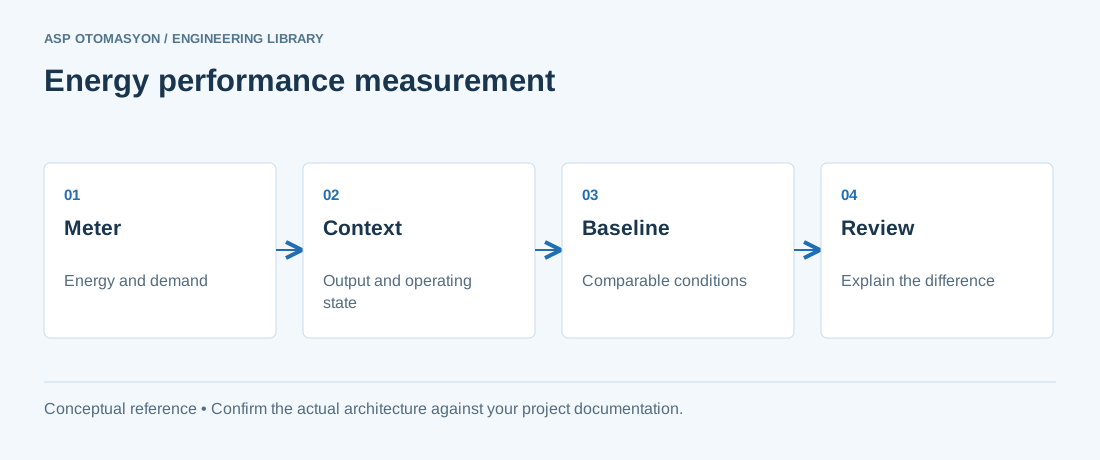
Decarbonization is data work: the plant's emissions are computed from its energy and production data. The automation stack contributes directly: energy metering and EMS (Scope 2 accuracy), production data for intensity metrics (SEC), condition monitoring for process efficiency, and the control systems that execute the efficiency measures. The emissions dashboard (energy × factors, per area, per product) is a natural extension of the plant's energy monitoring — and the credibility of the whole program rests on the quality of this data.
Common Mistakes
- Offsets before abatement — buying offsets to claim net zero while the plant's own emissions stay high; the credible path is abatement first, offsets for the residual only.
- Bad baselines — a baseline year chosen for convenience; the baseline must be representative and documented.
- Greenwashing by accounting — changing emission factors or boundaries to improve the number; auditors and customers catch it, and the reputational cost exceeds any benefit.
- Ignoring the grid — electrification without grid decarbonization shifts emissions rather than reducing them; the strategy tracks the grid's factor and its trajectory.
- No owner — decarbonization without a named program owner and quarterly review is a slide deck.
Summary
Manufacturing decarbonization is a measured, prioritized program: GHG inventory (Scopes 1–3), targets, an abatement cost curve, execution, and verified reporting. The levers are efficiency first, then electrification, renewables, fuel switching, and process innovation — with removals only for the residual. The plant's data infrastructure (energy metering, SEC, EMS) is the program's foundation, and the automation team is its natural operator. Net zero is a destination; decarbonization is the engineering.
Apply this to your project
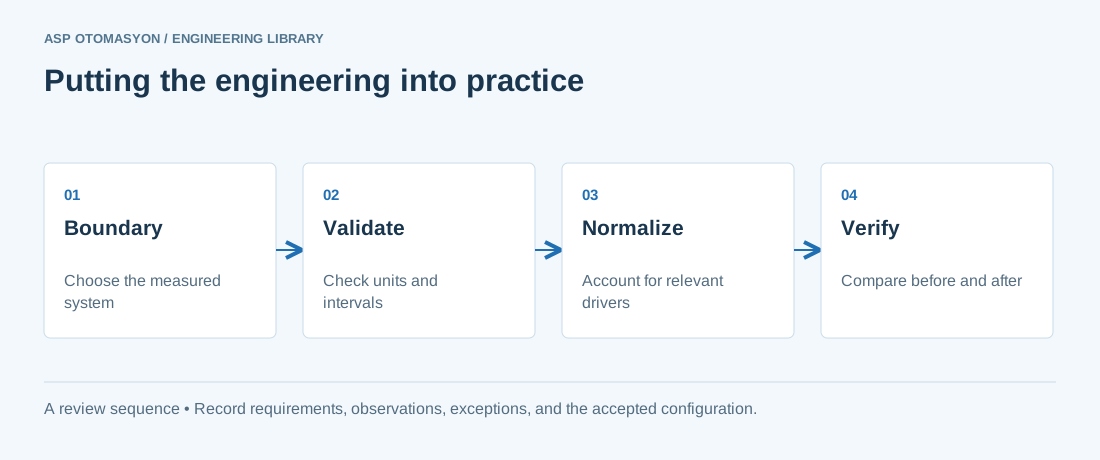
- Define the measurement boundary, meter ratios, units, time interval, and treatment of missing or reset readings.
- Capture production quantity, operating hours, and other relevant drivers alongside energy use.
- State the baseline and normalization assumptions when reporting a change; separate measured results from estimates.
Follow an ASP project guide to connect the fundamentals with implementation and acceptance.
Primary references and further reading
Use the original specifications and product documentation for implementation details. The examples in this guide are illustrative engineering scenarios, not published project results.