
Demand response (DR) and load shedding let an industrial facility control its electricity consumption in response to grid conditions, price signals, or its own constraints. Done well, they turn the electrical load from a passive cost into a managed resource: the plant can earn revenue or avoid penalties by reducing load when the grid is stressed, and it can protect critical processes automatically when supply is short. This article explains the concepts, the automation architecture, and how to design a load-shedding system that never compromises safety.
Two Related Concepts
| Concept | Trigger | Goal |
|---|---|---|
| Demand response | Price signals, grid operator requests, peak-demand periods | Reduce consumption to save money or earn program payments |
| Load shedding | Supply loss, under-frequency, plant generation failure, demand exceeding a limit | Keep critical loads running by shedding non-critical ones |
Both reduce load; the difference is the trigger and the urgency. Demand response is typically planned and economic; load shedding is often automatic and must act in seconds.
Demand Response Programs
Industrial facilities can participate in several ways:
- Price-based DR: shift consumption away from high-price periods (time-of-use tariffs, real-time pricing) — e.g., scheduling batch processes or energy-intensive steps to off-peak hours.
- Incentive-based DR: contracts with a grid operator or aggregator to reduce load by a committed amount when called, often with penalties for non-performance.
- Capacity / peak-demand management: limit the facility's maximum demand (kW) to avoid demand charges and transformer overloads.
- Frequency response: fast, automatic load reductions (or increases) to help stabilize grid frequency; requires automation with response times of seconds.
The business case depends on the local market rules, tariffs, and the facility's ability to shift or shed load without hurting production. An energy audit and a load profile analysis (see the Energy Monitoring article) are the starting point.
Load Shedding Fundamentals
Load shedding is a protection function: when available power is less than connected load, someone must decide what stays on. The classic use is a facility with limited import capacity or on-site generation (co-generation, emergency generators, renewable microgrids). Shedding must:
- Prioritize: define load classes — critical (safety systems, control systems, essential process equipment), semi-critical (main production), and sheddable (non-essential utilities, heating, some HVAC).
- Act fast: under-frequency or overload conditions require shedding within milliseconds to seconds, faster than any operator.
- Be automatic and testable: the shedding logic must be proven by test, not trusted because it is documented.
- Restore safely: after the event, loads are reconnected in a controlled sequence that respects process requirements — not all at once.
Automation Architecture
Grid / generation status (frequency, import power)
        │
        ▼
Power management controller / PLC (load-shed logic)
        │  (fast, deterministic, tested)
        ▼
Shedding actuators: breaker trips, drive speed reduction, load block
        │
        ▼
Reconnection logic (operator-assisted or automatic, sequenced)
Key components:
- Measurement: revenue-grade meters and frequency relays on the incoming supply and main feeders.
- Decision logic: a dedicated controller or PLC with hard-coded priority tables, configured via a protected interface.
- Execution: trip outputs to breakers or contactors, or speed reductions on large drives (VFDs can shed load by ramping down without stopping).
- Integration: status into the SCADA/DCS for visibility and event logging; alarms for every shed event.
Design Principles
- Safety first: safety systems and controls are never shed; shedding starts with the loads that are safest to interrupt.
- Determinism: the shedding order is fixed, documented, and tested — not decided ad hoc during an event.
- No single point of failure: the shed controller needs its own power supply and, ideally, a redundant path; its failure must fail safe (shed rather than risk overload).
- Operator visibility: operators see the shed state, what was shed, and the restoration plan.
- Simulation and testing: test the full sequence (simulated under-frequency, simulated import overload) during shutdowns; log the results.
Operational Integration with Energy Management
Demand response and load shedding should sit on top of the facility's energy management system:
- Real-time load monitoring identifies the sheddable capacity at any moment.
- Historical data (historian) supports DR program bidding and post-event reporting.
- Alarm and event logs document every DR event for settlement and audit.
- An ISO 50001-aligned process (see ISO 50001) keeps the load-shedding priorities reviewed as the plant changes.
Common Pitfalls
- Untested logic. A load-shed scheme that has never been exercised will misbehave exactly when needed.
- Stale priorities. The shed table must be reviewed whenever processes change; a "sheddable" load that is now critical is a production incident waiting to happen.
- Forgetting restoration. Shedding is only half the story; a poor reconnection sequence can cause process trips or a second overload.
- Ignoring motor inrush. Reconnecting large motors at once can exceed the import limit again; stagger restoration.
- DR overcommitment. Bidding load you cannot actually shed risks penalties; verify real sheddable capacity with tests.
Summary
Demand response and load shedding turn electricity consumption into a controllable resource. Build them on measurement and a clear load priority structure, automate the shedding with fast deterministic logic, test it, and integrate the results into the energy management and SCADA layers. The facility then responds to price signals for profit and to supply events for protection — automatically, safely, and provably.
Apply this to your project
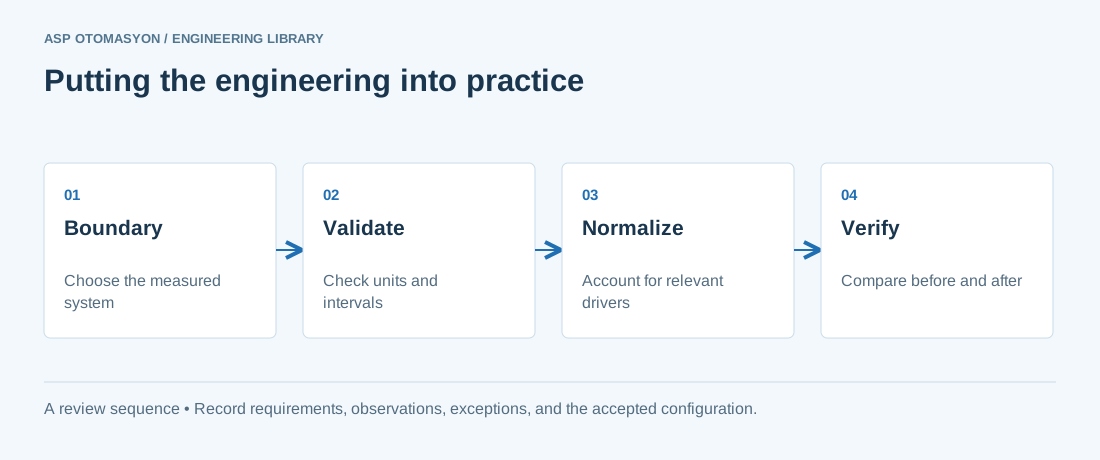
- Define the measurement boundary, meter ratios, units, time interval, and treatment of missing or reset readings.
- Capture production quantity, operating hours, and other relevant drivers alongside energy use.
- State the baseline and normalization assumptions when reporting a change; separate measured results from estimates.
Follow an ASP project guide to connect the fundamentals with implementation and acceptance.
Primary references and further reading
Use the original specifications and product documentation for implementation details. The examples in this guide are illustrative engineering scenarios, not published project results.