
ISO 50001 is the international standard for energy management systems (EnMS). It provides a framework — built on the Plan-Do-Check-Act cycle — that organizations use to continuously improve energy performance: reduce consumption, cut cost, and lower emissions, all while keeping production output unchanged or growing. For industrial facilities, where energy is often the second-largest cost after materials, ISO 50001 turns energy management from a set of ad-hoc projects into a managed, measurable system.
What ISO 50001 Is
ISO 50001 specifies requirements for establishing, implementing, maintaining, and improving an energy management system. Its scope is the organization's energy performance — energy efficiency, energy use, and energy consumption — and it applies to any organization regardless of size or sector. The current edition is ISO 50001:2018, which follows the same high-level structure (clauses 4–10) as other management system standards such as ISO 9001 and ISO 14001, making integration straightforward.
Core Concepts
| Concept | Meaning |
|---|---|
| Energy performance indicator (EnPI) | A measurable value of energy performance, e.g., kWh per tonne of product, kWh per unit produced |
| Energy baseline (EnB) | The reference value(s) of the EnPI used to measure improvement over time |
| Significant energy use (SEU) | Equipment, systems, or processes with substantial energy consumption and/or significant improvement potential |
| Energy review | The analysis of energy use and consumption that identifies SEUs and opportunities |
| Energy performance improvement | The measurable result of energy performance compared to the baseline |
The Energy Review
The energy review is the technical heart of the standard. It involves:
- Analyzing energy use: measure and understand where energy is consumed — by process, equipment, utility (electricity, gas, steam, compressed air), and time.
- Identifying significant energy uses: the systems that matter most (e.g., kilns, compressors, chillers, furnaces, motors).
- Identifying variables: the factors that affect energy use — production rate, weather, product mix, season.
- Determining energy performance: establish EnPIs and the baseline for each SEU.
- Identifying opportunities: prioritize improvement actions by impact and feasibility.
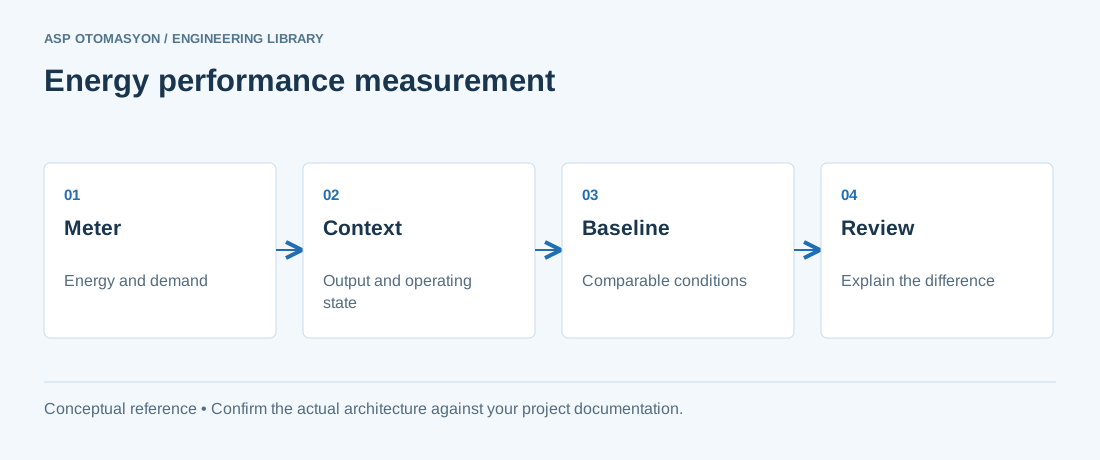
For an industrial plant, the review often starts with a utility balance: how much electricity, gas, steam, and water enters the site, and where it goes. Metering gaps become visible immediately, and metering is usually the first investment.
Plan-Do-Check-Act in Practice
Plan
- Define the energy policy and the management commitment
- Complete the energy review and set EnPIs with baselines
- Set energy objectives, targets, and action plans (who, what, when, resources)
Do
- Implement the action plans and operational controls
- Define how energy use is operated (procedures for SEUs — e.g., start/stop rules, setpoint policies)
- Raise competence and awareness: energy is everyone's job, but operators of SEUs have defined responsibilities
Check
- Monitor, measure, and analyze energy performance against the baselines
- Evaluate compliance with legal and other requirements
- Conduct internal audits of the EnMS
Act
- Management review: leadership reviews performance, results, and opportunities
- Corrective action and continual improvement: update objectives, adjust baselines when conditions change materially
Metering and Data
A functioning EnMS depends on data:
- Install meters at the site boundary and at SEU level (electricity, gas, steam, water, compressed air).
- Collect data automatically where possible — connect meters to the data historian or energy management software.
- Normalize by the variables (production, weather) so comparisons are fair — a plant that made 20% more product should use proportionally more energy.
- Report regularly (weekly/monthly) with clear dashboards; visibility drives behavior change as much as technology.
Typical Industrial Improvement Opportunities
- Compressed air: leak repair, pressure reduction, VSD compressors (see Compressed Air Optimization)
- Motors and drives: VFDs for variable loads, correct sizing, efficiency classes (see VFDs for Energy Efficiency)
- Thermal systems: insulation, heat recovery, steam trap maintenance, combustion efficiency
- Lighting and HVAC: LED retrofit, occupancy control, setpoint optimization
- Process optimization: scheduling, idle-mode management, setpoint tuning that reduces energy without affecting quality
Benefits and Pitfalls
Benefits: measurable energy savings (typically a few percent to double digits over years), cost reduction, emission reduction for reporting, better maintenance focus (energy anomalies reveal equipment faults), and a management framework that survives staff changes.
Pitfalls:
- Treating certification as the goal instead of performance — the standard works only when leadership uses it.
- Baselines that ignore production variables — you will misjudge improvement (or worse, look good by accident).
- No metering — an EnMS without data is paperwork.
- One-off projects instead of a system — savings decay without operational controls and review.
Summary
ISO 50001 provides the management structure that makes energy savings durable. Conduct a real energy review, define EnPIs against fair baselines, meter the significant uses, and operate the PDCA cycle with management commitment. For industrial facilities already investing in automation and data collection, ISO 50001 turns those investments into measurable, auditable energy performance.
Apply this to your project
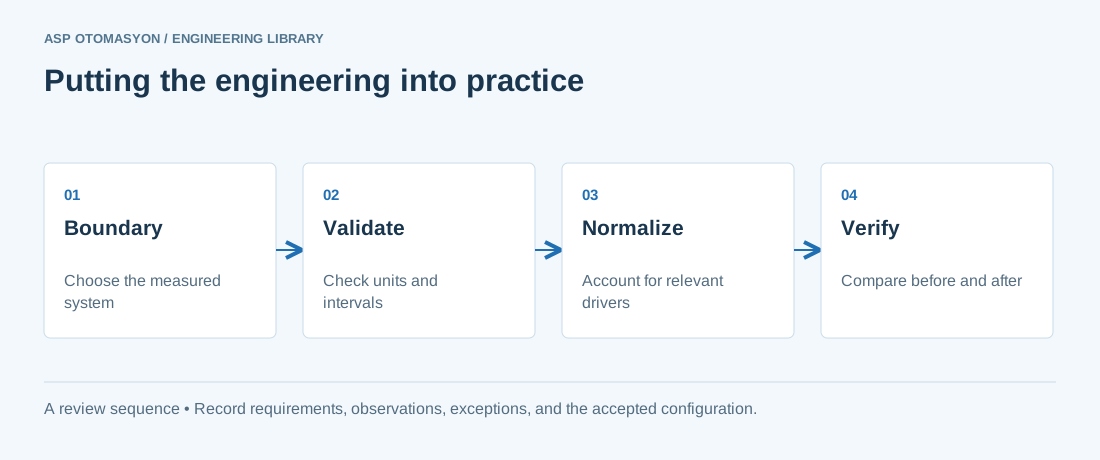
- Define the measurement boundary, meter ratios, units, time interval, and treatment of missing or reset readings.
- Capture production quantity, operating hours, and other relevant drivers alongside energy use.
- State the baseline and normalization assumptions when reporting a change; separate measured results from estimates.
Follow an ASP project guide to connect the fundamentals with implementation and acceptance.
Primary references and further reading
Use the original specifications and product documentation for implementation details. The examples in this guide are illustrative engineering scenarios, not published project results.