
Variable frequency drives (VFDs) are the single most impactful technology for improving energy efficiency in industrial motor systems. Electric motors consume approximately 60–65% of industrial electricity worldwide, and the majority of these motors drive variable-torque loads — centrifugal pumps, fans, and compressors — where output is traditionally controlled by throttling valves or dampers. VFDs reduce energy consumption by 25–60% in these applications by matching motor speed to actual process demand.
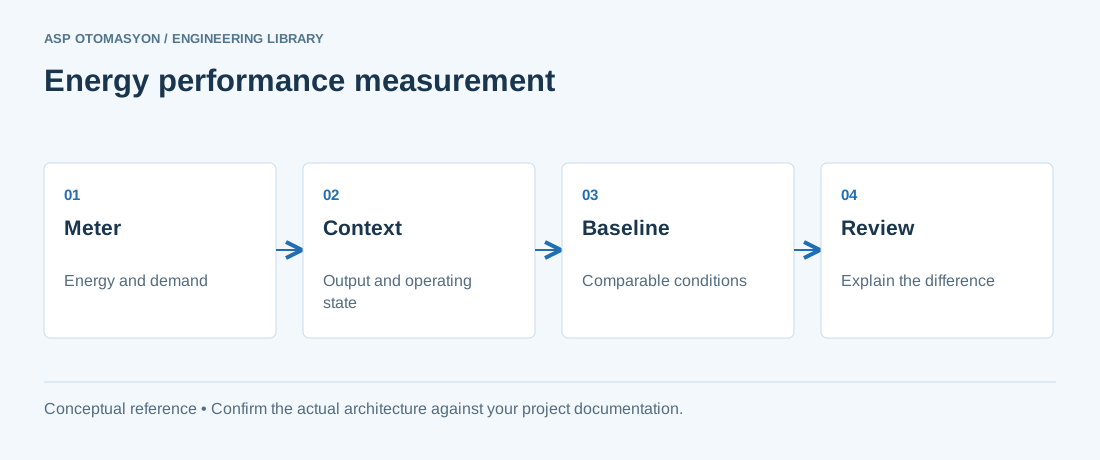
How VFDs Save Energy
The energy savings from VFDs are governed by the affinity laws for centrifugal loads:
- Flow (Q) is proportional to speed: Q₂ = Q₁ × (N₂/N₁)
- Pressure/Head (H) is proportional to speed squared: H₂ = H₁ × (N₂/N₁)²
- Power (P) is proportional to speed cubed: P₂ = P₁ × (N₂/N₁)³
This cubic relationship means that reducing speed by just 20% reduces power consumption by nearly 50%:
  At 100% speed: 100% power
  At  80% speed: 0.8³ = 0.512 → 51.2% power (48.8% savings)
  At  63% speed: 0.63³ = 0.250 → 25.0% power (75.0% savings)
  At  50% speed: 0.5³ = 0.125 → 12.5% power (87.5% savings)
VFD Operating Principle
A VFD converts fixed-frequency, fixed-voltage AC power into variable-frequency, variable-voltage AC power through three stages:
- Rectifier — A three-phase diode bridge converts AC line voltage to DC. Modern drives use active front ends (IGBT-based) for near-sinusoidal input current.
- DC link — A capacitor bank smooths the DC voltage and provides a stiff DC bus for the inverter stage.
- Inverter — IGBT switches convert the DC bus back to AC using pulse-width modulation (PWM), producing a quasi-sinusoidal output at the desired frequency and voltage.
Control Methods
| Method | Description | Efficiency | Application |
|---|---|---|---|
| Volts-per-Hertz (V/Hz) | Maintains a linear voltage-to-frequency ratio. Simple, open-loop. | Good | Pumps, fans, conveyors — general purpose |
| Vector control (FOC) | Independently controls magnetic flux and torque. Requires motor model. | Excellent | Hoists, extruders, winders — high dynamic performance |
| Direct torque control (DTC) | Directly controls motor flux and torque without PWM modulator. Fast torque response. | Excellent | Mining, metals, test stands — demanding applications |
Energy Savings by Application
| Application | Typical Savings | Payback Period |
|---|---|---|
| Centrifugal pumps (chemical, water) | 30–50% | 1–2 years |
| HVAC fans and blowers | 25–45% | 1–3 years |
| Compressed air systems | 15–35% | 1.5–3 years |
| Cooling tower fans | 30–60% | 1–2 years |
| Conveyor systems | 10–25% | 2–4 years |
Motor Considerations
When applying VFDs, several motor-side factors must be addressed:
- Motor insulation — PWM voltage pulses with fast rise times (dV/dt) stress motor insulation. Motors should be rated for inverter duty per NEMA MG-1 Part 31 (withstand 1,600 V peak, 0.1 µs rise time).
- Bearing currents — Common-mode voltages from PWM switching can cause electrical discharge machining (EDM) in bearings. Mitigation: insulated bearings, shaft grounding brushes, or common-mode chokes.
- Motor cooling — Standard TEFC motors rely on a shaft-mounted fan for cooling. At reduced speeds, cooling deteriorates. Consider forced ventilation (separate fan) for extended low-speed operation.
- Critical speeds — VFD-driven motors must avoid prolonged operation at mechanical resonance frequencies. Most drives include critical speed avoidance bands.
- Cable length — Long cables between VFD and motor cause voltage reflections. For 460 V systems, keep cable runs under 50 m or install dV/dt or sine-wave filters.
Regenerative and Four-Quadrant Operation
In applications where the load drives the motor (overhauling loads), the motor acts as a generator:
- Dynamic braking — A braking chopper and resistor dissipate regenerated energy as heat. Simple and economical for infrequent braking.
- Regenerative drives — Active front-end (AFE) drives return energy to the AC grid. Required for frequent braking applications (cranes, elevators, centrifuges, downhill conveyors).
ASP OTOMASYON specifies, programs, and commissions VFD solutions from ABB, Siemens, and other leading manufacturers. Our energy audits identify the highest-ROI VFD retrofit opportunities in your facility.
Apply this to your project
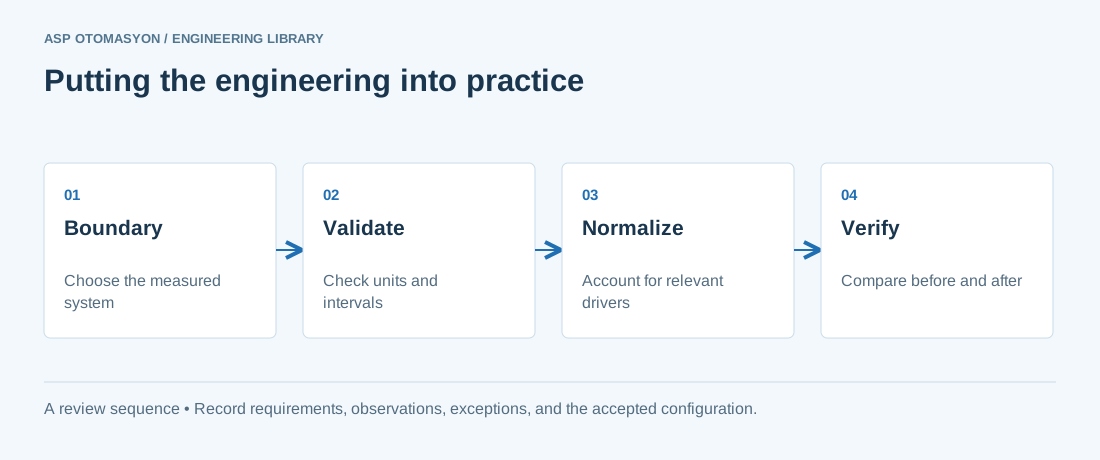
- Define the measurement boundary, meter ratios, units, time interval, and treatment of missing or reset readings.
- Capture production quantity, operating hours, and other relevant drivers alongside energy use.
- State the baseline and normalization assumptions when reporting a change; separate measured results from estimates.
Follow an ASP project guide to connect the fundamentals with implementation and acceptance.
Primary references and further reading
Use the original specifications and product documentation for implementation details. The examples in this guide are illustrative engineering scenarios, not published project results.