
HVAC in industrial facilities is a different problem than in commercial buildings: the loads include process heat, equipment, and ventilation requirements driven by health and safety (welding fume, chemical vapors, dust), the spaces are large and high-bay, and the operating schedule is often 24/7. HVAC can consume 20–40% of a plant's total energy — and much of it is waste: over-ventilation, simultaneous heating and cooling, and equipment running at fixed speed against varying demand. Optimization is both an engineering task (sizing, control) and an operational one (schedules, setpoints).
Know the Real Loads
Industrial HVAC optimization starts with understanding what the system is actually doing:
- Ventilation vs comfort loads — much industrial HVAC moves air for contaminant control at high rates; the energy is in the fan and in the heated/cooled makeup air. Reducing the ventilation requirement (better local extraction, lower general rates where code allows) is the biggest lever, far above equipment efficiency.
- Simultaneous heating and cooling — the classic waste: perimeter heating fighting interior cooling, or makeup air heated while exhaust heat could recover it. The first optimization is often simply balancing zones so they stop fighting.
- Occupancy reality — a 24/7 plant is not a 24/7-occupied building: offices, canteens, and low-activity zones follow schedules; the ventilation can too (with the safety minimums maintained).
- Process heat gain — ovens, furnaces, and machinery add heat; understanding the heat balance decides whether cooling is even needed in winter.
The Efficiency Measures
| Measure | How it saves |
|---|---|
| VFD on fans and pumps | Fan/pump power scales with the cube of speed; a 20% flow reduction saves ~50% of the motor energy. Most industrial HVAC runs at constant speed. |
| Demand-controlled ventilation | CO₂/VOC sensors modulate outdoor air to the actual occupancy/contamination; safety minimums retained per code. |
| Heat recovery | Exhaust-to-supply heat exchangers (run-around coils, heat wheels, heat pipes) recover 50–80% of the exhaust heat — the biggest single retrofit in cold climates. |
| Economizer operation | Use outdoor air for cooling when it is free (dry-bulb or enthalpy economizer), instead of mechanical cooling. |
| Setpoint and schedule management | Heating setpoint down 1 °C saves ~6% of heating energy; schedules for unoccupied zones; night/weekend setbacks with pre-start ramping. |
| High-efficiency equipment | Premium motors, high-efficiency fans (backward-curved, EC fans), condensing boilers, and correctly sized chillers (part-load performance matters). |
Control System Optimization
The control layer (BMS/PLC) is where HVAC savings are won or lost:
- Loop tuning and sequencing — heating/cooling valve loops tuned; chillers and boilers sequenced by efficiency curves (run the most efficient unit first); reset strategies: supply-air temperature and chilled-water temperature reset with load — each worth several percent.
- Alarm and fault discipline — stuck dampers, failed sensors, and bypassed schedules quietly destroy efficiency; the BMS alarms must be as managed as production alarms (see the alarm management article) — an HVAC alarm nobody reads is a leak.
- Data and trends — energy per air-handler, runtime hours, and zone temperatures trended and reviewed monthly; the review finds the anomalies (a damper stuck open since March shows up as a trend, not an anecdote).
- Integration with production — the HVAC schedule tied to the production schedule (shift changes, maintenance windows) via the BMS integration, not a static weekly timer.
Ventilation and Safety First
Industrial HVAC carries safety responsibilities: minimum ventilation rates for hazardous areas, fume and dust extraction, pressurization of clean areas, and fire/smoke control. Optimization must never compromise these: the safety ventilation minimums are constraints, not targets, and changes to ventilation rates are reviewed with the process safety process (a lower general ventilation rate requires the risk assessment to confirm local extraction covers the hazard). The engineer's rule: save energy within the safety envelope, and document the envelope.
Implementation Path
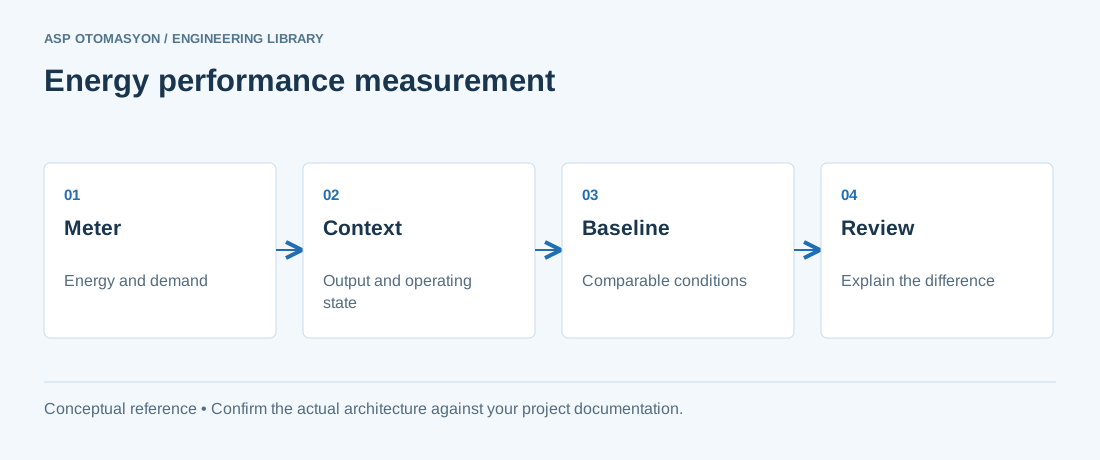
- Trend the current operation for a season: runtimes, setpoints, energy, and complaints — the baseline and the anomaly list.
- Fix the operational waste first: schedules, setpoints, simultaneous heating/cooling, and stuck equipment — mostly zero-capital.
- Add VFD and demand-control on the largest air handlers; verify with before/after metering.
- Evaluate heat recovery where exhaust heat is significant and the climate justifies it.
- Establish the monthly review: energy per unit of production (weather-adjusted), findings, and the next measures.
Summary
Industrial HVAC optimization is load reduction first (ventilation demand), then equipment efficiency (VFDs, heat recovery, economizers), then control quality (tuning, sequencing, resets, schedules), with safety minimums as the hard constraint. Measure before and after, review monthly against weather-adjusted baselines, and treat HVAC as a system under continuous improvement. The plant's air is a production resource; the energy it costs is a controllable expense.
Apply this to your project
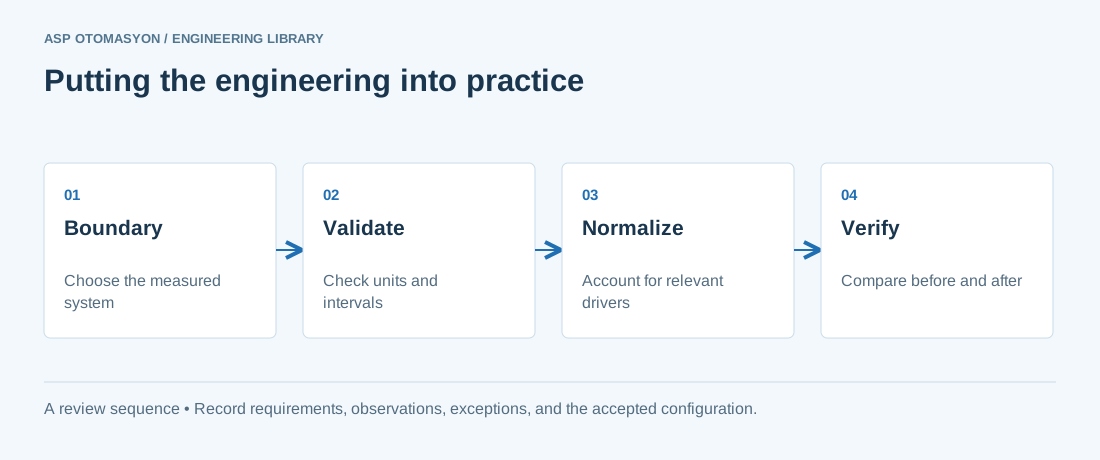
- Define the measurement boundary, meter ratios, units, time interval, and treatment of missing or reset readings.
- Capture production quantity, operating hours, and other relevant drivers alongside energy use.
- State the baseline and normalization assumptions when reporting a change; separate measured results from estimates.
Follow an ASP project guide to connect the fundamentals with implementation and acceptance.
Primary references and further reading
Use the original specifications and product documentation for implementation details. The examples in this guide are illustrative engineering scenarios, not published project results.