
Industrial electricity tariffs increasingly punish peaks: capacity charges based on the monthly maximum demand, and time-of-use rates that multiply the cost of the evening hours. Battery energy storage systems (BESS) attack both: they charge when power is cheap (or from on-site solar) and discharge during the peak window, shaving the demand that the plant pays for all month. Storage has crossed from pilot to standard industrial practice — the engineering question is now how to size, integrate, and operate it profitably.
The Economic Drivers
BESS value in industry comes from several mechanisms, usually combined:
- Demand (capacity) charge reduction — the biggest driver where tariffs charge per-kW maximum demand: the battery shaves the top of the daily load peak, reducing the billed demand every month of the year.
- Time-of-use arbitrage — charge at off-peak rates, discharge at peak rates; the spread must exceed the round-trip losses (~10–15%) and the tariff must be stable enough to plan against.
- Solar firming — store excess PV generation and discharge it in the evening — raising self-consumption where export is not remunerated.
- Backup / UPS functions — in some designs, a slice of the battery provides ride-through for critical loads (with the correct design for that duty — UPS duty and energy duty are different engineering).
- Demand response — monetizing the flexibility by offering load reduction to the grid operator (where programs exist).
The site analysis is: load profile (15-minute interval data for a year), tariff structure, and solar/CHP context — modeled together; the payback is computed from the model, not from vendor brochures.
Sizing the System
- Power (MW/kW) — the largest demand peak to shave determines the discharge power; typically 10–30% of the plant's peak.
- Energy (MWh) — the duration of the peak window (usually 1–4 hours) × the power; the battery must not be empty before the window ends.
- Cycles and degradation — batteries age by cycle and by calendar; the economic model includes the degradation (usually 10–20% capacity loss over 10 years) and the warranty terms (throughput clauses).
- Chemistry — LFP (lithium iron phosphate) dominates stationary storage for its cycle life and thermal safety; NMC for energy density where space is tight; flow batteries and sodium options for specific niches.
- Headroom — the model includes the system's round-trip efficiency, the minimum SOC floor (to protect the warranty and enable backup functions), and the forecast error in the daily peak prediction.
Integration and Control
The BESS is a power-electronics and control system in the plant:
- Grid connection — the inverter connects to the plant's LV or MV network per the utility's rules (export limits, anti-islanding, protection coordination re-study).
- The EMS/controller — the battery controller forecasts the day's load (from history, production plan, and weather) and schedules charging/discharging; the forecast quality determines the savings — a battery that discharges at the wrong hour saves nothing. The controller integrates with the plant's energy management system (OPC UA/Modbus) for status and data.
- Safety systems — a BESS has its own safety layer: thermal management, fire detection and suppression (a battery fire is a different fire), gas detection, and enclosure standards (UL 9540A / IEC 62933) — the safety case is part of the engineering package.
- Monitoring — SOC, SOH, cell temperatures, and inverter status are monitored continuously with alarm management; the BESS is an asset with a maintenance program, not a black box.
Operational Reality
- The daily routine — the battery cycles daily; the plant's energy team reviews the daily dispatch report (did it shave the peak? did the SOC align with the window?) and tunes the forecast inputs.
- Degradation management — operating bands (SOC limits) and thermal management extend life; the warranty's throughput terms set the operating envelope.
- Tariff changes — the economics follow the tariff; annual review of the dispatch strategy against the current tariff and the actual savings (metered, before/after).
- Safety operations — fire response planning, signage, and training for the plant's emergency team; the BESS is in the site's risk register.
Summary
BESS for industrial peak shaving is a size-and-dispatch problem with a solid business case where demand charges and rate spreads are real: analyze the interval load data and tariff, size power and energy to the peak window, integrate the controller with the plant's energy systems and safety layer, and operate the dispatch daily with metered verification. Storage does not save energy — it saves money by moving energy in time, and the plant that manages the forecast and the tariff makes that movement profitable.
Apply this to your project
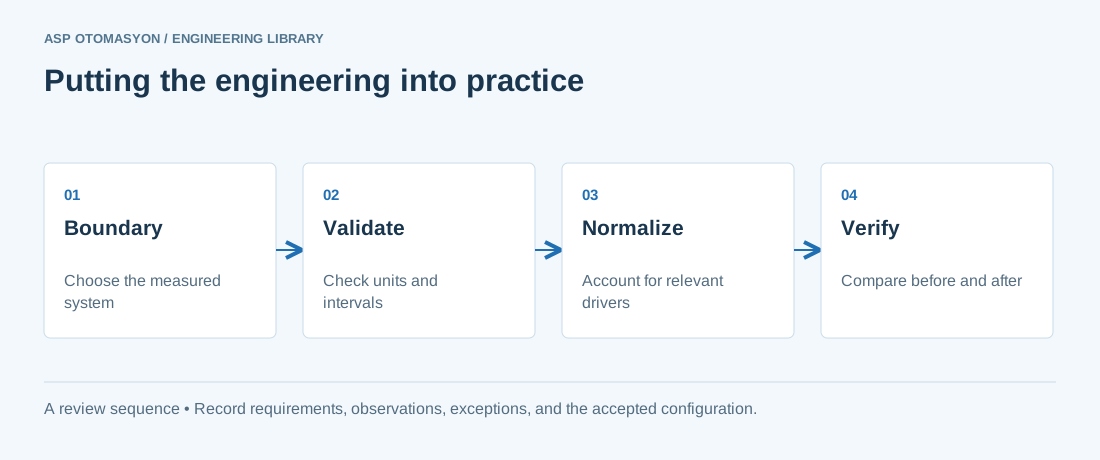
- Define the measurement boundary, meter ratios, units, time interval, and treatment of missing or reset readings.
- Capture production quantity, operating hours, and other relevant drivers alongside energy use.
- State the baseline and normalization assumptions when reporting a change; separate measured results from estimates.
Follow an ASP project guide to connect the fundamentals with implementation and acceptance.
Primary references and further reading
Use the original specifications and product documentation for implementation details. The examples in this guide are illustrative engineering scenarios, not published project results.