
Regulated industrial facilities — power plants, cement, waste incineration, refineries — must prove their emissions continuously: Continuous Emissions Monitoring Systems (CEMS) measure the stack's pollutant concentrations and flow, compute the mass emissions, and report them to the regulator with defined accuracy, availability, and data quality. CEMS is automation with a legal character: the data is the plant's compliance evidence, the system's performance is regulated (EN 14181, EPA 40 CFR Part 60), and a failed CEMS can be as costly as the emission itself.
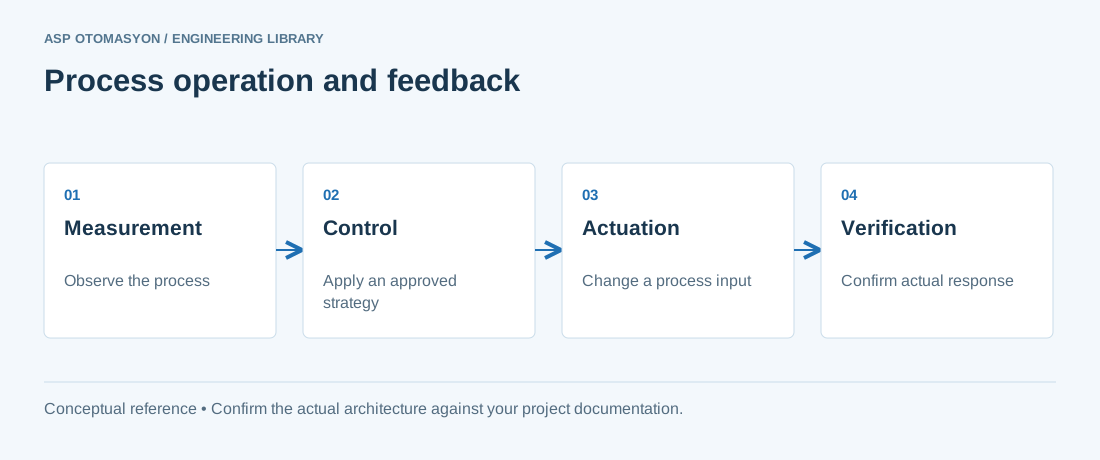
What a CEMS Measures
- Concentrations — NOx, SO₂, CO, CO₂, O₂, total hydrocarbons, and particulates (dust) — the regulated components per the plant's permit.
- Flow — stack gas velocity (pitot or ultrasonic) for mass computation: mass = concentration × flow.
- Supporting parameters — temperature, pressure, moisture (wet/dry correction) — the normalization to reference conditions (standard O₂, dry gas) that the limit values are expressed in.
The measurement methods are standardized: extractive analyzers (with sample conditioning) for most gases, in-situ analyzers (cross-stack) for some, and laser-based dust monitors — each with its calibration and drift behavior.
The Data Path
The CEMS data system is the compliance backbone:
- Data acquisition (DAHS) — the data acquisition and handling system collects the analyzer outputs, validates them (valid vs invalid periods), computes the averages (per the reporting period, e.g., 10-minute, hourly, daily), applies the corrections, and stores everything with the audit trail.
- Reporting — the regulated reports (daily, monthly, annually) generated automatically and submitted per the permit; the report content and format are regulatory requirements.
- Availability — the regulator defines the required availability (e.g., 95%+); when the CEMS is down, the plant is typically required to use substitute values (often conservative defaults) — a direct cost of downtime.
- Integrity — the data must be tamper-evident: access control, audit trails, and the regulatory requirement that manual intervention is limited and logged.
Quality Assurance: EN 14181
The European framework (EN 14181) structures CEMS quality:
- QAL1 — the analyzer is certified for the application (type approval to EN 15267).
- QAL2 — initial calibration against reference methods (parallel measurements by an accredited body) establishing the calibration function and its uncertainty.
- QAL3 — ongoing zero/span checks on a defined schedule (automated or manual) verifying the analyzer's drift; the results are recorded and acted on.
- AST (annual surveillance test) — the annual re-verification against reference methods confirming the calibration still holds.
The QA program is partly automation (the QAL3 checks are often automated sequences in the DAHS) and partly process (the annual tests, the maintenance, the documentation). The CEMS's audit trail must show all of it.
Automation Integration
The CEMS is an automation subsystem like any other, with its own integration rules:
- Plant integration — the CEMS data flows to the DCS/SCADA for operator visibility (the operators need the emissions trend like any process value) and to the plant historian; the regulatory data path (to the DAHS) is kept independent of the plant network's volatility.
- Alarms — analyzer faults, drift limits, and exceedance alarms are managed per the alarm philosophy; an emissions exceedance alarm is a process event with defined response (see the alarm management article).
- Process linkage — the emissions are controlled by the process: the combustion control, the abatement systems (scrubbers, filters, DeNOx), and the CEMS form one loop — the automation's job is that the plant runs within its limits, not that the CEMS reports after the fact.
- Cybersecurity — the CEMS is part of the regulated data chain: its network access is controlled, its configuration is change-managed, and the regulatory audit trail is protected (see the cybersecurity articles).
Operational Reality
CEMS operations are maintenance-heavy by nature: sample systems clog, filters load, analyzers drift, and the spare parts are specific. The operational discipline: a preventive maintenance schedule tied to the QA calendar (not separate from it), spare analyzers or modules for the critical components, a documented response procedure for CEMS failure (the substitute-value process is a procedure, not an improvisation), and the monthly review of availability, drift, and exceedances. The CEMS's history is the plant's environmental record — and the first evidence produced at any inspection.
Summary
CEMS is regulated measurement: certified analyzers, calibrated against reference methods (EN 14181 QAL1–3/AST), computing mass emissions into a tamper-evident data system with defined availability, and reporting to the regulator. The automation engineer's role spans the analyzer integration, the data system, the alarm and change discipline, and the process linkage that keeps the plant within its limits. The CEMS is the plant's environmental voice — it must be accurate, available, and beyond reproach.
Apply this to your project
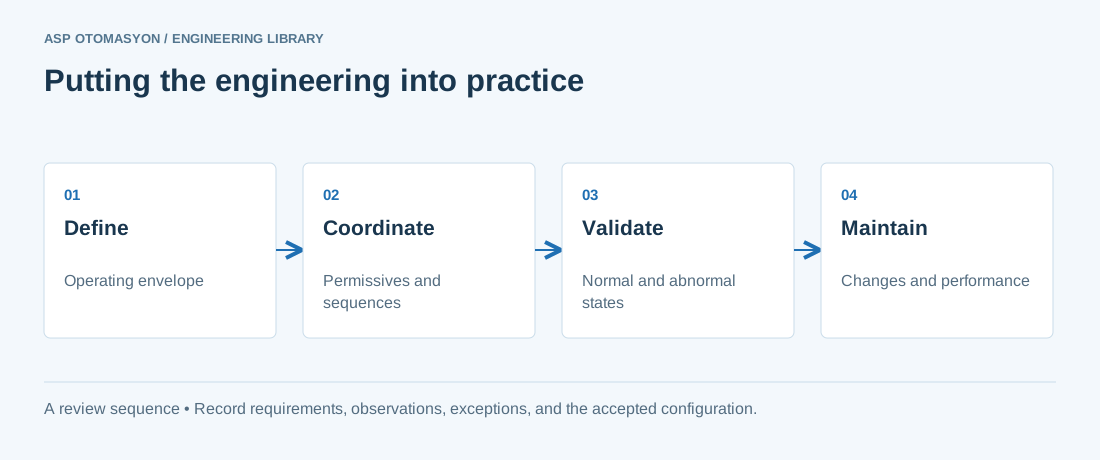
- Record process boundaries, required operating states, and interactions with independent protective systems.
- Check instrument quality, control authority, permissives, and operator responsibilities during state changes.
- Agree how tests, deviations, and configuration changes will be recorded within the facility's engineering procedures.
Follow an ASP project guide to connect the fundamentals with implementation and acceptance.
Primary references and further reading
Use the original specifications and product documentation for implementation details. The examples in this guide are illustrative engineering scenarios, not published project results.