
The ISA-88 standard (also known as IEC 61512) is the globally accepted framework for batch process control. It provides a consistent terminology, a physical equipment model, a procedural control model, and a recipe management structure that enables flexible, repeatable, and auditable batch manufacturing. Originally published in 1995 and updated through 2010, ISA-88 remains the standard governing everything from pharmaceutical tablet production to specialty chemical synthesis and food & beverage batching.
This article covers the full ISA-88 model — physical hierarchy, procedural hierarchy, recipe categories, state management, and integration with MES/ERP — with practical examples relevant to Turkish process industry professionals working in pharmaceuticals, chemicals, and food manufacturing.
The ISA-88 Physical Model
ISA-88 defines a hierarchical physical model that maps the plant equipment from the enterprise level down to individual control elements. Every batch process can be decomposed into these levels:
Enterprise                      (Corporate / Site)
    │
    └── Site                    (Factory / Plant)
            │
            └── Area            (Production Unit, e.g., "Reactor Hall 1")
                    │
                    └── Process Cell         (Group of equipment for one batch train)
                            │
                            ├── Unit         (Single major equipment item, e.g., "Reactor A")
                            │       │
                            │       ├── Equipment Module    (e.g., "Reactor A Jacket")
                            │       └── Control Module      (e.g., "Jacket Inlet Valve")
                            │
                            ├── Unit         (e.g., "Reactor B")
                            ├── Unit         (e.g., "Crystalliser C")
└── ...| Level | Description | Example |
|---|---|---|
| Enterprise | The entire corporation or organisation | ASP OTOMASYON A.Ş. |
| Site | A single geographic location | Istanbul Kimya Tesisleri |
| Area | A functional subdivision of a site | Üretim Sahası A |
| Process Cell | Equipment group that performs batch processing | Reaktör Hattı 1 |
| Unit | A major piece of equipment that can operate independently | Reaktör A (10 m³, SS316) |
| Equipment Module | A group of control modules forming a sub-function | Reaktör A Ceket Sistemi (heating/cooling jacket) |
| Control Module | The lowest level of control — typically a single sensor/actuator loop | VA-101 (jacket inlet valve), TT-101 (temperature transmitter) |
Key principle: A Unit is the central concept in ISA-88. It is a piece of equipment that can carry out one or more major processing activities independently of other units. Units have a "unit recipe" associated with them and maintain their own state machine.
The ISA-88 Procedural Model
While the physical model describes what exists, the procedural model describes what happens. It is also hierarchical:
Procedure                (Overall process, e.g., "Batch Polymerisation")
    │
    ├── Unit Procedure   (Operations within a single unit, e.g., "Reactor A: Heat & Hold")
    │       │
    │       ├── Operation        (e.g., "Heat to 150°C")
    │       │       │
    │       │       ├── Phase    (e.g., "Ramp Heating")
    │       │       │       │
    │       │       │       └── Step    (e.g., "Check valve position, ramp SP")
    │       │       │
    │       │       └── Phase    (e.g., "Hold Temperature")
    │       │
    │       └── Operation        (e.g., "Cool to 80°C")
    │
    └── Unit Procedure   (e.g., "Crystalliser C: Cool & Seed")
            ...
| Procedural Level | Description | Duration |
|---|---|---|
| Procedure | The complete strategy for producing a batch — defines the sequence of unit procedures across multiple units. | Hours to days |
| Unit Procedure | The part of a procedure that executes within a single unit. A unit procedure consists of one or more operations. | Minutes to hours |
| Operation | A major processing action (e.g., Charge, Heat, React, Cool, Discharge). Operations are sequence-independent within a unit procedure. | Minutes |
| Phase | The smallest element of procedural control that the operator views as a distinct action. Phases are the building blocks of operations. | Seconds to minutes |
| Step | The lowest level — individual logic instructions within a phase (e.g., "Set valve V101 to OPEN", "Wait for feedback"). | Milliseconds to seconds |
Recipe Management
ISA-88 defines four recipe categories that reflect the recipe lifecycle from product development through production:
1. General Recipe
Purpose: Technology transfer and product development. The general recipe is equipment-independent — it describes the chemistry and process steps without reference to specific plant equipment.
- Created by: R&D / Process Development.
- Stored in: Corporate recipe database.
- Contains: Raw materials, target process conditions, quality specifications, order of operations.
- Does NOT contain: Equipment-specific parameters, production scheduling, or site-specific constraints.
2. Site Recipe
Purpose: Adapt the general recipe to a specific production site. Equipment references are added, and site-specific constraints (e.g., available utilities, local raw material sources) are incorporated.
- Created by: Site Process Engineering.
- Stored in: Site-level recipe management system.
- Adds: Equipment requirements, site-specific materials, local regulatory constraints (e.g., ÇEVRE İzni for Turkish facilities).
3. Master Recipe
Purpose: A fully equipment-specific recipe that serves as the template for all production batches of a given product.
- Created by: Control / Automation Engineering.
- Stored in: DCS/PLC recipe database (or MES recipe manager).
- Adds: Equipment allocation rules, process parameters (PV/SP limits), phase logic, procedural sequences, cleanup instructions.
- The master recipe is the source code for batch execution in the automation system.
4. Control Recipe
Purpose: A single-use instance of the master recipe for one specific batch. The control recipe is created when a batch is scheduled and destroyed when the batch is complete.
- Created by: MES or batch management system (or operator, for manual scheduling).
- Contains: Master recipe parameters + batch-specific data (batch ID, lot numbers, operator ID, actual start time, actual parameters).
- The control recipe is the executable object — the automation system reads the control recipe and executes it.
Recipe Structure Diagram
                    GENERAL RECIPE
                    (Equipment-Independent)
                          │
                    [Site Adaptation]
                          │
                          v
                    SITE RECIPE
                    (Site-Specific, Equipment-Flexible)
                          │
                    [Equipment Allocation]
                          │
                          v
                    MASTER RECIPE
                    (Equipment-Specific Template)
                          │
                    [Batch Scheduling]
                          │
                          v
                    CONTROL RECIPE
                    (Single Batch Instance)
                          │
                          v
                    ┌───────────────────┐
                    │   BATCH EXECUTION │
                    │   (DCS / PLC /    │
                    │    Batch Server)  │
                    └───────────────────┘
State Management
Every batch and every unit in ISA-88 follows a standard state machine. The states are defined in the standard and implemented by all compliant batch control systems:
                    ┌──────────┐
                    │  IDLE    │
                    └────┬─────┘
                         │
                    ┌────v─────┐
              ┌────>│ RUNNING  │────┐
              │     └────┬─────┘    │
              │          │          │
         ┌────┴───┐  ┌──v────┐  ┌──v──────┐
         │ HELD   │  │ PAUSED│  │ COMPLETE │
         └────┬───┘  └──┬────┘  └────┬─────┘
              │         │            │
              └─────────┘            │
                                     │
                               ┌─────v──────┐
                        ┌──────│  STOPPED   │──────┐
                        │      └─────┬──────┐      │
                   ┌────v───┐   ┌────v────┐  ┌────v────┐
                   │ABORTED │   │RESETTING│  │ RESTART │
                   └────┬───┘   └────┬────┘  └────┬────┘
                        │            │            │
                        └──────┬─────┘            │
                               │                  │
                          ┌────v────┐             │
                          │  IDLE   │<────────────┘
└─────────┘| State | Meaning | Transitions To |
|---|---|---|
| IDLE | The unit or batch is ready to start but has not yet begun. Equipment is in a known safe state. | RUNNING |
| RUNNING | Active execution of the procedural logic. The unit is performing its assigned operations. | COMPLETE, HELD, PAUSED, STOPPED, ABORTED |
| COMPLETE | The batch or unit procedure has finished normally. All operations executed successfully. | STOPPED (for cleanup), IDLE (via RESETTING, if reusable) |
| HELD | Operator-initiated pause — the operator can resume from the hold point. Typically used for sample collection or manual intervention. | RUNNING (resume) |
| PAUSED | Automatic pause triggered by a predefined condition (e.g., waiting for temperature to stabilise). The system auto-resumes when the condition clears. | RUNNING (auto-resume) |
| STOPPED | Orderly shutdown initiated by the operator or a higher-level system. The batch may be restarted at the stop point if the system supports it. | RESTART, RESETTING, ABORTED |
| ABORTED | Emergency shutdown — all phases are terminated immediately. The batch cannot be resumed. The equipment must be cleaned and reset before the next batch. | IDLE (via RESETTING, after cleanup) |
| RESETTING | Transitional state — the unit is being prepared for the next batch (cleaning, flushing, resetting alarms). | IDLE |
| RESTARTING | Transitional state — resuming a STOPPED batch from its last stopping point. | RUNNING |
Equipment Control vs. Procedural Control
A critical distinction in ISA-88 is between two parallel control layers:
- Equipment Control — The continuous, always-active control that keeps the equipment safe. This includes interlocks, permissives, alarm handling, and regulatory control (PID loops). Equipment control runs regardless of whether a batch is active.
- Procedural Control — The batch-specific, sequence-oriented control that executes the recipe. Procedural control phases are allocated to units, run to completion (or exception), and release the unit for the next operation.
Example: In a reactor unit, the jacket temperature PID loop and the overpressure interlock are equipment control — they run continuously. The "Heat to 150°C" phase is procedural control — it sets the PID setpoint, monitors the ramp rate, and transitions to the Hold phase when the target is reached.
ISA-106 for Continuous Processes
While ISA-88 was designed for batch processes, the standard's principles have been extended to continuous processes via ISA-106 (Procedure Automation for Continuous Process Operations). The key differences:
| Aspect | ISA-88 (Batch) | ISA-106 (Continuous) |
|---|---|---|
| Operation mode | Discrete campaigns with start/end | Continuous, steady-state operation |
| State machine | IDLE → RUNNING → COMPLETE | STOPPED → STARTING → RUNNING → STOPPING |
| Procedures | Unit procedures with phases | Procedures for start-up, shutdown, grade change, abnormal handling |
| Recipe | Product-specific (different products, same equipment) | Grade-specific (different grades, same product family) |
| Equipment model | Unit-centric (one major operation per unit) | Train-centric (multiple vessels operate in series continuously) |
Integration with MES and ERP
ISA-88 is the bridge between the automation layer (PLC/DCS) and the business systems (MES/ERP). The standard integration model follows the ISA-95 functional hierarchy:
ERP (SAP, Oracle)          │
    │                       │ Business Planning
    ▼                       │ & Logistics
MES (Batch Management)     │ (ISA-95 Level 4 → Level 3)
    │                       │
    ├── Recipe Management   │
    ├── Batch Scheduling    │
    ├── Material Tracking   │
    └── Production Records  │
    │                       │
    ▼                       │
Batch Server / DCS           │
    │                       │ Automation
    ├── Control Recipe      │ (ISA-95 Level 2)
    ├── Unit Supervision    │
    ├── Phase Execution     │
    └── Data Collection     │
    │                       │
    ▼                       │
Field Devices (PLC, I/O)   │ (ISA-95 Level 1)
Integration points:
- MES → Batch Server: Sends the control recipe (product ID, batch size, parameters), receives batch status and production data.
- Batch Server → DCS/PLC: Executes phases via OPC UA, reads process values, writes setpoints.
- DCS/PLC → Batch Server: Reports equipment mode, alarm status, phase execution progress.
- Batch Server → MES: Returns actual materials consumed, actual parameters, batch deviation report, electronic batch record (EBR).
Example: Interface Table Between MES and Batch Server
| Tag/Field | Type | Direction | Description |
|---|---|---|---|
BATCH_ID | STRING(32) | MES → Batch | Unique batch identifier |
PRODUCT_CODE | STRING(16) | MES → Batch | Product being produced |
MASTER_RECIPE | STRING(32) | MES → Batch | Master recipe version to use |
BATCH_SIZE | REAL | MES → Batch | Target batch quantity (kg or L) |
EQP_ALLOCATION | STRING(64) | MES → Batch | Which units to use (comma-separated) |
BATCH_STATUS | STRING(16) | Batch → MES | Current batch state (Running, Complete, Aborted) |
BATCH_START | DATETIME | Batch → MES | Actual batch start timestamp |
BATCH_END | DATETIME | Batch → MES | Actual batch end timestamp |
ACTUAL_QTY | REAL | Batch → MES | Actual quantity produced |
DEVIATION_FLAG | BOOL | Batch → MES | TRUE if any parameter deviated from the recipe |
Implementing ISA-88: Practical Guidance
- Start with the physical model. Document every piece of equipment in the process cell. Assign each to a Unit, Equipment Module, or Control Module. This is the foundation of everything else.
- Design phases, not monolithic programs. Write small, reusable phase logic modules. A "Charge" phase should work identically whether it is called from the "React" operation or the "Clean" operation.
- Separate equipment control from procedural control. Your PLC code should have two distinct sections: continuous logic (alarms, interlocks, PID) running in a fast task, and sequential-logic phases running in a slower batch task.
- Use the standard state machine. Do not invent your own. Every DCS and batch management system understands the ISA-88 states. Custom state machines break MES integration and confuse operators.
- Build the recipe hierarchy. You may start with only master recipes, but plan for the general → site → master → control structure from day one. It is much harder to retrofit later.
- Validate with a mock batch. Before running a real product, execute the control recipe with water (for chemical processes) or placebo (for pharmaceutical processes). Verify every phase transition, every state, every alarm.
Key takeaway: ISA-88 is not just a standard — it is a design methodology. When applied properly, it delivers batch processes that are flexible (change product without rewriting code), repeatable (every batch follows the same procedure), auditable (every deviation is recorded), and scalable (add new equipment or products without redesigning the control system). For Turkish process industry manufacturers facing regulatory pressure (TİTCK for pharmaceuticals, ISO 22000 for food) and competitive pressure for shorter batch cycle times, ISA-88 compliance is not optional — it is a competitive necessity.
References & Further Reading
- ISA-88 / IEC 61512 — Batch Control Standards — International standard defining the physical model, procedural model, recipe management, and state machine for batch process control across all process industries.
- ISA-88.00.04 — Batch Production Records — ISA standard extension covering electronic batch records, data collection requirements, and audit trail specifications for compliant batch manufacturing.
- ISA-95 / IEC 62264 — Enterprise-Control System Integration for Batch — International standard providing the integration framework between ISA-88 batch systems and MES/ERP enterprise layers for production scheduling and tracking.
- IEC 61512-3 — Batch Control — Recipes and Recipe Management — IEC standard specifying the recipe data model, recipe categories (general, site, master, control), and recipe execution procedures for batch automation systems.
- ISA-106 — Procedure Automation for Continuous Process Operations — ISA standard extending ISA-88 procedural control concepts to continuous processes, covering start-up, shutdown, and grade change automation.
Apply this to your project
- Agree the test boundary and site authorization, especially where outputs or communications can affect operating equipment.
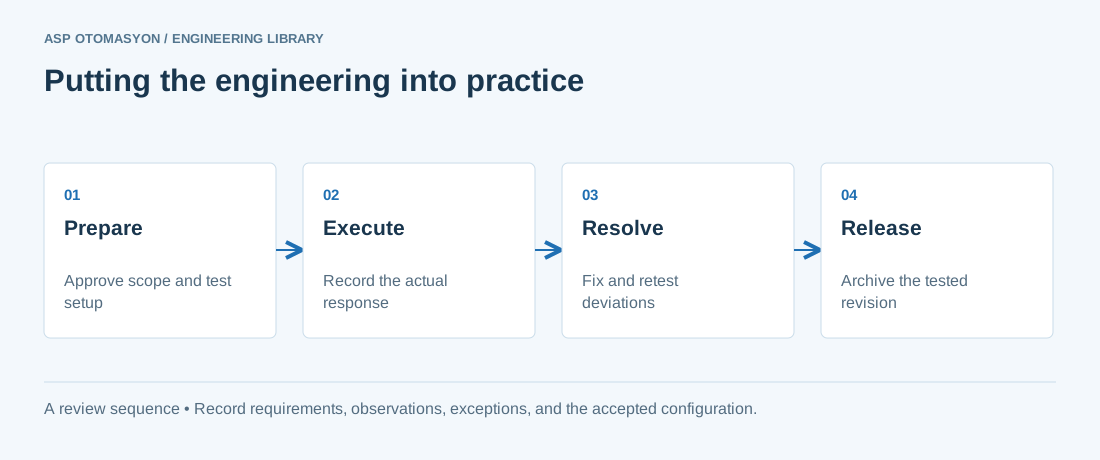
- Record expected and actual values, equipment identifiers, software revision, test conditions, and exceptions.
- Retest changed behavior and archive the final configuration with the test record and recovery instructions.
Follow an ASP project guide to connect the fundamentals with implementation and acceptance.
Primary references and further reading
Use the original specifications and product documentation for implementation details. The examples in this guide are illustrative engineering scenarios, not published project results.