
Supply chain shocks — pandemics, component shortages, logistics bottlenecks, price volatility — have made supply chain resilience a board-level topic in manufacturing. Supply chain digitalization is the response: replacing phone calls, spreadsheets, and inventory guesses with connected data across suppliers, production, logistics, and customers. The manufacturing plant sits at the middle of the chain, and its own data quality determines whether the chain's digital backbone has anything useful to carry.
The Four Data Flows of the Digital Chain
- Demand — forecasts and orders from customers into production planning; the plant's MES/ERP data determines what is promised and what is actually feasible.
- Supply — supplier capacity, lead times, and delivery status; component traceability (lot, batch, serial) flowing from suppliers through production to customers.
- Production — the plant's real availability, output, and quality — the honest "what can we ship when" signal that planning and customers rely on.
- Logistics — shipment tracking, warehouse status, and carrier performance connecting production output to customer receipt.
Digitalization means these flows are exchanged as structured data with agreed semantics — EDI or API — instead of emails and spreadsheets, and that decisions (planning, purchasing, promise dates) are made on the data.
Starting Inside the Plant
The chain is only as digital as its weakest link, and for most manufacturers the weakest link is inside: the ERP's inventory records vs the warehouse floor, the planned schedule vs actual production. Digitalization starts with internal truth:
- Inventory accuracy — cycle counting and a disciplined warehouse process; automated identification (barcode/QR/RFID) at receipt, issue, and transfer. ERP inventory is the first link in every promise.
- Production reality — the shop floor's actual output and availability (from automation and MES data, not paper reports) feeding planning. A plan built on optimistic availability produces chronic shortages.
- Traceability basics — lot/batch/serial capture at every transformation, with the connection to the automation data (batch records, process parameters). Traceability is not just regulatory; it is the foundation of recall management and quality investigations.
- Lead time honesty — measure real supplier and internal lead times; the planning parameters must reflect data, not ERP defaults from the implementation year.
Connecting with Suppliers and Customers
With internal data trustworthy, the chain links outward:
- Supplier collaboration — share rolling forecasts and get delivery confirmations electronically; digital kanban and VMI (vendor-managed inventory) for recurring materials; supplier performance (OTIF, quality) measured from the same data.
- Customer connectivity — order status visibility (the customer sees their order's real position), ASN (advanced shipping notices), and electronic invoicing. Visibility reduces the phone calls that consume planners' days.
- Logistics integration — carrier APIs and tracking data merged with orders; dock and warehouse execution systems feeding the same data model.
- Standards first — use the industry's standard message formats (EDI, GS1 identifiers, or modern APIs with a published schema); every custom point-to-point integration is future debt.
Technology That Actually Helps
The technology stack for supply chain digitalization is mostly unglamorous:
- An integration layer — the API/EDI hub that connects ERP, MES, WMS, and partner systems with versioned schemas and error handling. Integration is the project; the platforms are commodities.
- Track-and-trace identifiers — GS1 GTIN/SSCC/batch standards so every partner speaks the same identity language.
- Planning with constraints — APS or S&OP tools that respect real capacity and material constraints; a plan nobody can execute is worse than no plan.
- Analytics on the chain — lead-time distributions, supplier reliability scores, and inventory health dashboards — starting from the data already collected, not new data collection projects.
- AI where it earns it — demand forecasting from history + external signals, and anomaly detection on shipments; both after the data foundation exists.
Digitalization and Resilience
The goal of digitalization is not just efficiency — it is resilience: the ability to see a disruption early (a supplier's delay, a transport issue, a demand shift) and respond before it becomes a stockout. That requires the chain data to be fresh (daily or real-time for critical flows), trusted (quality-measured), and actionable (the planning process uses it). Resilience metrics worth tracking: time-to-detect a supply disruption, time-to-respond, and the inventory buffers' coverage — each improves measurably with digitalized flows.
Summary
Supply chain digitalization starts with internal truth — inventory accuracy, production reality, traceability, and honest lead times — then connects outward with standards-based data exchange, integration layers, and collaborative planning. Technology is the easy part; the discipline is data quality and process change at every link. The reward is a chain that is not only cheaper to run but visible, measurable, and responsive when the next disruption arrives.
Apply this to your project
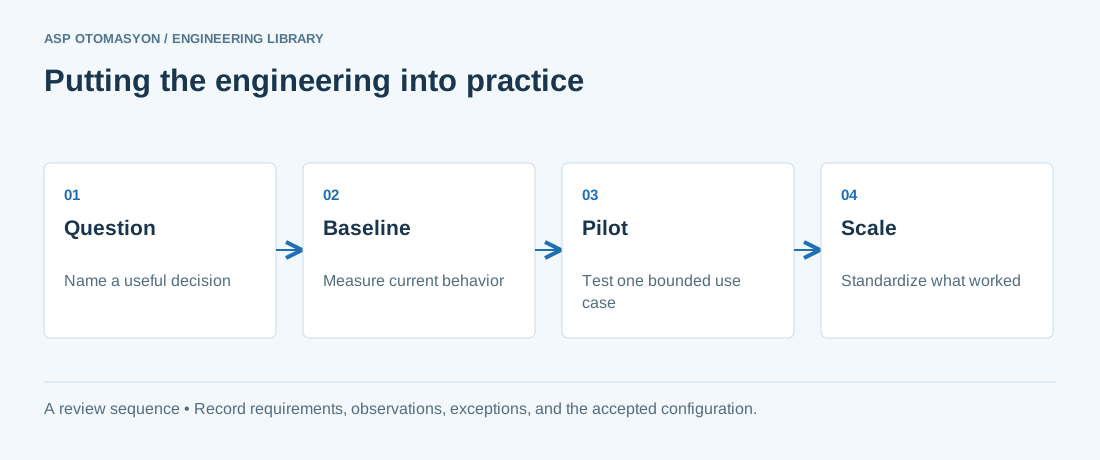
- Name the operational decision, its owner, and the evidence required to judge whether it improved.
- Document asset identifiers, units, timestamps, quality rules, and definitions shared between OT and business applications.
- Compare the pilot against a recorded baseline before extending it to other machines or sites.
Follow an ASP project guide to connect the fundamentals with implementation and acceptance.
Primary references and further reading
Use the original specifications and product documentation for implementation details. The examples in this guide are illustrative engineering scenarios, not published project results.