
Most industrial digitalization initiatives do not fail on technology. The sensors work, the dashboards render, the platform is stable — and the plant continues operating as before: the maintenance planner still uses the paper log, the shift leader still walks the line to collect numbers, and the OEE screen is decoration. Change management — the deliberate discipline of moving people and organizations from current to target behavior — is what separates digital transformation from digital installation. In a plant culture built on caution and procedure, it is the hardest part of the project.
Why Industrial Change Is Hard
Manufacturing organizations have three characteristics that make change management different from office digitalization:
- Consequence asymmetry — an IT system failure is an inconvenience; a control or process change can stop production or compromise safety. People therefore demand proof before adopting anything new.
- Experience-based authority — operators' and technicians' knowledge is the plant's real operating system; new tools that ignore or contradict that knowledge face quiet, effective resistance.
- Shift reality — the plant runs 24/7 with different crews; training, communication, and support must work across shifts, languages, and skill levels — a single classroom session does not.
The Change Management Framework
A practical framework for industrial change has five phases:
- Readiness assessment — before starting: who is affected, what will they gain or lose, what is the plant's change appetite? Identify champions (respected operators and technicians who will pilot and advocate) and blockers (people whose authority or routine is threatened — engage them early).
- Stakeholder plan — per stakeholder group: what changes for them, what is in it for them, what communication do they get, when, from whom. The maintenance department must hear from maintenance management; the union delegate hears from plant management.
- Communication cadence — regular, honest, two-way: shift briefings, visible pilot results, open feedback channels. Bad news (delays, failures) communicated fast builds the trust that makes good news credible.
- Training with the real work — training on the real system with real data and real scenarios, on all shifts, in small groups, with enough repetition that the skill survives the gap between training and use. Super-user programs (one trained supporter per shift per area) are the most reliable adoption mechanism.
- Reinforcement and review — measure adoption (usage rates, data quality, not just click counts), recognize the behaviors you want, and review at defined intervals — the change is not complete when the system goes live; it is complete when the new behavior is the default.
Designing for Adoption
Change management works best when it is designed into the system, not bolted on after:
- Solve a real pain — the tool must remove work the people actually dislike (manual data entry, walking to check status, phone calls to find the shift leader). A system that adds work to save management time will not survive.
- Make the new way easier than the old way — for the user. If the paper log is faster to fill than the tablet app, people will use the paper log and the digital data will rot.
- Give immediate value — the first users should see their own benefit within days: their own dashboard, their own reports, their own saved time — not "value for the plant" in quarter 4.
- Pilot visibly — one line, one shift, with champions, hard evidence, and a story. Nothing persuades a plant like a respected colleague saying "it works."
- Keep the old way available during transition — forcing a hard cutover before the new way is proven creates resentment and workarounds; parallel operation with a defined end date works better in most plants.
Common Failure Patterns
- Management-only sponsorship — the project is announced from the office and the plant floor never hears a coherent "why."
- Training as an afterthought — a one-hour session on the day of go-live, then the vendor goes home.
- Ignoring the informal system — the real workflow (WhatsApp groups, paper notes, the foreman's memory) survives the formal rollout and doubles the workload.
- Success theater — celebrating a go-live while adoption metrics tell the opposite story; the celebration tells everyone that appearance matters more than use.
- Change fatigue — launching five initiatives at once; plants adopt one change at a time well, five changes never.
Measuring Change Success
Define adoption metrics before go-live: active users per shift, data completeness (entries vs expected), reliance on the old channel (paper forms still submitted?), and the business metric the change serves (maintenance backlog accuracy, OEE reporting timeliness). Review monthly for the first two quarters; when the metrics are stable and the old channel is empty, the change is done — and the next change is easier because the plant remembers this one went well.
Summary
Digital transformation is a change in behavior, not a change in software. Assess readiness and champions, plan per stakeholder group, communicate honestly and repeatedly, train on real work across all shifts, and reinforce with measured adoption. Design the system to be easier than what it replaces, pilot visibly, and prove value to the first users. The plant changes one respected colleague at a time — change management is how you give that colleague the evidence they need.
Apply this to your project
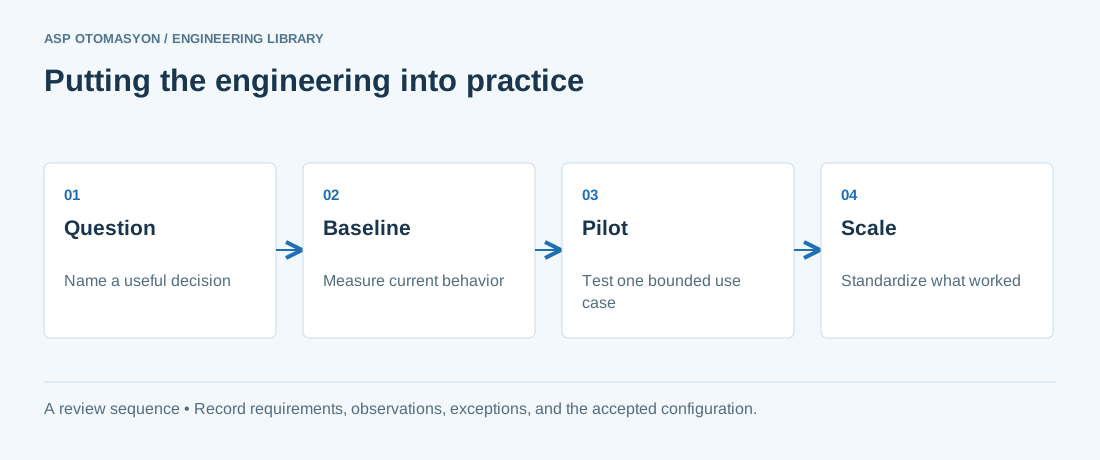
- Name the operational decision, its owner, and the evidence required to judge whether it improved.
- Document asset identifiers, units, timestamps, quality rules, and definitions shared between OT and business applications.
- Compare the pilot against a recorded baseline before extending it to other machines or sites.
Follow an ASP project guide to connect the fundamentals with implementation and acceptance.
Primary references and further reading
Use the original specifications and product documentation for implementation details. The examples in this guide are illustrative engineering scenarios, not published project results.