
A digital maturity assessment answers a question every manufacturer asks before investing in Industry 4.0 technology: where are we today, and what should we do first? Rather than buying platforms and sensors in the hope that they produce value, mature organizations measure their current capabilities across a set of dimensions, identify the biggest gaps between current state and business goals, and build a prioritized roadmap. This article explains the assessment dimensions, how to run one, and how to use the results without falling into the trap of chasing a perfect score.
What Digital Maturity Means
Digital maturity is the extent to which an organization uses data, connectivity, and digital tools to improve its operations — not the number of gadgets installed. A plant with one well-used dashboard that drives daily decisions can be more mature than a plant with a full IIoT stack nobody reads. Maturity is therefore measured in capabilities and usage, not in technology counts.
Common Assessment Dimensions
Most published maturity models (including the widely used Industry 4.0 Readiness models from IMPULS/acatech, the PwC/Digital Enterprise model, and others) converge on a similar set of dimensions:
| Dimension | What it measures | Example evidence |
|---|---|---|
| Strategy & organization | Digital goals, ownership, governance | A named digital lead, a funded roadmap, clear KPIs |
| Operations & automation | Level of control-system automation | % of units under closed-loop control, batch automation |
| Data & integration | Data availability, quality, and connectivity | Historians, OPC UA coverage, single source of truth |
| Analytics & intelligence | Use of data for decisions | Dashboards used daily, predictive models, alarm analytics |
| People & skills | Digital skills and change readiness | Trained operators, data-literate engineers, adoption rate |
| IT/OT infrastructure | Networking, security, architecture | Segmented OT network, patched systems, documented architecture |
Some models add product lifecycle, supply chain, and customer dimensions. Choose the dimensions that match your business goals — a food manufacturer's priorities differ from a discrete manufacturer's.
Running the Assessment
1. Scope and self-assessment
Decide the unit of analysis: one plant, one line, or the whole company. Collect evidence through structured interviews with operations, maintenance, engineering, and IT. A five-level scoring scale is common:
- Manual — paper-based or ad-hoc processes
- Connected — some instrumentation and local systems
- Integrated — systems exchange data; historians in place
- Analytical — data drives routine decisions
- Adaptive/autonomous — self-optimizing, predictive, automated response
Score each dimension at the level where the majority of the plant operates — not the best island of excellence.
2. Validate with data
Self-assessments drift. Cross-check scores with hard evidence: historian coverage (what share of critical assets is historized?), alarm rates, automation ratio, downtime data, and actual dashboard usage statistics. If the evidence contradicts the score, the evidence wins.
3. Prioritize gaps against business value
Not every gap deserves investment. Rank candidate initiatives by expected impact on the business goals (yield, OEE, energy, quality, safety) and by feasibility. The classic mistake is starting with the most visible technology instead of the biggest pain point. A good first project:
- Addresses a known, measured pain (e.g., 12% unplanned downtime on a bottleneck line)
- Uses data that already exists (historian, PLCs) before buying new sensors
- Delivers value in weeks, not quarters
- Builds skills the organization will reuse
4. Build the roadmap
Turn the prioritized gaps into a 12–36 month roadmap with phases, owners, and KPIs. Typical phases:
- Foundation: reliable data collection (historian, OPC UA, network hygiene, security basics)
- Visibility: dashboards, standard KPIs, alarm management, OEE tracking
- Optimization: advanced analytics, predictive maintenance pilots, closed-loop improvements
- Transformation: cross-plant integration, MES/ERP synchronization, digital twin pilots
5. Reassess periodically
Maturity is not a one-time score. Reassess every 12–18 months to measure progress, adjust priorities, and refresh the roadmap. The score itself matters less than the trend and the decisions it informs.
Pitfalls to Avoid
- Chasing the score. A high maturity score with no business impact is decoration. Tie every initiative to an operating or financial KPI.
- Technology-first thinking. Buying an AI platform for a plant with no historian is putting the roof on before the foundation.
- Islands of excellence. A pilot that never scales teaches the organization to distrust digital initiatives. Plan scale-out from day one.
- Ignoring people. The most common failure is not technical; it is operators and engineers who were not involved and do not use the tools.
- Overcomplicating the first step. The first project should be small, valuable, and visible — it builds the case for everything after.
Summary
A digital maturity assessment is a structured, evidence-based look at how a plant actually uses data and digital tools. Score the dimensions, validate with data, prioritize the gaps that matter to the business, and build a phased roadmap that starts with data foundation and visibility. The goal is not a perfect score — it is a sequence of investments that steadily convert data into operational results.
Apply this to your project
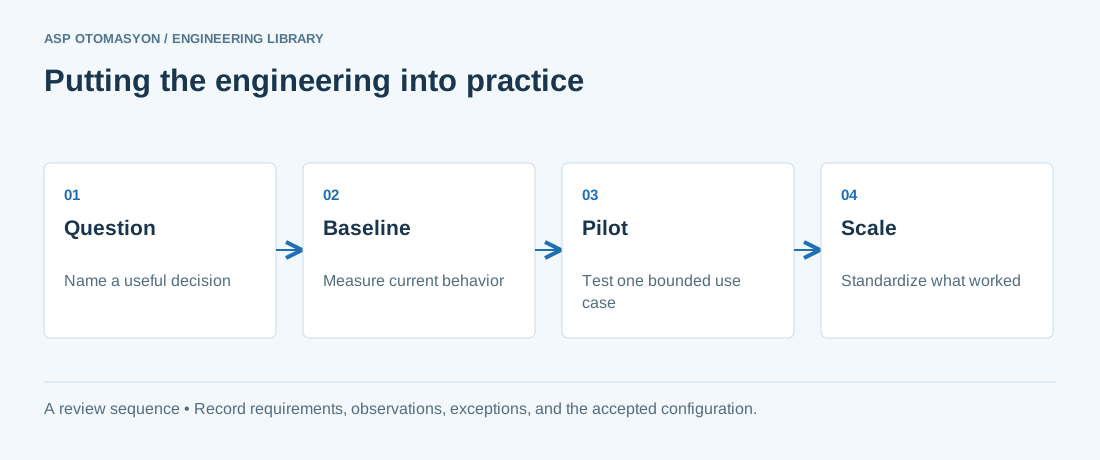
- Name the operational decision, its owner, and the evidence required to judge whether it improved.
- Document asset identifiers, units, timestamps, quality rules, and definitions shared between OT and business applications.
- Compare the pilot against a recorded baseline before extending it to other machines or sites.
Follow an ASP project guide to connect the fundamentals with implementation and acceptance.
Primary references and further reading
Use the original specifications and product documentation for implementation details. The examples in this guide are illustrative engineering scenarios, not published project results.