
The automation industry faces a demographic reality: the engineers who built today's control systems are retiring, and the talent pool entering the field is smaller and differently trained. Meanwhile the systems themselves are becoming more complex — cybersecurity, data integration, and software practices now sit alongside relay logic and loop tuning. The skills gap is not a future problem; it shows up today as commissioning delays, vendors doing work plants used to do in-house, and operators who cannot use the diagnostics their systems provide.
The Shape of the Gap
Four distinct gaps are usually conflated:
| Gap | Manifestation | Why it is hard |
|---|---|---|
| Retirement drain | Departures of senior engineers take decades of plant-specific knowledge. | That knowledge lives in heads, not documents. |
| New-technology gap | Existing staff untrained in IIoT, OPC UA, cybersecurity, and cloud integration. | These are new disciplines, not new versions of old ones. |
| Pipeline gap | Too few graduates entering industrial automation and instrumentation careers. | Perception, salaries, geography, and education mismatch. |
| Legacy-skills gap | Young engineers cannot maintain the older installed base (DCS platforms from the 1990s, ladder systems, pneumatic instrumentation). | New talent is trained on current technology, not installed technology. |
Most plants face all four simultaneously, which is why "hire more engineers" is not a strategy.
What the Plant Can Do
- Knowledge capture before retirement — systematic exit interviews, documented control narratives, standardized as-built documentation, and "shadowing programs" where juniors work alongside seniors for months with a capture plan. The goal is documentation that survives the person: the plant's real automation knowledge is currently undocumented by default.
- Deliberate apprenticeship — a structured 12–24 month program: rotation through maintenance, commissioning, and engineering; a mentor; defined competency milestones (read a loop diagram, tune a loop, configure a VFD, commission an OPC UA connection); and certification by demonstration, not years of service.
- Internal training tracks — a small curriculum per discipline (instrumentation, PLC, DCS, networks, cybersecurity) with vendor courses as modules. Budget training as capital: the skills are the plant's production capacity.
- Cross-training operations and maintenance — operators who understand the automation basics (alarm handling, trends, safe restarts) and technicians who understand the process reduce both failure rates and engineering workload.
- Partner with education — internships, capstone projects, and faculty visits create a pipeline and let students work on real systems (including simulators) before graduation.
- Standardize to reduce skill dependence — documented standards (programming conventions, naming, templates) mean any trained engineer can work on any part of the plant. The plant's resilience should not depend on two individuals.
Retaining and Attracting Talent
The gap closes on the demand side too. The engineers plants need choose employers deliberately:
- Modern tooling — engineers notice when the plant runs current software versions, real version control, and modern hardware; nothing signals "your career will grow here" like the engineering environment itself.
- Visible career paths — a published path from technician to specialist to lead engineer, with the training investments attached to each step.
- Real problem ownership — the work that attracts and keeps engineers is responsibility for systems, not tickets; delegate ownership with accountability.
- Remote-capable engineering — secure remote access and good documentation allow hybrid work and draw talent from a wider geography — for the younger generation, often decisive.
The Role of Standards and Vendors
Standards reduce the skill burden: IEC 61131-3 languages, OPC UA integration, and ISA-101 HMI design are portable skills that transfer between plants and vendors. When selecting vendors, weight their training ecosystem and documentation quality as heavily as the hardware — a platform with weak training locks the plant into the vendor's services forever. And insist on as-built documentation deliverables in every project: the vendor's knowledge must become the plant's knowledge at handover.
Measuring Progress
Track the gap like any other risk: average age of the automation team and retirement horizon, count of plant systems with current documentation and named second-competent owners, training hours per engineer per year, time-to-competency for new hires, and the number of engineering tasks outsourced because internal skills were missing. Review annually; the gap closes in years, not quarters, and the plan must be patient and persistent.
Summary
The automation skills gap has four faces — retirement, new technology, pipeline, and legacy — and the plant response is knowledge capture, structured apprenticeship, internal training, standardization, and deliberate retention. Treat skills as infrastructure: document what only people know, train by demonstration, standardize to de-risk, and build the employer brand with modern tooling and real ownership. The plants that invest in the workforce now will commission, run, and extend their systems themselves — the rest will depend on whoever is available.
Apply this to your project
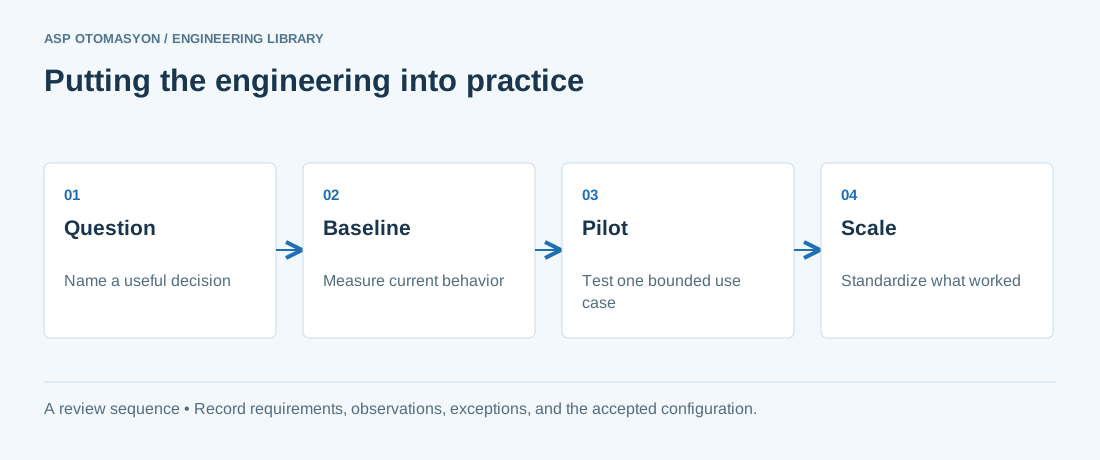
- Name the operational decision, its owner, and the evidence required to judge whether it improved.
- Document asset identifiers, units, timestamps, quality rules, and definitions shared between OT and business applications.
- Compare the pilot against a recorded baseline before extending it to other machines or sites.
Follow an ASP project guide to connect the fundamentals with implementation and acceptance.
Primary references and further reading
Use the original specifications and product documentation for implementation details. The examples in this guide are illustrative engineering scenarios, not published project results.