
In industrial security, the human is both the weakest link and the first line of defense: the operator who notices a USB stick that should not be there, the technician who reports a strange laptop on the control network, the engineer who questions a vendor request — these people catch what technology misses. But awareness is not a poster campaign; it is a structured program of training, reinforcement, and feedback that gives every role the knowledge and the authority to act. This article covers building an ICS-specific awareness program.
Why Generic IT Security Training Fails in OT
Office security training centers on phishing emails, passwords, and data protection. The plant floor faces different realities:
- Physical vectors dominate — USB sticks, contractor laptops, and mobile devices are normal work tools in plants; the training must address them as security instruments, not just convenience.
- Behavioral norms conflict — plants value helpfulness ("the vendor engineer needs to plug in") and continuity ("the shift must run") — exactly the behaviors attackers exploit; the program must give staff a defensible way to say no.
- Reporting is culturally hard — reporting a colleague's shortcut or a vendor's request feels like escalation; the program must make reporting safe, easy, and valued.
- The stakes are physical — a security event can stop production or endanger people; awareness content should be anchored in the plant's real processes and consequences, not abstract data loss.
Roles and Content
Awareness content is differentiated by role, not one-size-fits-all:
| Role | Focus areas |
|---|---|
| Operators | Physical security (visitors, USB, tailgating), reporting anomalies, social engineering at the gate and the control room. |
| Technicians/maintenance | Portable media discipline, laptop hygiene, remote access sessions, change authorization, spotting tampering. |
| Engineers | Secure development/config practice, credential hygiene, change management, vendor interactions, ICS threat landscape. |
| Management | Risk and consequence framing, incident decision roles, investment rationale, regulatory context. |
| Contractors/vendors | Plant security rules as contractual requirements, induction training, supervised access, reporting duties. |
Content should include real incident case studies (anonymized plant or industry examples: "a USB stick brought malware into a packaging line — what would have caught it") — stories transfer behavior better than slides of policies.
Delivery Methods That Work
- Shift-compatible scheduling — training embedded in the shift pattern (toolbox talks, shift-start briefings) rather than classroom days that production cannot spare.
- Short, frequent reinforcement — monthly 10-minute security topics in the existing meeting rhythm beat an annual 4-hour session.
- Practical drills — controlled exercises: a "lost" USB stick planted and reported, a simulated visitor tailgating the control room, a fake vendor request phone call. Debriefed properly, these change behavior measurably.
- On-the-job evidence — the security walk with the maintenance team (what would a tampered device look like here?) trains the observation skills the program depends on.
- Language and literacy — content in the workforce's working languages, with procedures that do not depend on reading a manual at 3 a.m.
Reporting: The Program's Feedback Loop
An awareness program without a functioning reporting channel is a lecture. The essentials:
- A simple, known channel — one phone number/address for security concerns, answered by a named person; anonymous option where culture requires it.
- Fast, visible response — every report acknowledged within a defined time and its outcome communicated (anonymized where needed). People stop reporting when reports disappear.
- No-blame culture — reporting an honest mistake is rewarded, not punished; the distinction is between errors (coached) and concealment (managed).
- Metrics — reports per month by category, drill results, training completion by role; the program is managed by its numbers like any other plant process.
Measuring the Program
Measure outcomes, not activity: report rates trending up (good — trust is building) then stabilizing (normal state), drill performance improving, and — the ultimate metric — security incidents caught by staff reporting. Annual refresh with new scenarios keeps the program from becoming background noise, and management visibility (quarterly security dashboard including awareness status) keeps the program funded.
Summary
ICS security awareness converts the plant workforce into a detection layer: role-specific content anchored in plant reality, shift-compatible delivery with frequent reinforcement, practical drills, and a reporting channel that responds visibly. Generic IT training does not transfer to the plant floor; a program designed for operators, technicians, and shift rhythm does. The sensors watch the network; the people watch everything else — and they will, if the program earns their trust.
Apply this to your project
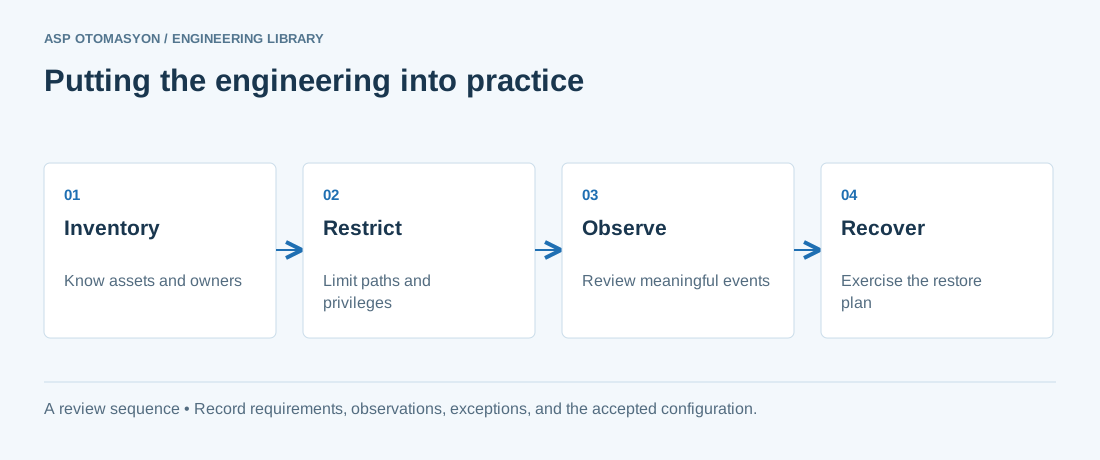
- Identify asset owners, permitted communications, operational dependencies, and consequences of losing the function.
- Test access restrictions and visibility without disrupting plant operations; agree the activity with the OT owner.
- Validate an offline recovery path and document who can authorize isolation, restoration, and return to service.
Follow an ASP project guide to connect the fundamentals with implementation and acceptance.
Primary references and further reading
Use the original specifications and product documentation for implementation details. The examples in this guide are illustrative engineering scenarios, not published project results.