
Industrial Control System (ICS) incident response is the structured approach to preparing for, detecting, containing, and recovering from cybersecurity events affecting operational technology (OT) environments. Unlike IT incident response, ICS response must account for physical process safety, production continuity, and the unique constraints of legacy control systems that cannot simply be rebooted or patched on demand.
Why ICS Incident Response Is Different
Responding to a cybersecurity incident in an OT environment differs fundamentally from IT response:
- Safety first — The primary concern is always human safety and environmental protection, not data confidentiality.
- Availability over integrity — In many OT scenarios, maintaining process availability takes priority over immediately restoring system integrity.
- Cannot simply isolate — Disconnecting a compromised DCS or SCADA system may cause an uncontrolled process shutdown, which can be more dangerous than the cyber event itself.
- Legacy systems — Many ICS components run unsupported operating systems (Windows XP, 2000) and cannot be patched or replaced quickly.
- Physical consequences — A successful attack on industrial equipment can cause explosions, chemical releases, fires, or equipment destruction.
Incident Response Lifecycle (NIST SP 800-61 Adapted for ICS)
1. Preparation
The most critical phase. Preparation activities include:
- Developing an ICS-specific incident response plan (IRP) with defined roles, escalation paths, and communication protocols.
- Establishing an ICS incident response team (ICS-CERT liaison, OT engineers, IT security, operations, management).
- Maintaining an up-to-date asset inventory of all ICS components (controllers, HMIs, engineering workstations, network devices).
- Creating and testing system images and backups for all ICS workstations and servers.
- Establishing out-of-band communication channels (not dependent on the compromised network).
- Conducting tabletop exercises and simulations at least annually.
2. Detection and Analysis
Detecting ICS incidents requires monitoring both IT and OT-specific indicators:
- Network monitoring — IDS/IPS tuned for industrial protocols (Modbus, DNP3, OPC, EtherNet/IP). Anomaly detection for unexpected traffic patterns.
- Engineering workstation monitoring — Detect unauthorized logic downloads, configuration changes, or firmware updates to PLCs/DCS controllers.
- Process behavior analysis — Unexpected setpoint changes, valve movements, or controller mode switches that do not match operator commands.
- Physical indicators — Alarms, unexpected equipment trips, or process deviations that may indicate a cyber-physical attack.
3. Containment
Containment in OT must balance security with safety and production continuity:
- Short-term containment — Isolate affected network segments while keeping safety systems and critical controls operational. Use firewall rules and VLAN segmentation rather than physical disconnection where possible.
- Alternative operations — Prepare for manual or local operation of critical processes if automated control must be removed from service.
- Evidence preservation — Capture forensic images of affected systems before remediation. Log all actions taken during response.
4. Eradication
- Remove malware, backdoors, and unauthorized accounts from affected systems.
- Rebuild compromised systems from known-good images.
- Apply security patches and updates (after testing in a staging environment).
- Reset all credentials that may have been compromised.
- Verify the integrity of controller logic and configurations.
5. Recovery
- Restore systems to normal operation in a controlled, phased manner.
- Validate process safety before returning to automated control.
- Monitor affected systems intensively for signs of re-compromise.
- Verify that all safety instrumented functions (SIS) are operational and have not been tampered with.
6. Lessons Learned
- Conduct a post-incident review within 2 weeks.
- Document timeline, root cause, effectiveness of response, and gaps identified.
- Update the incident response plan, detection rules, and security controls based on findings.
Key Standards and Frameworks
- NIST SP 800-82 — Guide to Industrial Control Systems Security. Provides ICS-specific security guidance.
- NIST SP 800-61 — Computer Security Incident Handling Guide. Adapted for ICS environments.
- IEC 62443-2-1 — Security for industrial automation and control systems: Establishing an ICS security program. Includes incident response requirements.
- CISA (ICS-CERT) — US Cybersecurity and Infrastructure Security Agency provides ICS-specific advisories, alerts, and incident response resources.
- MITRE ATT&CK for ICS — Knowledge base of adversary tactics and techniques specific to industrial control systems.
ASP OTOMASYON helps industrial facilities develop and test ICS incident response plans, conduct tabletop exercises, and implement detection capabilities aligned with IEC 62443 and NIST frameworks.
Apply this to your project
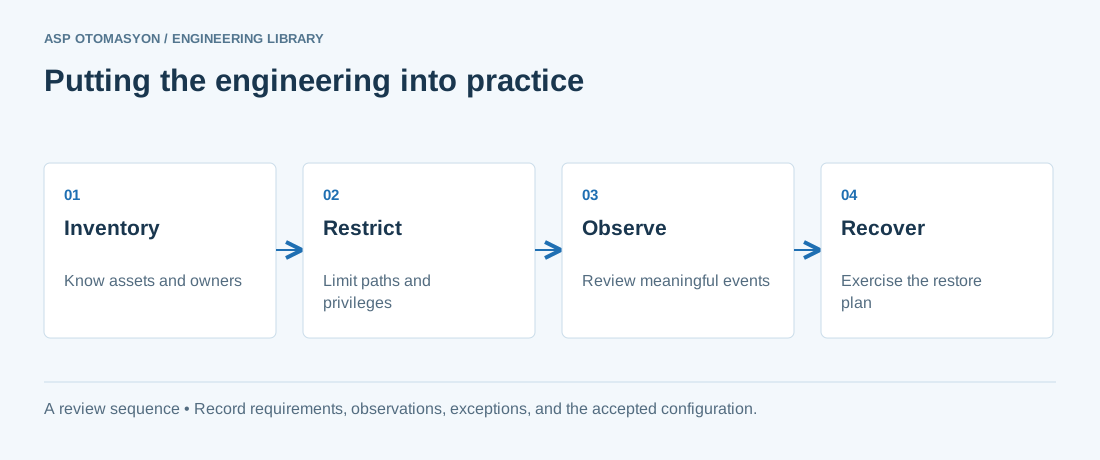
- Identify asset owners, permitted communications, operational dependencies, and consequences of losing the function.
- Test access restrictions and visibility without disrupting plant operations; agree the activity with the OT owner.
- Validate an offline recovery path and document who can authorize isolation, restoration, and return to service.
Follow an ASP project guide to connect the fundamentals with implementation and acceptance.
Primary references and further reading
Use the original specifications and product documentation for implementation details. The examples in this guide are illustrative engineering scenarios, not published project results.