
Augmented reality (AR) overlays digital information on the physical world: a technician looking at a machine sees its nameplate data, maintenance history, or step-by-step instructions anchored to the actual equipment. After a decade of pilot projects, AR has found its industrial niche — not replacing experts, but multiplying them: remote support, guided maintenance, and training for a workforce that is simultaneously retiring and newly hired. This article covers where AR delivers, how to deploy it honestly, and what kills the pilots.
Where AR Delivers Value
| Use case | What AR does | Evidence of value |
|---|---|---|
| Remote expert support | Field technician shares their view; the remote expert annotates the live image and guides the task. | Shorter resolution times for unfamiliar faults; fewer expert site visits; works across language barriers. |
| Guided procedures | Step-by-step instructions (text, images, 3D overlays) anchored to the equipment for inspection, calibration, and replacement tasks. | Fewer errors and less supervisor time on low-frequency or high-complexity tasks. |
| Training | Interactive practice on real or digital equipment with guidance, feedback, and recording. | Shorter time-to-competency; safe practice of rare and risky procedures. |
| Visualization of hidden state | Sensor data, thermal images, or commissioning notes displayed at the point of measurement. | Faster diagnosis; fewer lookups across systems. |
The common thread: AR wins where the task is spatial (hands on equipment), the information needed is contextual (about this exact asset), and the alternative is switching between paper, laptop, and machine.
Technology Choices
- Smartphones and tablets — zero hardware cost, familiar interface; the pragmatic workhorse for remote support and document lookup. AR on phones is video-call-plus-annotation; the value is real and the deployment is trivial.
- Smart glasses — hands-free headsets (from enterprise models to tethered devices) for tasks where both hands are busy; the premium price and battery/comfort constraints limit them to the highest-value jobs.
- Head-mounted display (HMD) with full overlay — for training simulators and complex assembly guidance where 3D anchors matter; heavier integration, stronger effect.
Rule for most plants: start with phones/tablets and remote support, measure the workflow change, and only then evaluate glasses for the specific tasks where hands-free is decisive.
Content Is the Real Project
AR hardware is mature; AR content is the bottleneck. Every guided procedure requires: a scripted task analysis, the equipment context (which machine, which model), the steps with clear pass criteria, media (photos/videos of the actual equipment — stock images destroy credibility), and localization into the workforce's language. Budget accordingly:
- Author procedures from the actual work: film the best technician doing the task, then structure the video into steps with decision points.
- Reuse existing content: the CMMS instructions, OEM manuals (with permission), and vendor videos become the AR library's raw material.
- Maintain the content: equipment changes, procedures change; an out-of-date AR procedure is worse than none because it looks authoritative.
- Connect to the asset register: the AR session should pull the asset's history (last maintenance, open work orders, alarms) from the CMMS/ERP via API — AR as a window into the digital thread, not a standalone app.
Deployment Realities
- Network and IT — AR sessions stream video and need reliable Wi-Fi/cellular coverage in the maintenance areas, plus authentication for the data the sessions access; involve IT early.
- Safety in the field — AR must not compromise situational awareness: headsets for walk-around inspection need pass-through modes and training on distraction risks; plant safety rules (PPE, zones) apply to the device.
- Privacy and recording — remote sessions record plant views; define who may record, store, and view them, and follow local data rules (photos of proprietary equipment).
- Culture — the pilot champions matter more than the technology: technicians who shape the procedures will own them; technicians who receive them from an office will resist.
Measuring ROI Honestly
Pilot metrics should be chosen before the pilot: mean time to resolve for remote-supported faults (vs baseline), errors or rework per guided task, training time to competency, and expert site-visit counts. Compare against the baseline with the same people doing the same tasks. Many AR pilots fail the ROI test because they measured enthusiasm instead of workflow; the ones that survive are measured on time, errors, and travel.
Summary
AR's industrial value is concrete: remote expert support, guided procedures, and training on real equipment. Deploy pragmatically — phones and tablets first, content authored from real work and connected to asset data, glasses only where hands-free pays — and measure time, errors, and travel against a baseline. AR does not replace the experienced technician; it extends that experience to more people, more places, and more shifts.
Apply this to your project
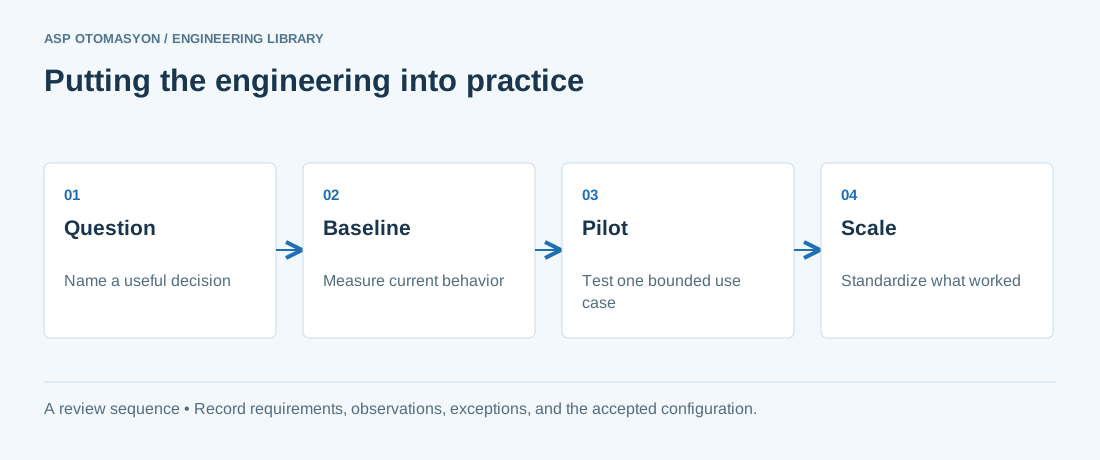
- Name the operational decision, its owner, and the evidence required to judge whether it improved.
- Document asset identifiers, units, timestamps, quality rules, and definitions shared between OT and business applications.
- Compare the pilot against a recorded baseline before extending it to other machines or sites.
Follow an ASP project guide to connect the fundamentals with implementation and acceptance.
Primary references and further reading
Use the original specifications and product documentation for implementation details. The examples in this guide are illustrative engineering scenarios, not published project results.