
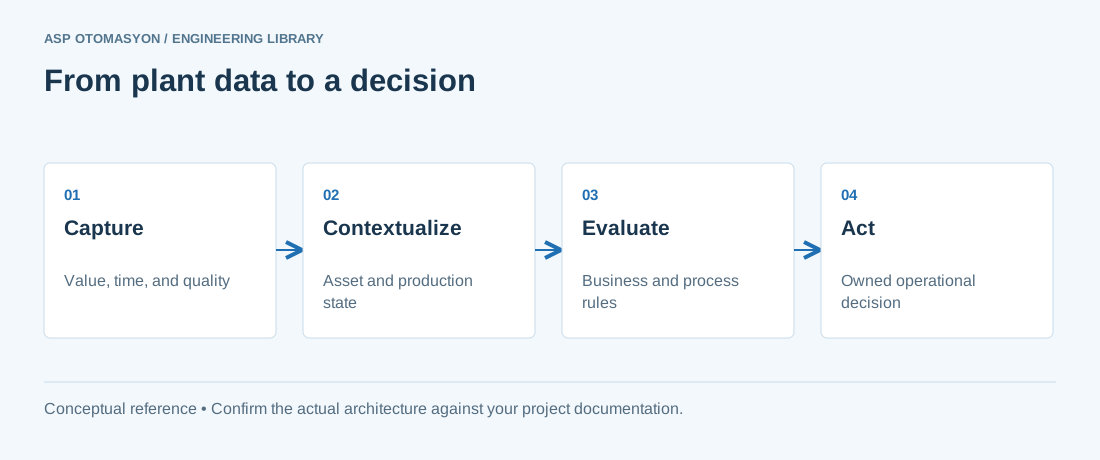
Two terms dominate Industry 4.0 discussions — digital twin and digital thread — and they are routinely confused. The digital thread is the data spine: the connected flow of information about a product or asset across its whole lifecycle. The digital twin is the living model: a virtual representation of an asset that mirrors its real-world state. A twin consumes thread data; the thread connects the twin to engineering, production, and operations. Understanding the difference is the foundation of a realistic implementation plan.
Defining the Concepts
- Digital thread — the traceable, bidirectional flow of data and models across lifecycle stages: design (CAD/PLM), engineering (simulation), manufacturing (ERP/MES/automation), operation (SCADA/historian), and service (maintenance records). It answers "what data exists about this asset, and how did it change over time?"
- Digital twin — a virtual model synchronized with a physical asset: geometry, behavior, state, and history. It answers "what is the asset doing right now, and what will it do if...?" Twins range from simple digital shadows (one-way data flow) to full digital twins (bidirectional: the model can influence the asset).
Practical definition used in industry: a digital shadow has manual data flow, a digital model has one-way automated flow, and a digital twin has fully automated two-way flow. Most industrial deployments today are shadows or models — and that is often exactly right.
The Thread in Practice
A digital thread implementation does not require new technology everywhere; it requires linking what already exists:
- Asset identity — every physical asset gets a persistent identifier (serial number, asset tag) that is the same in ERP, CMMS, PLM, and the historian.
- Lifecycle data capture — each stage writes its data against that identity: design revision, manufacturing batch and serial, configuration as built, commissioning results, operating data, maintenance events.
- Reference data governance — a master data model defines what a "pump" or "production order" means across systems; without it, the same asset has five different records in five databases.
- Data access layer — APIs and standards (OPC UA, ISA-95 interfaces, REST) that let applications pull the data they need instead of receiving periodic exports.
The value appears when the thread is queried: "which batch of material went into the units that failed?" or "how many machines are running the firmware version that caused the downtime?" — questions that are expensive or impossible without the thread.
Digital Twin Levels of Fidelity
| Twin type | Content | Use case |
|---|---|---|
| Descriptive twin | Static model: 3D geometry, documents, parameters | Training, documentation, visualization. |
| Diagnostic twin | Live state: sensor data, alarms, health indicators | Condition monitoring, troubleshooting, remote support. |
| Predictive twin | Behavior models: degradation, remaining useful life | Predictive maintenance, spare part planning. |
| Prescriptive twin | Optimization: what-if simulation driving decisions | Production planning, energy optimization, operator guidance. |
Start at the descriptive/diagnostic level for critical assets; the predictive and prescriptive levels need data history and modeling effort that most pilots underestimate.
Implementation Roadmap
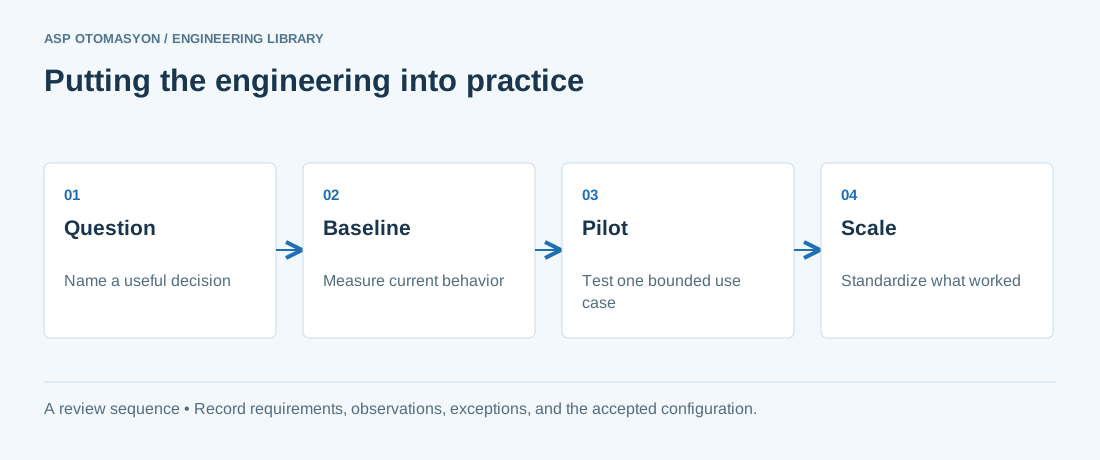
- Pick the asset class — a twin for everything is a doomed project. Choose assets where state visibility pays: high-value, high-failure-cost, or regulatory-critical equipment.
- Define the questions — write down the decisions the twin must support (maintenance timing, energy optimization, quality investigation). The data model follows the questions, not the other way around.
- Build the data pipeline — connect the asset's OPC UA/fieldbus data to the historian/cloud; clean, align, and timestamp it.
- Develop the model incrementally — a physics-based model for known behavior, data-driven models where physics is unknown; validate against real operation, not simulation.
- Close the loop with the thread — twin findings (e.g., "bearing degrading") write back into the CMMS work order and the design feedback loop — this is where the thread pays.
- Measure value — track decisions actually changed by the twin: avoided failures, reduced energy, fewer investigations. Unmeasured twins get cancelled.
Common Failure Modes
- Twin without thread — a beautiful 3D model fed by manually maintained spreadsheets: stale within weeks.
- Data quality neglect — twin accuracy is bounded by sensor quality, calibration, and historian gaps; garbage in, confident garbage out.
- Tool-driven instead of question-driven — buying a platform and then looking for problems it can solve.
- Perpetual pilots — dozens of demos, no production deployment; the fix is ruthless prioritization and a defined success metric per pilot.
Summary
The digital thread links data across the lifecycle; the digital twin mirrors an asset's state and behavior. Build the thread first — persistent identity, governed reference data, accessible APIs — then add twins where the questions justify the model. Start descriptive, add prediction only with real data history, and close the loop so twin insights change decisions. The thread is the infrastructure; the twin is the application — neither works without the other.
Apply this to your project
- Name the operational decision, its owner, and the evidence required to judge whether it improved.
- Document asset identifiers, units, timestamps, quality rules, and definitions shared between OT and business applications.
- Compare the pilot against a recorded baseline before extending it to other machines or sites.
Follow an ASP project guide to connect the fundamentals with implementation and acceptance.
Primary references and further reading
Use the original specifications and product documentation for implementation details. The examples in this guide are illustrative engineering scenarios, not published project results.