
Steelmaking is automation's most demanding industrial environment: temperatures above 1,500 °C, massive drives, fast-moving strip at hundreds of meters per minute, and a production chain that spans days from ore to finished coil. Steel plant automation covers the full ISA-95 stack — from level 1 drive and sequence control to level 2 process models and level 3 production management — and it is a benchmark domain for high-performance control: the strip mill and the arc furnace push control technology further than most other industries.
The Process Chain and Its Automation
| Area | Process | Automation characteristics |
|---|---|---|
| Melt shop | Electric arc furnace (EAF), ladle metallurgy, casting | Extreme environment; EAF electrode control and scrap charging sequences; ladle tracking; continuous caster with level control and mould monitoring. |
| Hot rolling | Reheat furnace, roughing mill, finishing mill, coilers | The control frontier: speed and tension control between stands, automatic gauge control (AGC), strip profile and flatness control, and runout-table cooling control for metallurgical properties. |
| Cold rolling and processing | Tandem mills, pickling, galvanizing, annealing, temper | High-speed gauge and tension control, strip tracking through process lines, furnace temperature control with strip-speed coordination. |
| Finishing and logistics | Inspection, cutting, coil handling, shipping | Automated material handling, tracking systems, and MES integration for order-to-dispatch. |
Level 2: Where Steel Automation Is Unique
Steel plants are distinguished by mature Level 2 process models — computers that compute setpoints for the Level 1 controllers:
- Reheat furnace models — compute the slab heating curve (temperature profile) for the production rate and target discharge temperature, optimizing fuel.
- Mill setup models — calculate roll gap, speed, and cooling settings for each product (grade, gauge, width) from the metallurgical model — the famous "setup calculation" that runs before each bar/strip enters the mill.
- Cooling models — the runout table sprays are computed to hit the metallurgical targets (ferrite, bainite, martensite fractions) — a model whose error shows up as off-grade coil.
- Gauge and flatness control — feedforward (from entry gauge and hardness) plus feedback (from exit gauge and shape meters) with mill modulus compensation — control at millisecond scale.
The Level 2 systems make steel automation a software engineering discipline: models, adaption (on-line tuning from measured results), and the interface to Level 1 and Level 3 are the plant's intellectual property.
Drive Systems and High-Performance Control
The electrical drives are the muscle: main mill drives rated in the tens of megawatts, with speed and tension control loops whose performance decides the product. Key elements:
- Speed-tension control — between stands, the strip tension is controlled by speed trimming of the adjacent stands (or looper position in hot mills); the control must be stable across the full speed range and during threading.
- Automatic gauge control (AGC) — thickness corrected by roll force measurement and position control at millisecond rates; the AGC is the flagship control loop of the industry.
- Automation of material handling — cranes, coil cars, and transfers running on PLCs with tracking; the physical logistics is as automated as the process.
- Robotics — increasingly in sampling, testing, and packaging areas (see the robotic cell article for integration patterns).
Environment and Reliability Engineering
Steel automation must survive its environment: heat, dust, water, and electromagnetic noise from the drives. Practical rules: IP-rated cabinets with cooling, fiber optics for the long noisy runs, redundancy for the critical controllers (hot standby), and maintenance windows planned around the process (continuous casting stops for nobody). The historian records everything — the coil's automation data (temperatures, forces, speeds) is part of the product's quality file and the basis of the continuous improvement loop.
MES and the Order Chain
Steel production is order-driven: customer orders → production planning → heat/slab/coll tracking → dispatch. The MES layer (see the MES article) tracks every piece from order to shipment, with the automation data attached (each coil's process history). The integration is ISA-95 standard: Level 3 passes the order and quality targets down; Level 2 reports the actuals and quality up. The tracking identity (heat number, slab ID, coil ID) is the data spine the whole plant runs on — the digital thread in its purest form.
Summary
Steel plant automation spans the whole ISA-95 stack: robust Level 1 drive and sequence control in an extreme environment, model-based Level 2 systems (furnace, mill setup, cooling) that are the industry's specialty, high-performance gauge/tension control, and MES-level order tracking with full process data attachment. It is a domain where control theory, software engineering, and mechanical harshness meet — and where the quality of the automation shows up in every ton shipped.
Apply this to your project
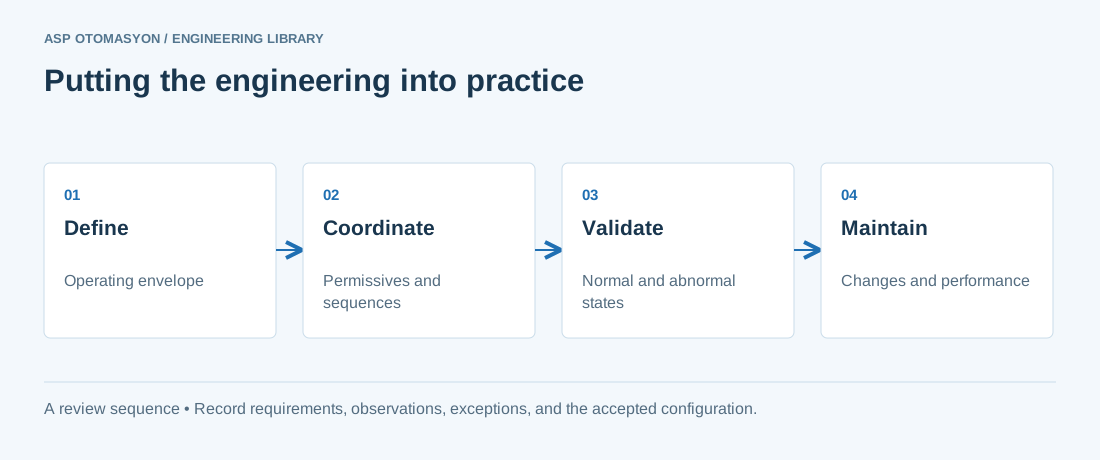
- Record process boundaries, required operating states, and interactions with independent protective systems.
- Check instrument quality, control authority, permissives, and operator responsibilities during state changes.
- Agree how tests, deviations, and configuration changes will be recorded within the facility's engineering procedures.
Follow an ASP project guide to connect the fundamentals with implementation and acceptance.
Primary references and further reading
Use the original specifications and product documentation for implementation details. The examples in this guide are illustrative engineering scenarios, not published project results.