
Pulp and paper is one of the most energy- and capital-intensive process industries: a modern mill runs continuous processes (digesting, washing, bleaching, papermaking) at massive scale, where a 1% efficiency improvement is worth millions. The automation challenges span the full spectrum — batch and continuous chemistry in the pulp mill, high-speed web handling at the paper machine (1,500+ m/min), and plant-wide energy and recovery optimization. The industry was also an early adopter of advanced process control, quality control systems (QCS), and, today, digitalization.
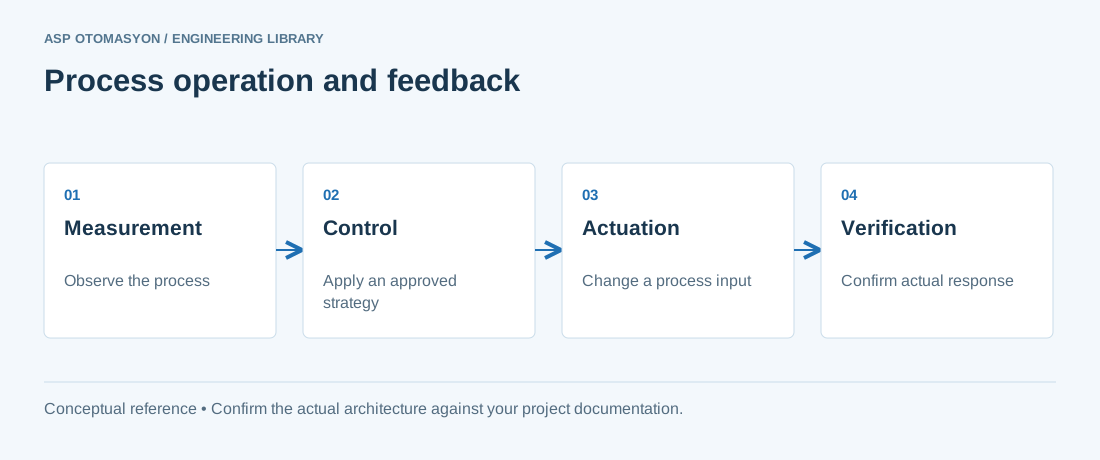
The Process Chain
| Area | Process | Automation focus |
|---|---|---|
| Woodyard | Debarking, chipping, chip handling | Material handling control, chip quality (size) measurement. |
| Digesting | Batch or continuous cooks converting chips to pulp | Kappa number control (degree of cooking) — the classic inferential control problem: calculated from temperature, pressure, and liquor chemistry. |
| Washing and screening | Brown stock washing, screening, cleaning | Dilution factor and consistency control, washer drum level control. |
| Bleaching | Chlorine-free stages (O, D, E, P) brightening pulp | Stage-by-stage chemical dosing control, brightness measurement and control. |
| Recovery boiler and causticizing | Black liquor burning, chemical recovery, lime kiln | The mill's energy and chemical heart: combustion control, liquor density, kiln temperature profile — and the plant's largest energy recovery system. |
| Paper machine | Stock preparation, headbox, forming, pressing, drying, finishing | The control frontier: basis weight, moisture, caliper, and profile control across the web. |
The Paper Machine: QCS and Profile Control
The paper machine is where the industry's control technology concentrates. The Quality Control System (QCS) measures the web's properties (basis weight, moisture, caliper, gloss, color) with scanning sensors and closes control loops:
- Machine-direction (MD) control — basis weight via the headbox flow or stock valve, moisture via steam pressure in the dryer section; the loop dynamics are the classic paper machine challenge (long dead times, coupling between weight and moisture).
- Cross-direction (CD) control — slice lip actuators, steam box zones, and caliper actuators shape the profile across the web; CD control is a high-dimensional (100+ actuators), interacting control problem — one of the industrial applications where model-based and advanced control earns its keep.
- Dilution control headboxes — basis weight profile control via dilution water instead of slice movement: faster, less mechanical, the modern standard.
The QCS is integrated with the DCS: setpoints, measurements, and quality reports flow both ways, and the grade-change sequence (product changes on the fly) coordinates machine speed, stock, and dryer settings — a sophisticated sequence that automation makes routine.
Energy and Recovery: The Mill Economy
A mill's energy economy is its competitive position:
- The recovery boiler — burns black liquor to recover chemicals and produce high-pressure steam; combustion and emission control, smelt bed monitoring, and the tie to the steam balance make it the mill's most valuable and most dangerous unit.
- Steam and power balance — the mill's turbines and steam users are dispatched by a site-wide energy management system (see the EMS articles); the steam header pressures are controlled across the whole site, not per unit.
- Water and effluent — water usage and effluent treatment are regulated; the automation includes the treatment plant (see the water/wastewater article) and water use monitoring.
Digitalization in Pulp and Paper
The industry's digitalization follows the general patterns with mill specifics: advanced process control (MPC) on digesters, bleach plants, and the recovery boiler; predictive maintenance on the machine's critical rotating assets (the dryer section bearings, the winder); production optimization (grade scheduling, trim optimization — minimizing the trim waste when cutting reels into rolls); and the digital twin concepts applied to the drying section and energy flows. The data foundation is the same as everywhere: historian, tag discipline, and the ISA-95 integration between DCS, QCS, and MES.
Summary
Pulp and paper automation spans chemical batch/continuous control (digesting, bleaching, recovery), high-speed web control (QCS with MD/CD loops), and plant-wide energy optimization — with the recovery boiler as the industrial crown jewel of energy recovery. The control problems are rich (inferential kappa, interacting profiles, grade changes), the scale is massive, and the payoff of good automation is measured in percentage points of a very large number. It is a domain where control engineering directly sets the mill's profitability.
Apply this to your project
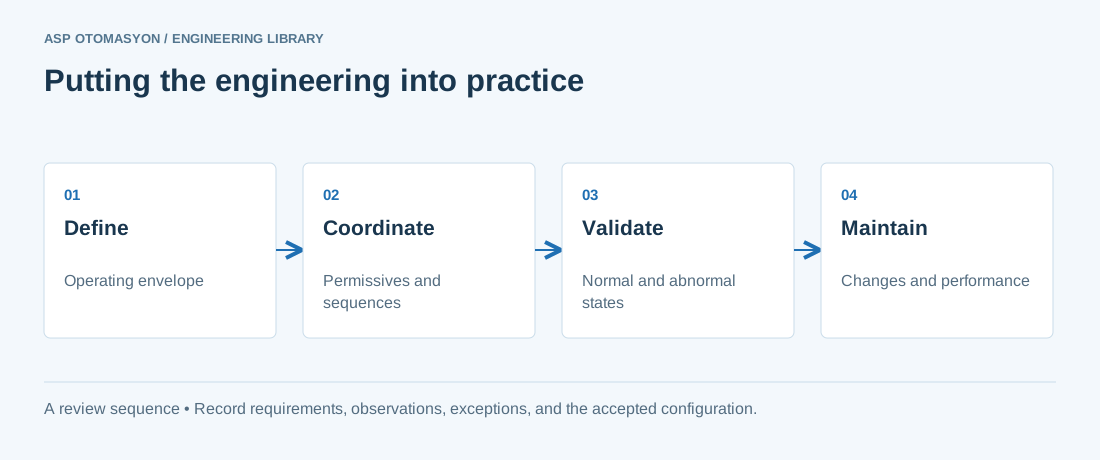
- Record process boundaries, required operating states, and interactions with independent protective systems.
- Check instrument quality, control authority, permissives, and operator responsibilities during state changes.
- Agree how tests, deviations, and configuration changes will be recorded within the facility's engineering procedures.
Follow an ASP project guide to connect the fundamentals with implementation and acceptance.
Primary references and further reading
Use the original specifications and product documentation for implementation details. The examples in this guide are illustrative engineering scenarios, not published project results.