
Quality 4.0 is the application of digital technologies to quality management: connecting quality data across the value stream, analyzing it continuously, and acting on it in real time — instead of sampling, recording on paper, and discovering defects at the final inspection. It is not a replacement for quality management systems (QMS) but their digital evolution: the same principles (control, assurance, improvement) executed with data that flows automatically and analysis that runs continuously.
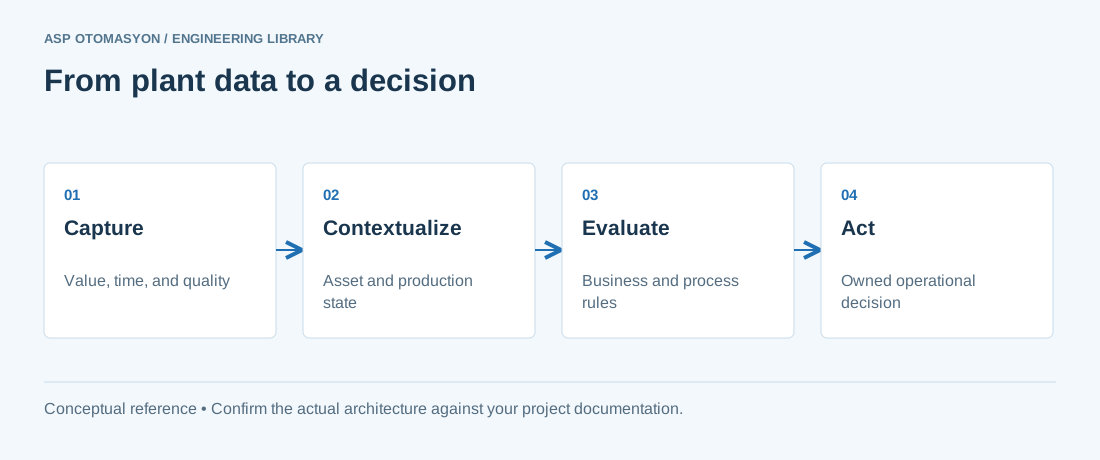
The Quality 4.0 Stack
- Connected quality data — measurement data (dimensions, weights, parameters) captured automatically from instruments, gauges, and test systems; quality events from the MES; inspection records from the LIMS — all in one time-aligned data model with the production context (batch, machine, operator, material).
- Real-time SPC — control charts computed on live process data with rules (Western Electric / Nelson) applied automatically; out-of-control signals reach the operator immediately instead of at the shift report.
- Predictive quality — models that predict defect likelihood from process parameters (temperature profiles, pressure, machine health) and warn before the part is made — the same pattern as predictive maintenance applied to quality.
- Digital workflows — non-conformance, CAPA (corrective and preventive action), and audit processes managed electronically with routing, deadlines, and evidence attached — the QMS becomes a system, not a file cabinet.
- Traceability and analytics — the digital thread from material lot to shipped unit, with quality analytics (Pareto, six-pack, capability) refreshed continuously instead of monthly.
Starting Points That Work
Quality 4.0 is a transformation of many parts; the plants that succeed start with one:
- Automate the data capture — replace manual gauge entry with digital gauges and automated measurement systems where the volume justifies it. Data entry errors and inspection lag are the two most damaging quality data defects.
- Real-time SPC on the critical parameters — choose the 20 characteristics that drive the most cost (scrap, rework, escapes), implement live charts with operator-visible signals, and attach the out-of-control action plan (OCAP) to each signal.
- Close the loop with the process — quality data feeds back to the process parameters: drift in a characteristic triggers a machine adjustment or maintenance call, not just a record. This is where quality data becomes process control.
- Digitalize the NCR/CAPA workflow — the fastest visible win: non-conformance reports that route, escalate, and archive themselves with full evidence, and CAPAs whose effectiveness is verified on data.
- Connect quality to the digital thread — batch genealogy: which material lots, machines, and parameters produced a given unit — the foundation of recall scope and root cause analysis.
Technology and Integration
The enabling choices are mostly integration and data management:
- Measurement devices connect over standard fieldbuses or OPC UA; test systems expose results via APIs; the MES/LIMS/QMS share one batch identity.
- SPC and analytics run on the same historian/lake used by production — quality data should not live in a separate island.
- Vision inspection results (from the automation layer) feed the same quality data model — automated inspection is quality data generation.
- Select QMS software that has APIs and a data model, not a document repository with a quality label; the system must exchange data with the plant, not just store PDFs.
Regulatory Context
For regulated industries (pharma, medical devices, food, automotive), Quality 4.0 must respect validation and data integrity rules: 21 CFR Part 11 / EU GMP Annex 11 for electronic records and signatures; ALCOA+ principles (attributable, legible, contemporaneous, original, accurate) for data; and validation of the systems that generate regulated data. These rules are compatible with digitalization — they require audit trails, access control, and system validation, which modern systems provide — but they must be planned from the start, not retrofitted. Automated data capture is, in fact, the best answer to many data integrity requirements.
Organizational Change
Quality departments are conservative by design, and for good reason. The change levers: quality engineers leading the analytics (not IT), inspectors shifting from data entry to data review and process support, and management reporting on leading quality indicators (process capability trends, SPC signal response times) instead of only lagging ones (scrap %, escapes). The technology amplifies the quality profession; the profession must adopt the amplifier.
Summary
Quality 4.0 connects quality data, analyzes it in real time, and feeds it back into the process: automated capture, live SPC with action plans, predictive quality, digital NCR/CAPA workflows, and batch traceability — built on integration standards and governed by data integrity discipline. Start with one high-value characteristic or workflow, measure the loop's response time, and expand. Quality was always a data discipline; Quality 4.0 is what happens when the data finally flows.
Apply this to your project
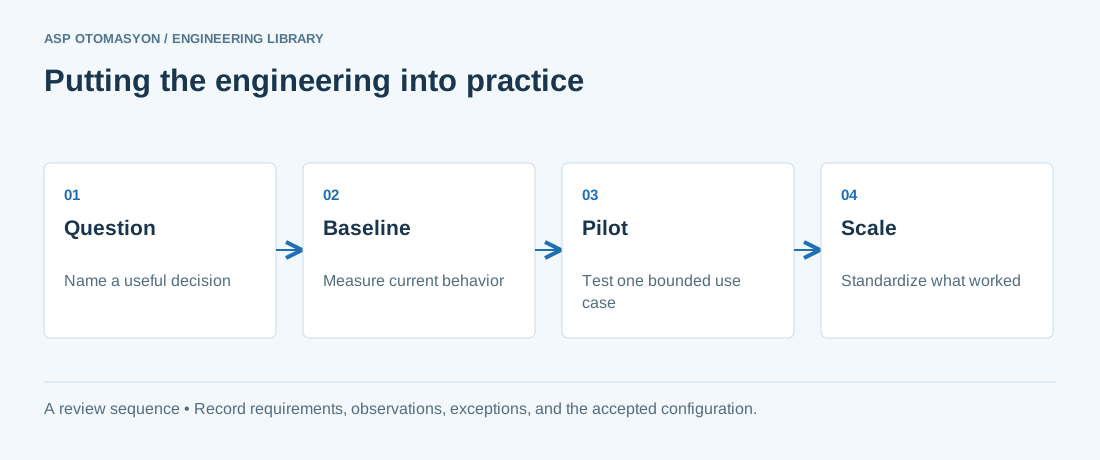
- Name the operational decision, its owner, and the evidence required to judge whether it improved.
- Document asset identifiers, units, timestamps, quality rules, and definitions shared between OT and business applications.
- Compare the pilot against a recorded baseline before extending it to other machines or sites.
Follow an ASP project guide to connect the fundamentals with implementation and acceptance.
Primary references and further reading
Use the original specifications and product documentation for implementation details. The examples in this guide are illustrative engineering scenarios, not published project results.