
Industrial digitalization projects collect more data every year — historians, MES, quality systems, energy meters, edge devices — and then struggle with the same symptoms: three different systems report different OEE, the KPI dashboard's numbers change depending on who answers, and nobody owns the definitions. Manufacturing data governance is the discipline that fixes this: clear ownership, agreed definitions, measured quality, and documented lineage for the data that decisions depend on. It is less glamorous than AI, and it is what makes AI work.
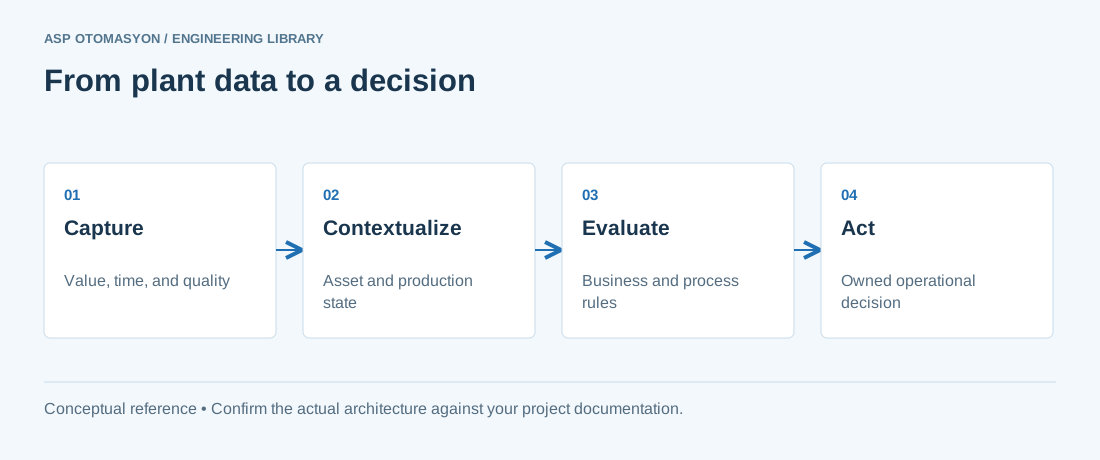
What Data Governance Means on the Plant Floor
Governance is not bureaucracy; it is answering five questions for every important data asset:
- What is it? — an agreed definition. "Downtime" means what, exactly? Planned vs unplanned? Does a changeover count? The definition lives in one place and is used everywhere.
- Who owns it? — a named accountable person per data domain (production data, quality data, energy data, maintenance data). Ownership means they decide definitions, access, and quality priorities.
- Where does it come from? — the authoritative source system for each fact. The historian is authoritative for machine states; the MES for order progress; the CMMS for work orders. Conflicts are resolved by source, not by convenience.
- How good is it? — measured quality: completeness, timeliness, accuracy, consistency. "Good enough for monitoring but not for billing" is a legitimate, documented classification.
- Who may use it, and how long do we keep it? — access rules (who sees downtime by operator?) and retention (how long does process data stay before archival/deletion?).
Building the Governance Foundation
Start small and formalize incrementally:
- Business glossary — a document (wiki page is fine) with the definitions of the top 50 terms: OEE, availability, yield, downtime classes, scrap, RFT. Each term has one definition, one formula, and one source system.
- Data owners and stewards — an owner per domain; a steward does the operational work (definitions maintenance, quality monitoring). This is a role assignment, not a new department.
- System-of-record map — one page listing every system and which facts it owns. When two systems disagree, the map says who wins.
- Quality monitoring — automated checks on critical data flows: historian gaps, negative values where impossible, stale timestamps, duplicate events. Alert the steward, not the whole plant.
- Change control — definitions change (a new product type changes "yield"); the change is recorded with an effective date so history stays comparable.
Data Lineage and Traceability
Lineage is the record of where a number came from: which sensor, which calculation, which system, which transformation. It matters most when data crosses system boundaries:
- Every KPI on a dashboard should be traceable to its raw data and its calculation (with version).
- Regulated industries (pharma, food) already demand audit trails; lineage makes them usable for analytics instead of an afterthought.
- Machine learning models trained on plant data need lineage to answer "what changed between model version 2 and 3?" — the most common production ML failure.
Practical lineage tools: the historian's tag metadata (source, engineering unit, last calibration), ETL/edge pipeline logs, and — for the important flows — a simple data catalog that records pipeline versions and refresh times.
Governance and the Automation Layer
The automation department is both a data producer and a data consumer, and governance friction concentrates at its boundaries:
- Tag names change during commissioning — the historian consumers downstream break silently. Govern tag renames with a notice period and a mapping table.
- PLC programs are the de facto definition of machine behavior; the governance model must include the control narrative and interlock documentation as reference data.
- OT data flowing to IT systems needs contracts (units, quality, timestamps) — the same discipline as any interface, but now with governance consequences.
Making Governance Stick
Governance fails when it is a document exercise. The practices that survive:
- Governance reviews attached to real decisions (monthly performance review walks the glossary; disagreements escalate with evidence).
- Data quality KPIs in the same dashboard as production KPIs — quality is not a separate report.
- One owner per KPI, visibly named on the dashboard.
- Annual data inventory review — systems and facts change faster than documents.
Summary
Manufacturing data governance is the operating system for industrial analytics: agreed definitions, named owners, authoritative sources, measured quality, and documented lineage. Build the glossary, the system-of-record map, and the quality monitoring first; attach governance to real decisions; and make owners accountable in the visible KPI process. Without it, every analytics project is an argument about whose numbers are right.
Apply this to your project
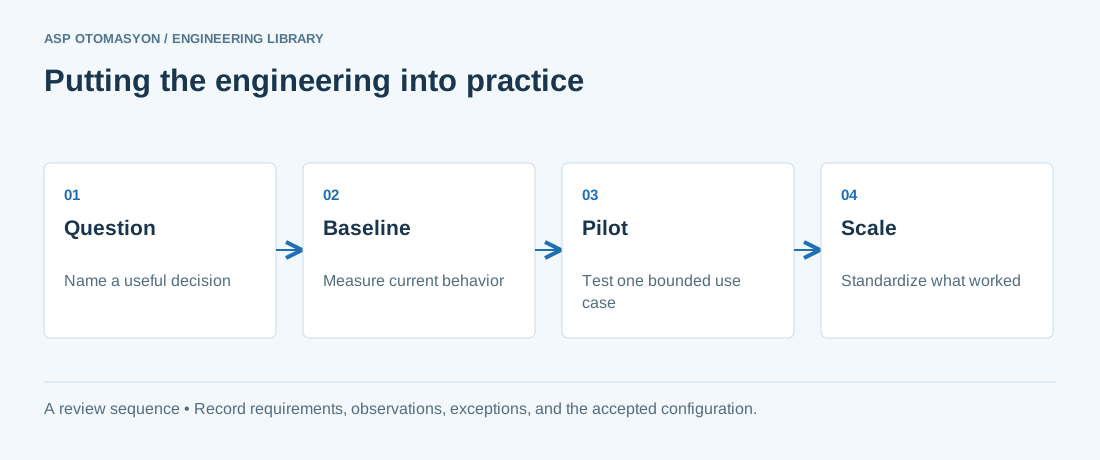
- Name the operational decision, its owner, and the evidence required to judge whether it improved.
- Document asset identifiers, units, timestamps, quality rules, and definitions shared between OT and business applications.
- Compare the pilot against a recorded baseline before extending it to other machines or sites.
Follow an ASP project guide to connect the fundamentals with implementation and acceptance.
Primary references and further reading
Use the original specifications and product documentation for implementation details. The examples in this guide are illustrative engineering scenarios, not published project results.