
Firewalls and intrusion detection are the mechanical core of OT network security: firewalls enforce the zones-and-conduits policy, and IDS/NDR systems watch what passes. But industrial deployments differ from IT in critical ways: the devices must be invisible to the production network (no management traffic disturbing control), they must understand industrial protocols (not just ports), and they must fail in the right direction (never block production on a license or hardware fault). This article covers deploying these controls in OT without breaking the process.
Industrial Firewalls: The Conduit Gatekeepers
A firewall in OT stands at every conduit — the controlled path between zones (see the IEC 62443 zones article): OT/IT boundary, DMZ, remote access, and — increasingly — between plant areas and between controllers and HMIs (micro-segmentation). Deployment principles:
- Default deny with explicit allowances — the conduit rule set lists exactly which source/destination/protocol pairs are permitted; everything else is blocked and logged. The rule set is small if the network design is honest (applications were mapped before rules were written).
- Stateful with industrial awareness — industrial firewalls track session state and understand protocols (Modbus, OPC UA, PROFINET, EtherNet/IP), enabling rules like "writes to this controller only from the engineering station" — beyond what a port-based rule can express.
- Fail-safe behavior — hardware bypass or fail-closed according to the risk: for the OT/IT boundary, fail-closed (no traffic if the device fails); for inline machine-cell protection, the decision depends on whether blocking is safer than passing — design and document it.
- Management isolation — firewall management (config, logging) on a dedicated management network, never through the production path; credentials per admin with audit.
- Performance with margin — the firewall is inline; its throughput must cover peak traffic with headroom (firmware updates, backups, historian traffic all count).
IDS/NDR in OT
Intrusion detection in OT is overwhelmingly passive (see the OT monitoring article): SPAN/tap-based, protocol-aware, baseline-anchored. Deployment decisions:
- Sensor coverage — at the boundaries (OT/IT, DMZ, remote access) and at the core; coverage of the most critical zones (where the highest-consequence controllers live) is a priority, not an afterthought.
- Alert quality — OT IDS alerts must be tuned to the plant: maintenance windows, known batch traffic, and device behavior are baselined; alert fatigue is the #1 cause of failed OT monitoring.
- Integration — the IDS feeds the incident response workflow; alerts reach the on-call engineer per the escalation matrix, and the review cadence (weekly triage, monthly report) is staffed.
- Signature + anomaly — signatures catch known attacks; anomaly detection (baseline deviation) catches the unknown; both are needed, and anomaly is where OT's regular traffic patterns give it an advantage over IT.
The Whitelist Question: Industrial IPS
Inline intrusion prevention (IPS) in OT is a serious decision: blocking production traffic on a false positive is itself a production incident. The pragmatic pattern: deploy IDS (passive) first, build confidence in the alert quality, then add inline blocking only for narrowly defined, high-confidence rules (e.g., block writes to a protected controller from any host outside the engineering station, block unknown source IPs) — the industrial firewall with protocol awareness is often the safer place for these rules than an IPS engine. Inline active response should always be override-able and logged.
Deployment Process
- Map the zones and conduits — the network design (see the segmentation article) defines where the controls go; deploying firewalls without the design is securing random points.
- Define the rule sets from application traffic — capture and analyze the traffic per conduit for a representative period; rules are written from observed need, not guesswork.
- Stage and test — the firewall is configured and tested in the lab with the actual protocols; failure behavior verified (power loss, link loss, config reload).
- Cut over with monitoring — deploy during a maintenance window with the IDS/logs watched; blocked-but-legitimate traffic is found in the first days, not months.
- Operate and review — rule changes follow change management; logs are reviewed per the schedule; the rule set is audited annually (stale rules are a common finding).
Summary
Industrial firewalls enforce the zones-and-conduits policy with protocol awareness and fail-safe design; IDS/NDR watches the traffic passively with tuned, baseline-anchored alerts; and inline blocking is applied narrowly and reversibly. Deploy from the network design, write rules from observed traffic, stage and test every device, and operate with review and change control. The firewall is a policy made physical — and like all policies, it is only as good as its maintenance.
Apply this to your project
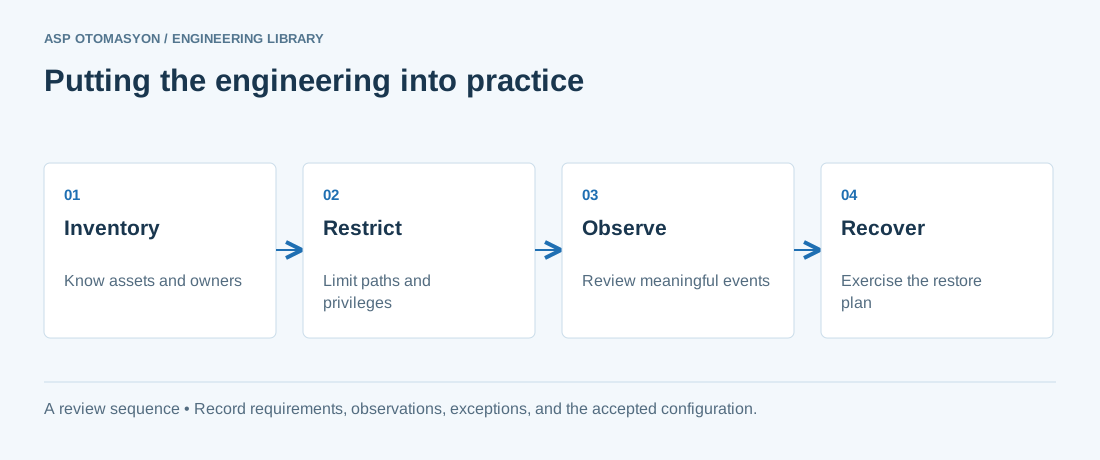
- Identify asset owners, permitted communications, operational dependencies, and consequences of losing the function.
- Test access restrictions and visibility without disrupting plant operations; agree the activity with the OT owner.
- Validate an offline recovery path and document who can authorize isolation, restoration, and return to service.
Follow an ASP project guide to connect the fundamentals with implementation and acceptance.
Primary references and further reading
Use the original specifications and product documentation for implementation details. The examples in this guide are illustrative engineering scenarios, not published project results.