
Ransomware has become the defining threat of industrial cybersecurity: high-profile attacks have shut down meat plants, breweries, and pipeline operators — not because the attackers targeted the process, but because industrial networks were reachable, unpatchable, and business-critical. Defending ICS against malware is a layered problem: malware must be kept out (prevention), detected when it arrives (detection), and survived when it executes (containment and recovery). This article outlines the defense layers in OT context.
Why OT Is a Malware Target
- High availability value — production downtime costs far more than the ransom; plants are tempted to pay.
- Legacy and unpatchable systems — controllers and old Windows HMIs cannot be patched; the attack surface is static and known to attackers.
- Flat networks and shared credentials — once inside, malware moves laterally through the plant easily; the OT network is often one flat LAN with common service accounts.
- Operational noise — a plant's operations generate alerts and chaos; the malware's first actions (scans, new connections) can hide in the noise.
The Entry Points (and Their Defenses)
| Entry vector | Defense |
|---|---|
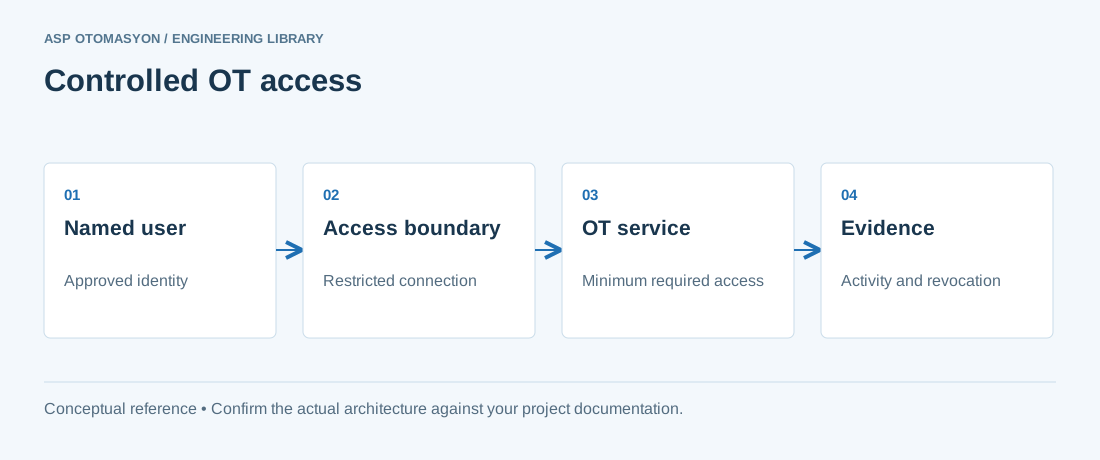
| Email/IT pivot (phishing into IT, lateral to OT) | OT/IT segmentation with strict DMZ; no direct paths; IT treats OT as critical data (and OT treats IT as untrusted). |
| Remote access (vendors, support) | Centralized, authenticated remote access with MFA, session recording, and approval; never direct modem/4G backdoors. |
| USB and portable media | Technical controls (USB lockdown, scanned transfer stations) plus procedure; the classic OT malware path. |
| Supply chain (software updates, laptops) | Vendor/contractor security requirements, verified update media, dedicated maintenance laptops that never touch the internet. |
| Internet-exposed services | No direct internet exposure of OT services; expose only through the DMZ with strong authentication and patching. |
Containment Design
Assume malware will arrive; design so that arrival is survivable:
- Segmentation — zones and conduits per IEC 62443: a compromise of the IT network or one production line does not reach the whole plant; inter-zone traffic is controlled and monitored.
- Least privilege — accounts, shares, and services minimized; no domain-admin-equivalent credentials on OT; local accounts per machine where possible.
- Application control — allowlisting (only approved executables run) is the single most effective control on legacy Windows OT systems, where AV signatures are useless; modern allowlisting handles PLC/HMI software updates cleanly when maintained.
- Network containment — the monitoring (see the OT monitoring article) must be able to see the lateral movement early; micro-segmentation of the most critical functions limits the blast radius.
Detection and Response
Detection on OT is: baseline-anomaly monitoring (new connections, new executables, unusual protocol use), allowlist violations, and account anomalies (service account suddenly logging in from a new host). The response plan (see the incident response article) must include the OT-specific decisions: when to shut down a process (safety first, but a controlled shutdown beats a forced one), how to run the plant without the infected systems, and the recovery path from verified backups. Ransomware drills — tabletop and technical — convert the plan into reflexes.
Recovery: The Last Line
When encryption begins, recovery speed is decided by what was done years earlier:
- Verified, offline backups — configurations, historian data, controller programs, and images; stored immutably and air-gapped from the OT network (ransomware deletes what it can reach).
- Restore procedures tested — the quarterly restore drill (see the SCADA backup article) is the difference between two days and two weeks of downtime.
- Clean rebuild paths — known-good OS images, license keys, and installation media for every OT platform; a plant that cannot rebuild a server is held hostage by its own environment.
- Communication plan — who decides to pay (never — paying funds the ecosystem and does not guarantee recovery), who informs authorities and insurers, who talks to customers and regulators.
Summary
Ransomware defense for ICS is a layered system: prevent entry at the vectors (segmentation, remote access control, USB controls, supply chain), contain with zones and allowlisting, detect with baseline monitoring, and survive with verified offline backups and rehearsed recovery. The goal is not to make malware impossible — it is to make infection visible early, contained locally, and recoverable quickly. Plants are attacked; prepared plants recover.
Apply this to your project
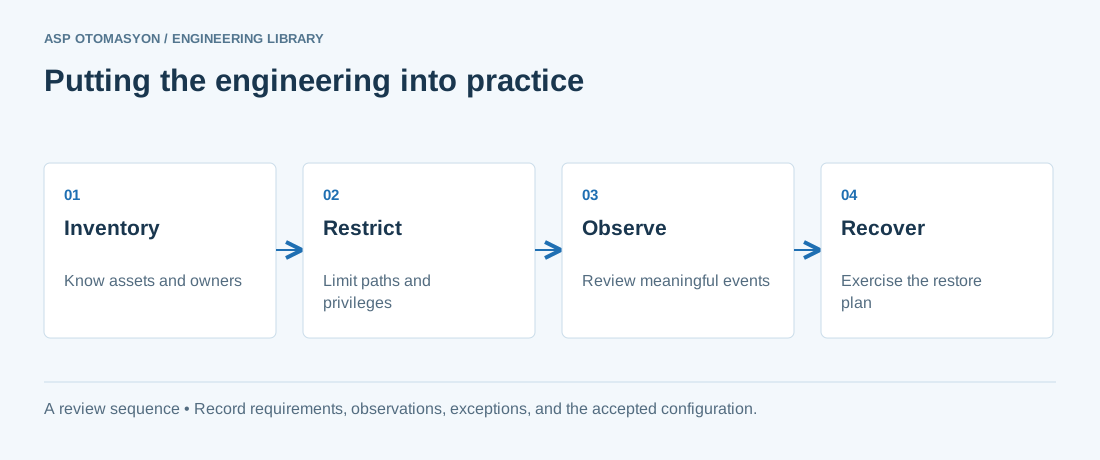
- Identify asset owners, permitted communications, operational dependencies, and consequences of losing the function.
- Test access restrictions and visibility without disrupting plant operations; agree the activity with the OT owner.
- Validate an offline recovery path and document who can authorize isolation, restoration, and return to service.
Follow an ASP project guide to connect the fundamentals with implementation and acceptance.
Primary references and further reading
Use the original specifications and product documentation for implementation details. The examples in this guide are illustrative engineering scenarios, not published project results.