
Alarm rationalization is the structured process of deciding which alarms a plant actually needs, what their priorities are, and how they should behave — before they reach the operator. Studies and guidance from ISA-18.2 / IEC 62682 and EEMUA 191 consistently show that poorly managed alarm systems overwhelm operators: too many alarms, too many stale or redundant alarms, and too many that require no action. Rationalization is the cure, and it is a documented, repeatable engineering process, not an opinion exercise.
Why Alarm Systems Fail
Alarm floods — hundreds of alarms in a few minutes during a disturbance — are the classic symptom. Contributing causes:
- Alarm creep: alarms added over the years without review, often as a substitute for fixing a root cause.
- Bad actors: a handful of chattering or stale alarms that generate most of the annunciations.
- Redundancy: the same condition alarmed at multiple levels (DCS, SIS, MCC) without coordination.
- No priority logic: every alarm treated as equally important, so operators cannot triage.
Guidance in EEMUA 191 and ISA-18.2 suggests that in steady state an operator should receive no more than about six alarms per ten minutes on average, with the majority of alarms at low priority. Rationalization is the process that makes those numbers achievable.
The Rationalization Process
1. Alarm philosophy (the rulebook)
Write or update the alarm philosophy document: definitions of alarm types, priorities, setpoint rules, suppression rules, shelving policy, and the roles responsible for the system. Everything downstream follows this document.
2. Inventory and screening
Extract the complete alarm list from the DCS/SIS and screen it against criteria:
- Is it an alarm (operator action required), or merely a notification/event?
- Is it valid (does the condition matter)?
- Is it duplicative of another alarm?
- Is it actionable — can the operator actually do something?
Items that fail screening are reclassified as events or removed.
3. Classification and prioritization
Classify each alarm by consequence and assign priority based on the response time required and the safety/environmental/economic impact:
| Priority | Typical definition | Expected operator response |
|---|---|---|
| Critical / Emergency | Immediate action required to protect people, environment, or major assets | Immediate, within seconds to a minute |
| High | Prompt action required to avoid process upset or damage | Prompt, within minutes |
| Medium | Action required, but time is available | Within a shift or on schedule |
| Low / Advisory | Informational; no immediate action | At operator's discretion |
Priorities should be assigned with a documented method (e.g., a risk matrix combining severity and time-to-respond), not by intuition alone.
4. Setpoint and deadband review
For each alarm, verify the setpoint against the process operating envelope: the alarm should trip before the condition becomes harmful but not during normal transients. Deadbands and hysteresis prevent chattering at the setpoint. Document the basis (e.g., "above maximum normal operating pressure").
5. Documentation (the master alarm database)
Every rationalized alarm is recorded in the Master Alarm Database (MAD): tag, description, cause, consequence, corrective action, priority, setpoint, deadband, and classification. The MAD is the single source of truth that the DCS configuration must match.
6. Implementation and testing
Configure the rationalized list in the DCS, test each alarm (setpoint, annunciation, suppression rules), and verify against the MAD. Test documentation is part of the record.
Ongoing Management
Rationalization is not a one-time project; the alarm system must be managed continuously:
- Alarm performance monitoring: measure alarm rate, flood frequency, chattering alarms, stale alarms, and shelved alarms. ISA-18.2 defines the key performance indicators.
- Management of change (MOC): any new alarm or setpoint change goes through the same screening process and is added to the MAD.
- Bad-actor review: periodically (quarterly) review the top alarm generators and eliminate or fix them at the root.
- Operator feedback: operators know which alarms are useless; a structured feedback channel keeps the system honest.
Pitfalls
- Rationalizing without a philosophy. Priorities and rules become inconsistent the moment different people decide differently.
- Focusing only on quantity. Cutting alarm count without fixing setpoints and priorities leaves operators blind where it matters.
- Ignoring safety-system alarms. SIS alarms must follow their own standards (IEC 61511) and be coordinated with — not duplicated by — DCS alarms.
- Shelving as a crutch. Shelving is a temporary tool; if alarms are permanently shelved, they should be re-rationalized instead.
Summary
Alarm rationalization transforms an alarm system from noise into a decision-support tool. Write the philosophy, screen and prioritize the inventory with documented methods, keep the master database accurate, and manage the system continuously with KPIs and MOC. The payoff is measurable: operators who can trust their alarms, faster responses to real events, and fewer process upsets caused by alarm floods.
Apply this to your project
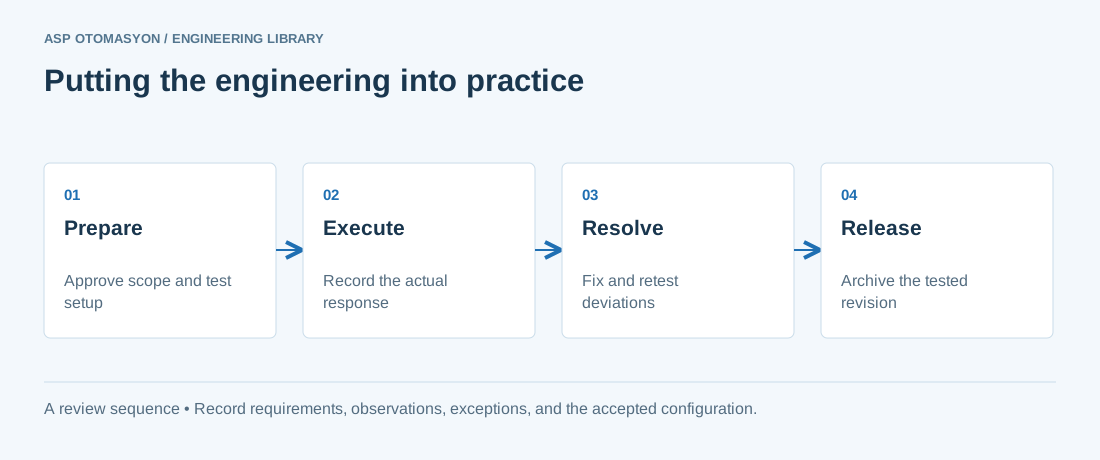
- Agree the test boundary and site authorization, especially where outputs or communications can affect operating equipment.
- Record expected and actual values, equipment identifiers, software revision, test conditions, and exceptions.
- Retest changed behavior and archive the final configuration with the test record and recovery instructions.
Follow an ASP project guide to connect the fundamentals with implementation and acceptance.
Primary references and further reading
Use the original specifications and product documentation for implementation details. The examples in this guide are illustrative engineering scenarios, not published project results.