
Industry 4.0 architectures put edge devices and cloud services on the OT network's boundary: gateways that collect data and forward it to cloud platforms, edge servers running analytics, and remote monitoring services with access to plant systems. Each of these is a new trust boundary — and each is a favorite target, because an edge gateway is a computer with OT credentials and an internet connection. Securing cloud-connected OT means treating the edge as a security-critical component: hardened, identified, monitored, and operated with the same rigor as the controllers it serves.
The New Attack Surface
- The gateway itself — a general-purpose OS (Linux/Windows) on the OT network, often with credentials to PLCs, historians, and cloud services; compromise of the gateway exposes both sides.
- The cloud path — the outbound connection is a conduit into the plant's data (and potentially back in, if the cloud side is ever used for commands); the cloud account is a credential to plant data.
- The management path — edge devices are managed (firmware, config) — often from the cloud or by vendors; each management path is an attack path.
- Physical exposure — edge devices sit in the plant, often in accessible locations; a tampered gateway is a listening post.
Hardening the Edge
- Minimal platform — the gateway runs only what it needs: no extra services, no unused ports, no development tools; the OS is patched (and the patch process is defined — an edge device that cannot be patched is a liability).
- Strong identity — every edge device has a unique identity with hardware-backed keys (TPM/secure element) for both directions: to the plant network (device certificate) and to the cloud (device certificate); shared keys or factory defaults are excluded.
- Least privilege both ways — the gateway's access to plant systems is limited to what the data flow needs (read-only subscriptions where commands are not required; scoped service accounts); its cloud access is limited to its own scope (device-scoped, not account-wide).
- Secure boot and integrity — verified boot chain and runtime integrity monitoring where the platform supports it; a tampered gateway should fail closed or alert, not silently run.
- Physical protection — the gateway is in a locked cabinet or enclosure with tamper evidence; USB ports disabled where not needed.
Securing the Cloud Path
- TLS everywhere — all device-to-cloud traffic encrypted with modern TLS, certificates validated (no blanket "accept any cert"), and the cloud endpoints allow-listed at the plant firewall.
- Outbound-only architecture — the cloud never initiates connections into the plant; management and command flows are pull-based (device polls) or brokered through the DMZ with full authentication.
- Cloud-side controls — the cloud tenant has its own security: MFA on all accounts, least-privilege roles, audit logging, and the same change control as the plant; the cloud is a partner system, not a magic place where rules are suspended.
- Data classification — what leaves the plant is a decision: tag-level policies (which data may go to the cloud), retention rules, and the understanding that cloud data is subject to the cloud provider's and jurisdiction's rules.
Monitoring and Operations
The edge and cloud path is monitored like any other security-critical asset: gateway health (uptime, firmware version, config drift) and security events (failed auth, unexpected connections, tamper alerts) feed the same alerting as the rest of OT; the cloud side logs are reviewed on a schedule (failed logins, unusual API calls). Remote management of the edge devices themselves uses the plant's managed remote-access solution with MFA and session recording — never the vendor's ad-hoc back door.
Supply Chain and Lifecycle
The edge/cloud stack adds vendors: gateway hardware/software vendors and cloud providers. Apply the supply chain discipline (see the supply chain article): security expectations in the contracts, update and vulnerability-response commitments, and the ability to replace the solution without data hostage situations (export your data and configuration — lock-in is a security risk). Lifecycle: edge devices get firmware updates on a defined cadence; when the device reaches end of life, it is replaced or removed — a dead gateway with a live connection is a permanent vulnerability.
Summary
Securing cloud-connected OT means hardening the edge (minimal platform, hardware identity, least privilege, integrity, physical protection), securing the path (TLS, outbound-only, cloud-side controls with MFA), and operating it (monitoring, managed remote access, supply chain discipline, lifecycle). The gateway is a computer on both networks — treat it as the most exposed computer in the plant. The data flow it carries is valuable; the access it represents is critical; both deserve the full control set.
Apply this to your project
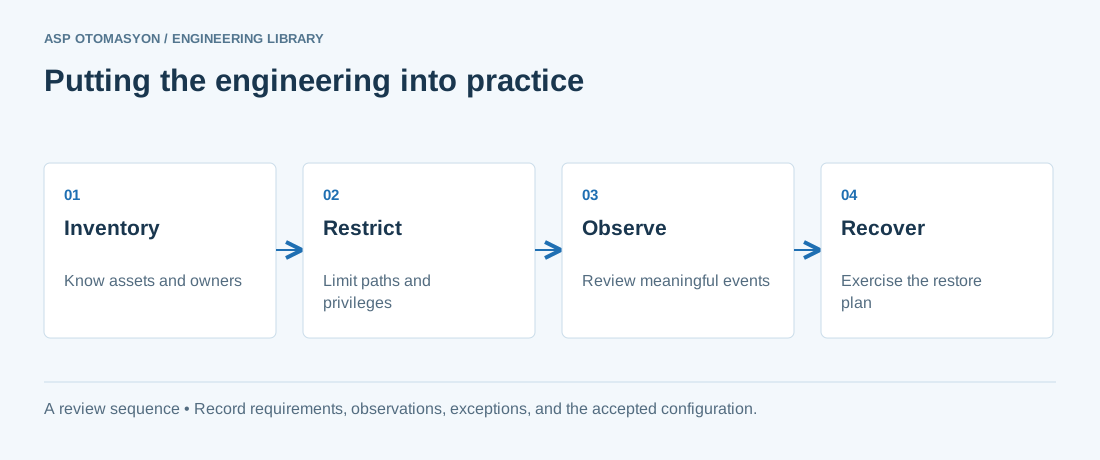
- Identify asset owners, permitted communications, operational dependencies, and consequences of losing the function.
- Test access restrictions and visibility without disrupting plant operations; agree the activity with the OT owner.
- Validate an offline recovery path and document who can authorize isolation, restoration, and return to service.
Follow an ASP project guide to connect the fundamentals with implementation and acceptance.
Primary references and further reading
Use the original specifications and product documentation for implementation details. The examples in this guide are illustrative engineering scenarios, not published project results.