
Clean-in-Place (CIP) is the automated process that cleans product-contact surfaces of food, beverage, dairy, and pharmaceutical equipment without disassembling them. A CIP system circulates cleaning and sanitizing solutions through pipes, tanks, and processing equipment at controlled flow, temperature, and time, then rinses to remove residues. Automating CIP correctly is critical: it directly affects product safety, water and chemical consumption, and the availability of the production line.
The CIP Sequence
A typical CIP cycle follows a defined sequence of phases, often expressed as a recipe:
- Pre-rinse: cold or warm water removes gross product residue.
- Caustic wash: hot caustic solution (typically 1–3% NaOH, 60–85 °C depending on the application) removes organic soils.
- Intermediate rinse: water removes the caustic.
- Acid wash (optional): acid solution (e.g., 0.5–1% nitric or phosphoric acid) removes mineral scale.
- Final rinse: water removes the acid; quality is verified by conductivity/temperature.
- Sanitize (optional): hot water or chemical sanitizer before the next production run.
Not every application needs all phases; dairy, beverage, and pharmaceutical processes each have their own validated sequences. The sequence is controlled by a recipe that defines setpoints and durations per phase, typically managed as an ISA-88-style batch procedure (see the Batch Control with ISA-88 article).
Key Process Variables
| Variable | Why it matters | Typical control |
|---|---|---|
| Flow rate | Ensures turbulent flow and mechanical cleaning action | Flow meters + control valves; minimum flow interlocks |
| Temperature | Chemical activity and solubility depend on temperature | Temperature sensors + steam/heat exchanger control |
| Concentration | Correct chemical strength | Conductivity measurement + dosing pumps |
| Time | Contact time for the chemistry to work | Recipe phase timers |
| Return conductivity | Confirms rinse completeness | Conductivity at the return line, with divert-to-drain logic |
The most important safety interlock: the CIP unit must never pump chemical into a vessel that is still connected to product or to a closed valve. Valve position feedback and pressure/flow verification are the safeguards.
Automation Architecture
CIP skid (pumps, heat exchanger, tanks, dosing)
        │
        ▼
CIP controller (PLC with recipe manager)
        │  ── valve manifolds / routing to multiple circuits
        ▼
Process equipment (tanks, fillers, separators) with CIP connections
- CIP skid: the central unit with supply and return pumps, a heat exchanger, chemical tanks, and dosing systems.
- Routing: valve manifolds (often with mix-proof valves in food plants) direct the cleaning solution to the selected circuit and back.
- Recipes: stored phase sequences per circuit; each circuit has its own validated recipe because pipe lengths and equipment differ.
- Integration: the CIP system exchanges status with the production line control — the line must know when CIP is complete and production can resume.
Design and Validation
- Circuit definition: each CIP circuit has a defined flow path, length, and volume; design the skid capacity (flow, heating power) for the worst-case circuit.
- Dead legs: minimize dead legs and ensure complete drainage; product residues in dead legs are a contamination source.
- Drainability and air removal: the system must be self-draining and ventable; trapped air prevents contact.
- Sensors: place flow, temperature, and conductivity sensors where they represent the circuit (supply and return).
- Documentation: for regulated industries (dairy, beverage, pharmaceuticals), CIP is validated: installation/operational qualification (IQ/OQ/PQ), and every cycle should be logged (time, temperatures, flows, conductivity) for traceability. See also 21 CFR Part 11 compliance for electronic records.
Operational Practices
- Monitor and trend cycle data: a slow drift in rinse conductivity or required caustic time indicates fouling or a failing component — trend the data (see the historian article).
- Water and chemical use tracking: CIP is a significant consumer of water and chemicals; track usage per cycle and optimize phase durations and concentrations.
- Heat recovery: recover heat from caustic return streams to reduce energy cost.
- Preventive maintenance: pumps, valves (especially mix-proof valves), and sensors in the CIP path need regular inspection; a leaking valve contaminates both product and cleaning circuits.
- Operator training: operators must understand the phases, the interlocks, and what to do when a cycle aborts mid-sequence (product safety decisions belong to trained people).
Common Pitfalls
- Insufficient flow for the circuit. Long or large circuits need more flow; an undersized skid "cleans" by chemistry alone, which is not enough.
- Temperature measured only at the skid. The temperature at the far end of the circuit is what matters; measure return temperature too.
- No divert logic. A failed rinse that returns chemical to the tank instead of diverting to drain contaminates the next batch.
- Recipe drift. Operators extending phase times "to be safe" waste water and chemicals and can damage equipment; manage changes through the recipe owner.
- Skipping validation. In regulated industries, an unvalidated CIP cycle is a compliance incident waiting to happen.
Summary
CIP automation is a recipe-driven, safety-critical utility process: control flow, temperature, concentration, and time per validated phase; route correctly with interlocked valves; log every cycle; and maintain the skid like production equipment. Done right, CIP protects product safety, minimizes water and chemical use, and keeps the line available — quietly, cycle after cycle.
Apply this to your project
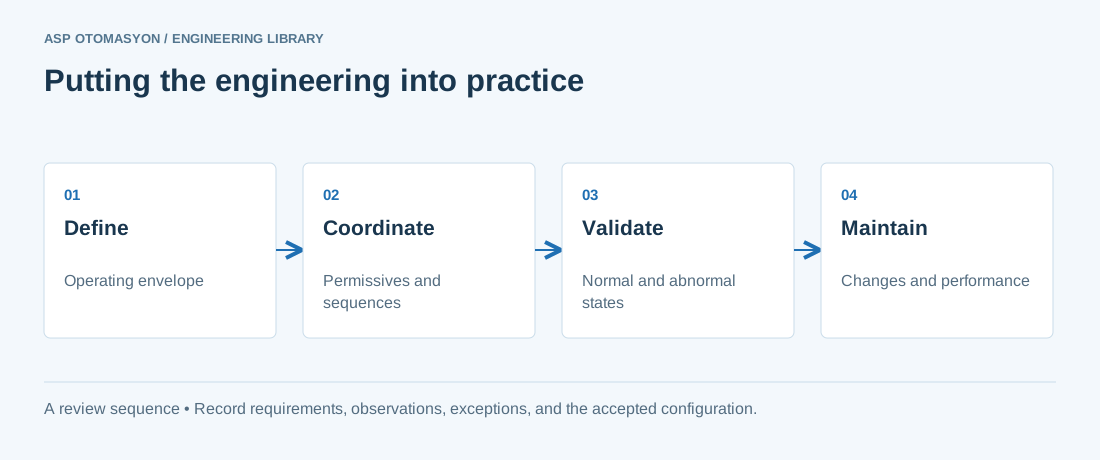
- Record process boundaries, required operating states, and interactions with independent protective systems.
- Check instrument quality, control authority, permissives, and operator responsibilities during state changes.
- Agree how tests, deviations, and configuration changes will be recorded within the facility's engineering procedures.
Follow an ASP project guide to connect the fundamentals with implementation and acceptance.
Primary references and further reading
Use the original specifications and product documentation for implementation details. The examples in this guide are illustrative engineering scenarios, not published project results.