
Analytical instrumentation — pH, conductivity, dissolved oxygen, and related measurements — monitors the chemistry of the process rather than its physical state. Water treatment, chemical production, food and beverage, pharmaceuticals, and power generation all depend on these measurements for product quality, environmental compliance, and process control. Analytical instruments have a reputation for being "high maintenance", and that reputation is earned when they are treated like pressure transmitters. This article explains the core technologies and the maintenance discipline that keeps them reliable.
pH Measurement
pH measures the acidity or alkalinity of a solution (the negative logarithm of hydrogen ion activity, 0–14 scale). The measurement is made with a glass electrode system:
- Measuring electrode: a special glass membrane develops a potential proportional to pH.
- Reference electrode: provides a stable reference potential (typically Ag/AgCl or calomel) through a junction.
- Temperature compensation: pH depends on temperature; a Pt100/RTD in the sensor corrects the reading.
Key facts for reliable pH:
- Calibrate with buffer solutions (typically pH 4, 7, and 10) — a two-point calibration bracketing the process range is standard; the electrode slope (ideally ~59 mV/pH at 25 °C) indicates health.
- Electrodes age and dry out; keep them wet, store in storage solution (not water), and replace on schedule (typical life 6–24 months depending on the process).
- The reference junction clogs over time in dirty processes — this is the #1 cause of drifting pH readings; clean or replace the junction.
Conductivity Measurement
Conductivity measures the ability of a solution to carry current, which correlates with ion concentration. Two main technologies:
| Type | Principle | Use |
|---|---|---|
| Contacting (electrode) | Two or four electrodes measure solution resistance; cell constant converts to conductivity | Clean liquids, pure water (with appropriate cell), CIP verification |
| Toroidal (inductive) | Induced current measured without electrode contact | Dirty, scaling, or corrosive liquids (wastewater, acids, slurries) |
- Temperature compensation: conductivity is strongly temperature-dependent (about 2%/°C for many solutions); use the solution's temperature coefficient or standard reference temperature (25 °C).
- Calibration: with standard solutions (e.g., KCl solutions of known conductivity) or by verifying the cell constant; toroidal sensors are factory-calibrated and need less frequent checks.
- Cleanliness: electrode coating changes the cell constant; clean periodically and verify with a standard.
Dissolved Oxygen (DO)
Dissolved oxygen measurement is essential in wastewater treatment (aeration control), aquaculture, and food/beverage (product stability). Technologies:
- Optical (luminescence): a luminescent dye is quenched by oxygen; the decay time correlates with DO. No consumables, low drift, low maintenance — now the standard for most applications.
- Electrochemical (Clark cell): oxygen diffuses through a membrane to a cathode; generates a current proportional to DO. Requires electrolyte and membrane replacement; still used where optical is impractical.
Optical DO sensors need periodic (e.g., 6–12 monthly) calibration in saturated air or water and spot-checking against a reference; they tolerate fouling better than Clark cells.
Other Common Analytes
- ORP (oxidation-reduction potential): measures the oxidizing/reducing character of a solution; used in disinfection (chlorine, ozone) and chemical treatment control.
- Turbidity: light scattering by suspended particles; used in water treatment and quality control.
- Residual chlorine / ozone: for disinfection control in water systems.
- Specific ion electrodes: for ammonia, fluoride, and other ions where required.
Designing the Installation for Reliability
- Sample systems: for many applications, a properly designed sample system (fast loop, filtration, flow control) keeps the sensor in a representative, stable environment and extends sensor life.
- Retractable housings: allow sensor removal and cleaning without draining the line or stopping the process.
- Location: place sensors where the chemistry is representative and the environment is manageable; avoid dead legs where the sample goes stale.
- Auto-cleaning: ultrasonic or water-jet cleaning for fouling processes; automatic calibration with buffer solutions for continuous processes.
- Redundancy for critical loops: for control or compliance-critical analytics, dual sensors with validation logic prevent a bad measurement from controlling the process.
Maintenance Discipline
Analytical instruments fail gradually, and the failure looks like process change. The maintenance program is the difference between trustworthy and useless measurements:
- Calibration schedule: pH weekly-to-monthly (process-dependent), conductivity monthly, optical DO every 6–12 months. Adjust by as-found history.
- Consumables: pH electrodes, reference junctions, DO membranes/electrolyte, and buffer/standard solutions are consumables — stock them and track age.
- Validation with a second method: periodically check against a lab sample or portable meter to catch slow drift the calibration routine misses.
- Diagnostics from smart transmitters: electrode impedance, slope, and response time are health indicators — trend them.
- Documentation: calibration records, as-found values, and sensor replacement dates, integrated with the plant's calibration management (see the sensor calibration article).
Common Pitfalls
- Treating analytical like physical measurement: no one calibrates a pressure transmitter weekly, but a pH electrode that is not cleaned and calibrated will drift badly.
- Bad sample location: a sensor in a dead leg reads yesterday's chemistry.
- Ignoring temperature: uncompensated pH/conductivity readings wander with process temperature and look like process upsets.
- Running sensors to failure: electrodes fail gradually; replace on schedule or on diagnostic trend, not after the control loop has been chasing ghosts for a week.
- No process backup: for compliance-critical analytics, a failed sensor with no backup means a production or compliance incident.
Summary
Analytical instrumentation measures the chemistry that physical instruments cannot see. Choose the right technology (glass pH, contacting or toroidal conductivity, optical DO), install it with a proper sample system and retractable housing, and — above all — run a real maintenance program: calibration, consumables, diagnostics, and validation. With that discipline, analytical measurements become dependable inputs to control and compliance rather than the plant's chronic source of "mystery" readings.
Apply this to your project
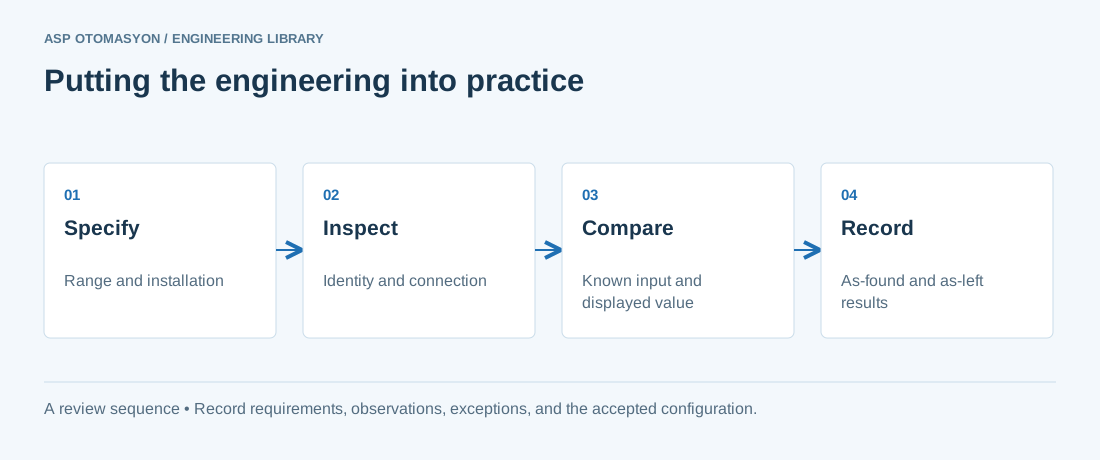
- Confirm the instrument tag, range, engineering unit, process connection, and environmental suitability against approved documents.
- Check the complete measurement chain, including sensor configuration, channel scaling, quality indication, and display units.
- Record reference equipment, uncertainty where relevant, test points, deviations, and the final configuration.
Follow an ASP project guide to connect the fundamentals with implementation and acceptance.
Primary references and further reading
Use the original specifications and product documentation for implementation details. The examples in this guide are illustrative engineering scenarios, not published project results.