
Water and wastewater treatment facilities are among the most automation-intensive infrastructure systems. From raw water intake through treatment, distribution, collection, and wastewater processing, every stage relies on continuous monitoring and control. Effective automation ensures regulatory compliance, chemical optimization, energy efficiency, and reliable service delivery to communities and industries.
Water Treatment Process Overview
  Raw Water Intake (River, Lake, Reservoir)
       │
       ▼
  +--------------------+      +--------------------+
  | SCREENING &        | ---> | COAGULATION &      |
  | GRIT REMOVAL       |      | FLOCCULATION        |
  | Bar screens, grit  |      | Chemical dosing     |
  | chambers           |      | (PAC, alum, FeCl₃)  |
  +--------------------+      +--------+-----------+
                                       |
  +--------------------+               |
  | FILTRATION         |      +--------v-----------+
  | Rapid gravity,     | <--- | SEDIMENTATION       |
  | pressure, membrane |      | Clarifiers, lamella |
  +--------+-----------+      +--------------------+
           |
  +--------v-----------+      +--------------------+
  | DISINFECTION        | ---> | CLEARWATER STORAGE  |
  | Chlorine, UV, ozone |      | & DISTRIBUTION      |
  +--------------------+      +--------------------+
Key Control Loops in Water Treatment
Flow and Pressure Control
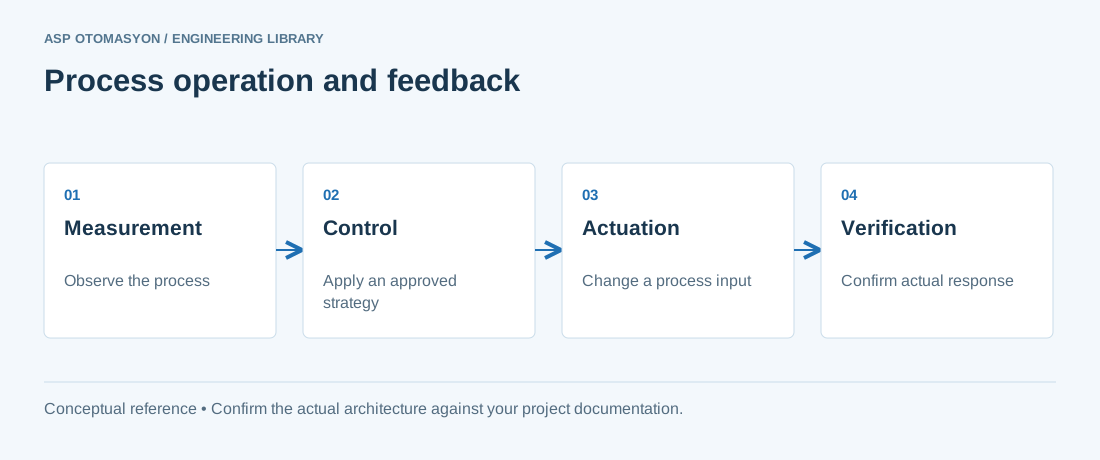
Variable frequency drives (VFDs) on pumps maintain constant pressure in distribution networks using closed-loop pressure control. Flow pacing ensures chemical dosing rates are proportional to raw water flow (flow-proportional dosing).
Chemical Dosing Control
- Coagulant dosing — Flow-proportional with trim from streaming current detector (SCD) or jar test feedback. Typical: 5–50 mg/L depending on raw water turbidity.
- Chlorine dosing — Flow-proportional with residual chlorine feedback (compound loop). Target: 0.2–0.5 mg/L residual at the farthest point in the distribution network.
- pH adjustment — Dosing of acid (H₂SO₄) or alkali (NaOH, Ca(OH)₂) with pH feedback. Critical for coagulation efficiency and corrosion control.
- Fluoridation — Flow-proportional dosing of hydrofluosilicic acid to achieve 0.5–1.0 mg/L fluoride.
Filter Backwash Control
Automatic backwash sequences are triggered by head loss (differential pressure across the filter), time, or turbidity breakthrough. The sequence includes air scour, water wash, and return-to-service steps with controlled flow rates.
Wastewater Treatment Process Overview
  Influent (Raw Sewage)
       │
       ▼
  +--------------------+      +--------------------+
  | PRELIMINARY        | ---> | PRIMARY            |
  | TREATMENT           |      | TREATMENT           |
  | Screening, grit    |      | Sedimentation       |
  | removal, flow       |      | (primary clarifier) |
  | measurement         |      +--------+-----------+
  +--------------------+               |
                              +--------v-----------+
  +--------------------+      | SECONDARY          |
  | SLUDGE TREATMENT    |      | TREATMENT           |
  | Thickening,         | <--- | Activated sludge,   |
  | dewatering,         |      | biological reactor  |
  | digestion           |      +--------+-----------+
  +--------------------+               |
                              +--------v-----------+
                              | SECONDARY           |
                              | CLARIFIER           |
                              +--------+-----------+
                                       |
                              +--------v-----------+
                              | TERTIARY /          |
                              | ADVANCED TREATMENT  |
                              | Filtration,         |
                              | nutrient removal    |
                              +--------+-----------+
                                       |
                              +--------v-----------+
                              | DISINFECTION &      |
                              | EFFLUENT DISCHARGE  |
                              +--------------------+
Key Control Loops in Wastewater Treatment
Dissolved Oxygen (DO) Control
The most critical control loop in activated sludge processes. DO sensors (optical or membrane-type) in the aeration basin provide feedback to control blower speed (via VFD) or guide vane position. Target: 1.5–2.5 mg/L DO. Energy savings of 20–40% are achievable with automatic DO control compared to fixed-speed blowers.
Chemical Oxygen Demand (COD) and Nutrient Removal
- Nitrogen removal — Nitrification (aerobic) followed by denitrification (anoxic). DO and nitrate recirculation control.
- Phosphorus removal — Biological (EBPR) or chemical (FeCl₃ or alum dosing). Flow-proportional with orthophosphate feedback.
- External carbon source — Methanol or acetate dosing for denitrification when influent BOD is insufficient.
Sludge Management
- Waste activated sludge (WAS) — Controlled by sludge volume index (SVI) and mixed liquor suspended solids (MLSS) measurement.
- Sludge blanket level — Ultrasonic or optical sensors in secondary clarifiers control return sludge flow and waste rates.
- Digester control — Temperature (mesophilic: 35–38 °C or thermophilic: 50–55 °C), pH, and feed rate control for anaerobic digestion.
Instrumentation Requirements
| Measurement | Technology | Typical Location |
|---|---|---|
| Flow | Electromagnetic (magmeter), ultrasonic (open channel) | Influent, effluent, chemical dosing lines, sludge lines |
| Level | Ultrasonic, radar, hydrostatic | Tanks, wells, channels, sumps |
| Turbidity | Optical (scattered light) | Filter effluent, raw water, final effluent |
| pH | Glass electrode (differential or combination) | Influent, process tanks, effluent |
| Dissolved oxygen | Optical (luminescent) or membrane (galvanic) | Aeration basins |
| Chlorine residual | Amperometric or colorimetric | Post-disinfection, distribution points |
| MLSS / sludge density | Optical (near-infrared) | Aeration basins, clarifiers |
SCADA Architecture for Water Utilities
Water and wastewater systems are geographically distributed, requiring SCADA architectures that span wide areas:
- Central control room — SCADA servers, operator workstations, historian, alarm management.
- Remote sites — RTUs and PLCs at pump stations, reservoirs, lift stations, and treatment plants.
- Communications — Fiber optic backbone with cellular (4G/5G) or radio (licensed/unlicensed) for remote sites. Redundant paths for critical sites.
- Cybersecurity — IEC 62443 compliance, network segmentation between IT and OT, secure remote access for vendors.
ASP OTOMASYON provides complete automation solutions for water and wastewater treatment facilities, from instrumentation and PLC/SCADA programming through commissioning and long-term support.
Apply this to your project
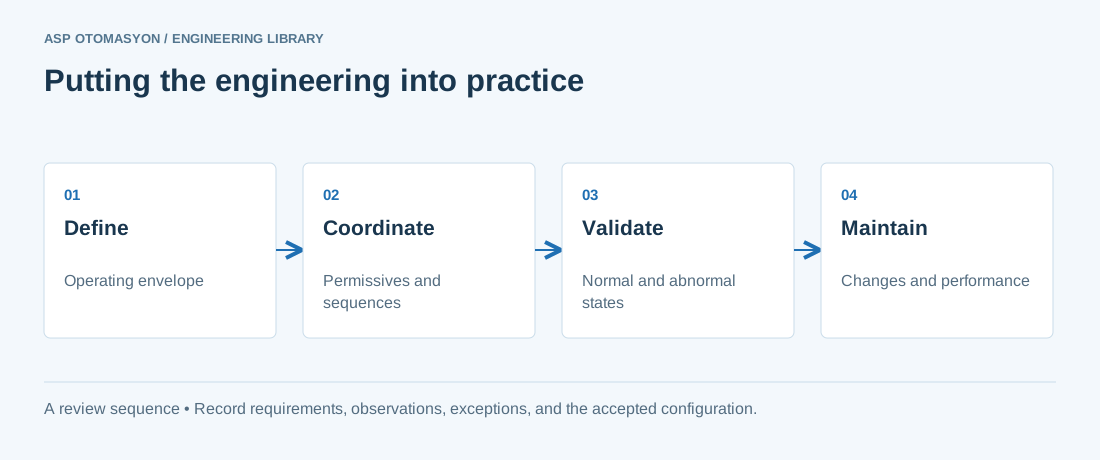
- Record process boundaries, required operating states, and interactions with independent protective systems.
- Check instrument quality, control authority, permissives, and operator responsibilities during state changes.
- Agree how tests, deviations, and configuration changes will be recorded within the facility's engineering procedures.
Follow an ASP project guide to connect the fundamentals with implementation and acceptance.
Primary references and further reading
Use the original specifications and product documentation for implementation details. The examples in this guide are illustrative engineering scenarios, not published project results.