
Between the extremes of Coriolis accuracy and orifice simplicity sits the workhorse pair of modern flow measurement: magnetic flowmeters (magmeters) for conductive liquids and ultrasonic flowmeters for clean liquids, gases, and the applications where the pipe cannot be cut. Together they cover the majority of industrial flow applications — and the selection between them (and against the alternatives) is decided by the fluid's conductivity, cleanliness, and the installation constraints.
Magnetic Flowmeters
A magmeter measures the voltage induced when a conductive liquid flows through a magnetic field (Faraday's law): the voltage is proportional to the average velocity. The measurement is:
- Independent of density, viscosity, and temperature — no Reynolds or property corrections; the meter is essentially linear.
- Unobstructed — no moving parts, no pressure drop beyond the pipe itself; the full-bore design handles slurries and solids (with the right liner).
- Limited to conductive liquids — the fluid needs a minimum conductivity (typically ≥ 5 µS/cm, lower for modern meters); hydrocarbons, pure water (borderline), and gases are out.
- Liner and electrode dependent — the liner (rubber, PTFE, PFA) matches the chemical and abrasive service; the electrodes match the fluid's chemistry; grounding requirements are strict (the meter needs the electrical potential reference).
The magmeter is the default for water, wastewater, pulp slurries, acids, and most process liquids — accuracy typically 0.2–0.5% of rate with the right sizing.
Ultrasonic Flowmeters
Ultrasonic meters come in two families:
- Transit-time — the difference in travel time of sound pulses with and against the flow gives the velocity; for clean liquids and gases, with clamp-on (no pipe cutting!) and inline versions. Accuracy depends on the flow profile and the installation (straight runs), typically 0.5–2% for good installations.
- Doppler — the frequency shift of sound reflected off particles/bubbles gives the velocity; for dirty liquids with entrained solids or gas (wastewater, slurries); lower accuracy, the right tool for trending, not custody.
The ultrasonic strengths: no pressure drop, no moving parts, clamp-on installation on existing pipes (the meter that does not require a shutdown), and bidirectional measurement. The weaknesses: sensitivity to the flow profile (straight-run requirements, disturbed flows), to pipe condition (scale, lining, poor acoustics), and the measurement is velocity-based — the volume needs the internal pipe area (and its uncertainty).
The Selection Decision
| Service | First choice | Notes |
|---|---|---|
| Conductive liquids, clean or dirty (water, acids, slurries) | Magnetic | Accuracy, no obstruction, slurry-capable with liner selection. |
| Non-conductive clean liquids (hydrocarbons, pure products) | Ultrasonic (transit-time) or Coriolis | Magmeter not applicable; transit-time for economics, Coriolis for accuracy. |
| Existing pipe, no shutdown, no line cut | Clamp-on ultrasonic | The only non-invasive option; accept the accuracy limits. |
| Gases | Ultrasonic (transit-time), thermal, or DP | Ultrasonic for clean gases at moderate conditions; the flow comparison article covers the full field. |
| Dirty liquids with solids/gas | Magnetic (if conductive) or Doppler ultrasonic | Magmeter first; Doppler for non-conductive dirty streams. |
| Custody transfer | Coriolis or certified turbine/ultrasonic | The accuracy and approvals decide; see the Coriolis article. |
Installation Engineering
- Magmeter — the pipe must run full (avoid partially filled pipes — mounting in a rising line or at a low point), straight runs upstream/downstream per the manufacturer (5D/2D typical, more for disturbed flows), proper grounding (the electrodes need the fluid's electrical reference — the grounding rings and the earth connection are mandatory, not optional), and the liner/electrode selection documented against the fluid.
- Ultrasonic (transit-time) — straight runs matter most (10D upstream / 5D downstream typical, more where pumps or valves disturb the profile), the transducer placement at the correct axial position and pipe diameter measurement, coupling compound quality, and — for clamp-on — the pipe material and wall condition (a scale-lined pipe measures the scale, not the flow).
Diagnostics and Maintenance
Both technologies offer strong self-diagnostics: the magmeter reports electrode fouling, empty-pipe condition, and coil/electrode faults; the ultrasonic meter reports signal strength, signal-to-noise, and profile quality — each flagging the installation drift (electrode coating, transducer degradation, flow profile change) before the reading goes wrong. The trend of the diagnostic values is the maintenance plan: rising electrode resistance means cleaning; falling ultrasonic signal strength means re-coupling or pipe scale. The meters are low-maintenance; their diagnostics are the maintenance.
Summary
Magmeters serve the conductive-liquid world with unobstructed accuracy; ultrasonic meters serve the clean-fluid and non-invasive world with clamp-on flexibility. Select by conductivity, cleanliness, and installation constraints; engineer the installation (full pipe, straight runs, grounding, acoustics); and operate on the diagnostics. For the majority of plant liquids, one of these two is the right answer — the comparison article covers the rest of the field.
Apply this to your project
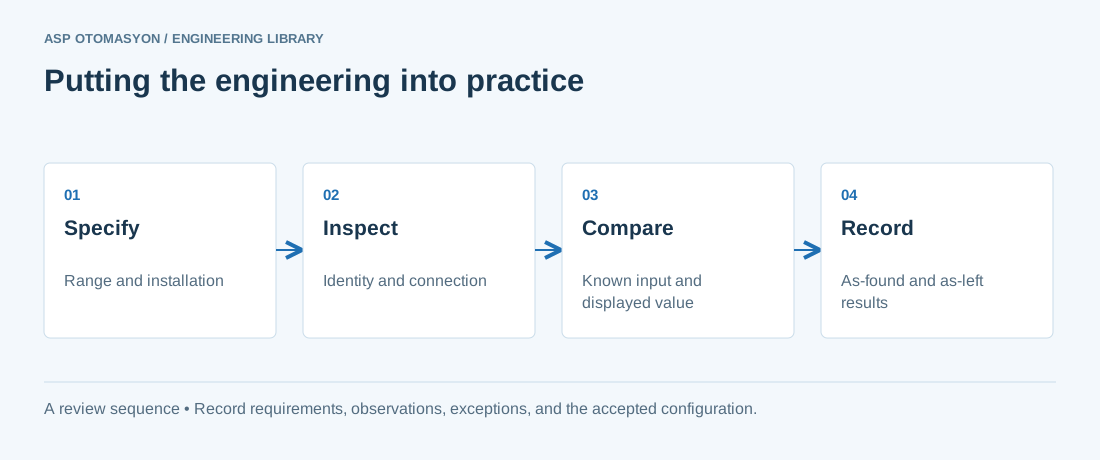
- Confirm the instrument tag, range, engineering unit, process connection, and environmental suitability against approved documents.
- Check the complete measurement chain, including sensor configuration, channel scaling, quality indication, and display units.
- Record reference equipment, uncertainty where relevant, test points, deviations, and the final configuration.
Follow an ASP project guide to connect the fundamentals with implementation and acceptance.
Primary references and further reading
Use the original specifications and product documentation for implementation details. The examples in this guide are illustrative engineering scenarios, not published project results.