
The Coriolis flowmeter is the most accurate flow technology in industrial instrumentation: it measures mass flow directly (not inferred from volume), measures density simultaneously, and — with those two — derives volume, temperature-corrected volume, and concentration. No other flowmeter does all of this in one device, which is why Coriolis is the standard for custody transfer, critical batching, and any application where the mass matters. The costs are price, pressure drop, and installation sensitivity — the selection is about where those costs are worth paying.
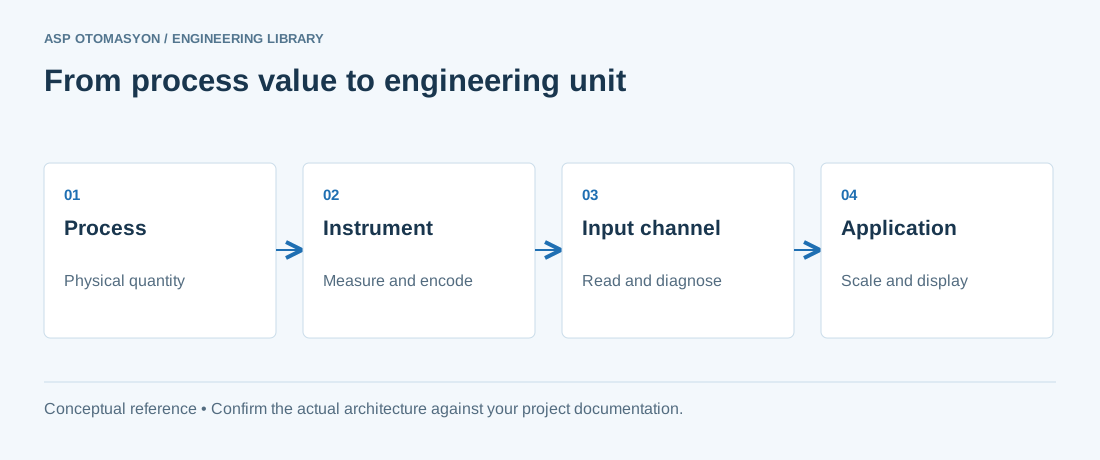
The Measurement Principle
A Coriolis meter contains one or more vibrating tubes (U-shaped, straight, or omega designs) driven at resonance. When fluid flows through a vibrating tube, the Coriolis force twists the tube: the phase difference between the inlet and outlet sides of the tube is proportional to the mass flow. The tube's resonant frequency changes with the fluid's density, and the temperature is measured by an integral sensor. Three measurements, one device — mass flow, density, and temperature — with the mass flow independent of the fluid's properties (no density, viscosity, or flow-profile corrections).
Applications Where Coriolis Wins
- Custody transfer and fiscal metering — the accuracy (0.05–0.2% of rate for mass flow) and the repeatability justify the price; approvals (MID, OIML, API) are available.
- Batching and blending — mass-based batching is immune to temperature and density variation; the meter's fast response and the batch controller's accuracy make recipe dosing precise (see the weighing/batching article for the system view).
- Density-critical processes — concentration measurement (acid strength, sugar brix, polymer concentration) from the density reading, with temperature compensation; the density accuracy (0.0005–0.002 g/cm³ typical) drives the application.
- Multiphase and viscous fluids — slurries, viscous polymers, and fluids with changing composition behave correctly because the measurement is direct mass.
- LPG and liquefied gases — where volume measurement is distorted by density changes, mass measurement is the answer.
Limitations and Selection Trade-offs
- Pressure drop — the tube geometry restricts the flow; the meter is sized for acceptable pressure drop (a line-size increase is common), not just for flow range.
- Two-phase and gas entrainment — gas bubbles disturb the vibration and the measurement; modern meters handle some entrainment with diagnostic monitoring, but the application must respect the limit (see the meter's gas-handling specification).
- Vibration and installation — the meter is sensitive to external vibration and to mounting stresses: rigid support, no pipe strain on the flanges, and proper straight-run considerations (less demanding than most technologies, but real).
- Cost — price and weight scale with line size; the economic analysis compares the value of the mass/density information against the meter's premium.
- Erosion and corrosion — the wetted materials and the flow velocity must match the service; erosive slurries wear the tubes.
Density and Concentration Applications
The density channel turns the Coriolis meter into an analyzer: with the known density-temperature relationship of the mixture, the meter reports concentration (e.g., % acid, % solids, °Brix) in line, continuously — replacing grab sampling for process control. The engineering: the density is temperature-compensated to the reference temperature, the concentration curve is verified for the specific mixture (impurities shift it), and the meter's density zero is verified periodically (in air and in water — the classic checks). The density diagnostics also detect process changes the flow channel cannot see: the wrong product in the line, a contaminated batch, or a product changeover boundary.
Verification and Maintenance
Coriolis meters are stable, but they do drift and they do fail — the maintenance regime: zero verification (with the line full and no flow) on a schedule, the meter's self-diagnostics (drive gain, tube damping, asymmetry) monitored via HART/fieldbus (see the HART article), and periodic proof against a reference where custody duty demands it. A rising drive gain is the classic warning: coating on the tubes, erosion, or a change in the fluid. The meter's diagnostic suite is its best feature after the measurement itself — use it.
Summary
Coriolis flowmeters deliver direct mass flow, density, and temperature in one device — the accuracy and functionality standard for custody transfer, batching, and concentration measurement. Select by the application's value (mass and density worth paying for), size for pressure drop and gas entrainment limits, install with support and no strain, and operate with zero checks and diagnostics. Where the mass is the money, Coriolis is the meter.
Apply this to your project
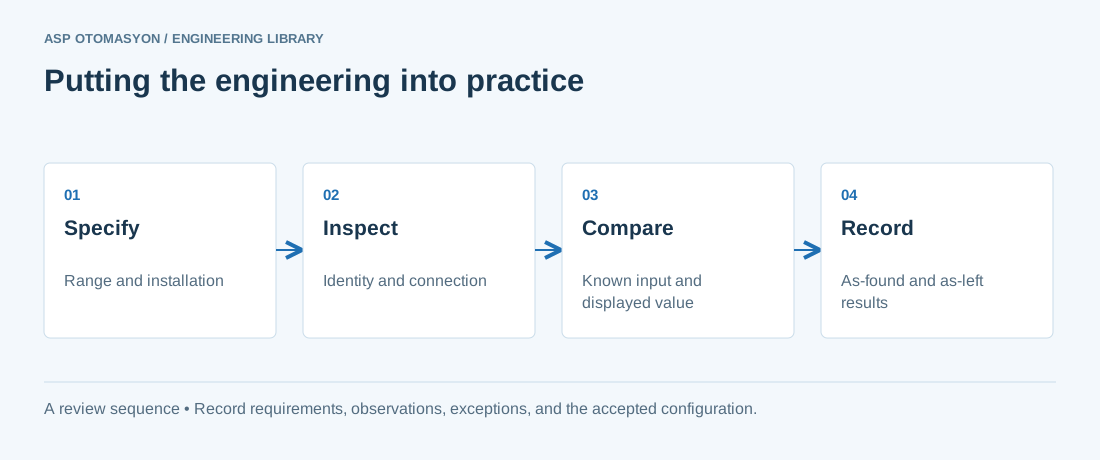
- Confirm the instrument tag, range, engineering unit, process connection, and environmental suitability against approved documents.
- Check the complete measurement chain, including sensor configuration, channel scaling, quality indication, and display units.
- Record reference equipment, uncertainty where relevant, test points, deviations, and the final configuration.
Follow an ASP project guide to connect the fundamentals with implementation and acceptance.
Primary references and further reading
Use the original specifications and product documentation for implementation details. The examples in this guide are illustrative engineering scenarios, not published project results.