
Tank farms and product terminals — refineries' storage, oil depots, chemical bulk storage, and loading terminals — are where inventory becomes a measured business: millions of dollars of product, moved by automated systems whose errors show up as lost product, wrong blends, or spills. Tank farm automation covers gauging (level, temperature, density), inventory management, blending, loading (road, rail, marine), and the safety systems that make storage safe. The discipline is measurement integrity: the tank farm's data is its money.
Gauging: The Measurement Foundation
- Level gauging — servo gauges, radar (guided wave and free-space), and hybrid systems (see the radar level article); the accuracy class (API MPMS Chapter 3) is selected for the custody-transfer duty.
- Temperature — average temperature (multi-point or spot probes) per API; the volume correction factor (VCF) turns observed volume into standard volume — the basis of all inventory and transfer calculations.
- Density — hydrometer-style density or mass from level + density; mass-based inventory is the modern standard (mass does not need temperature correction).
- Water and sediment — interface detection (water bottom) matters for custody and for product quality; the gauging system includes interface measurement where relevant.
The gauging system (typically a tank gauging system per API 2350/MPMS) reports level, temperature, density, and calculated volume/mass to the inventory system — with the accuracy and recalibration discipline that custody transfers demand.
Inventory and Business Integration
Terminal automation sits between the field and the business:
- Inventory management — per-tank standard volume/mass, reconciled against movements; the inventory report is the terminal's balance sheet, and reconciliation variance is the fraud/leak early warning.
- Movement transactions — receipt, transfer, and delivery transactions with product, quantity, and counterparty — feeding the ERP/billing; the automation's transaction records are the billing evidence.
- Blending — in-line blending (see the ratio control article) for product specification blending, with analyzer feedback and batch certification.
- Allocation and loss control — the reconciliation loop (book inventory vs gauged inventory) per tank, per product, per period; the loss report is management's control instrument.
Loading Automation
Loading terminals automate the highest-risk operations — product in motion near people:
- Road loading — automated loading bays: driver identification (RFID/card), product allocation, batch presets, loading arm interlocks, and meter-based quantity with printout; the loading system enforces the business rules (credit check, product entitlement) before a liter flows.
- Rail and marine loading — larger-scale: marine terminal automation with ship-shore interface (SSI) interlocks, overfill protection, and emergency shutdown integration.
- Safety interlocks — grounding verification, vapor recovery connection, overfill protection (independent high-high level switches per API 2350), and emergency stop chains — the loading system's safety layer is as critical as its measurement layer.
Safety Systems and Overfill Protection
Tank farms follow recognized standards (API 2350 for overfill protection, IEC 61511 for the safety functions):
- Independent protection — the automated gauging (used for control) is separate from the safety layer: independent high-high level switches (or independent radar) with their own logic and actuation (close the inlet valve / stop the pump).
- Alarm management — high/high-high alarms with defined operator response, per ISA-18.2; tank farms were the scene of the overfill incidents that shaped the standard.
- Testing — the overfill protection is proof-tested on schedule, and the gauging accuracy is verified by manual dips on a schedule; the test records are the terminal's safety evidence.
Architecture and Integration
The terminal automation system (TAS) ties it together: field instruments and loading systems connect over fieldbus/wireless (WirelessHART is common in tank farms — see the WirelessHART article), the TAS manages inventory and transactions, and the business layer (ERP, TMS) exchanges data via standard interfaces (OPC UA for the field, APIs for the business). The historian records everything — product movements, alarms, and transactions — because the terminal's disputes (a truck short-delivered, a tank gained product) are settled with data, not conversation.
Summary
Tank farm and terminal automation is measurement integrity plus safety discipline: accurate gauging (level, temperature, density, water), inventory and movement transactions feeding the business, automated loading with interlocks, and independent overfill protection per API 2350. The data is the money, the safety layer is the license, and the reconciliation is the control. Terminals that respect both run profitable and safe; terminals that neglect either find out expensively.
Apply this to your project
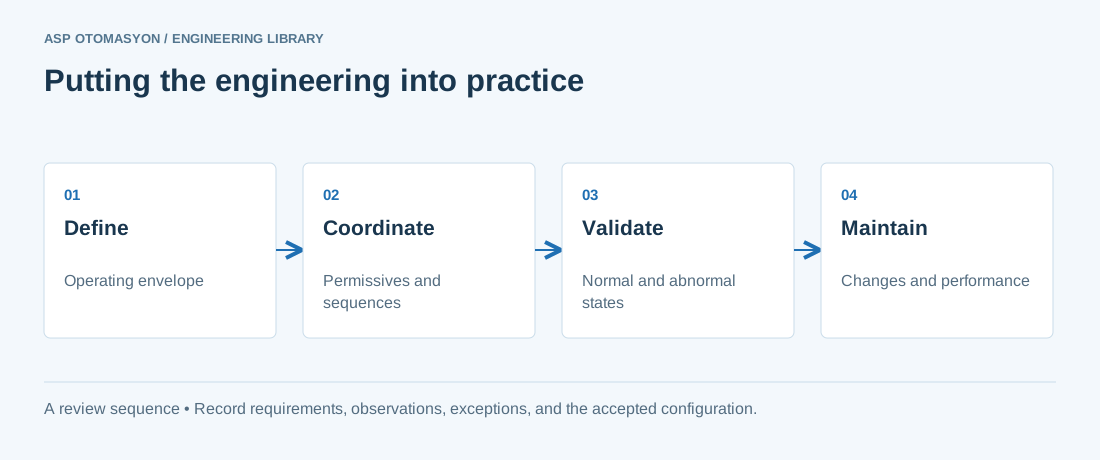
- Record process boundaries, required operating states, and interactions with independent protective systems.
- Check instrument quality, control authority, permissives, and operator responsibilities during state changes.
- Agree how tests, deviations, and configuration changes will be recorded within the facility's engineering procedures.
Follow an ASP project guide to connect the fundamentals with implementation and acceptance.
Primary references and further reading
Use the original specifications and product documentation for implementation details. The examples in this guide are illustrative engineering scenarios, not published project results.