
Chemical plants are the classic domain of continuous process automation: reactors, distillation columns, heat exchangers, and separators operating 24/7 under tight control, with safety and stability as the prime directives. The control challenges are defined by the chemistry — exothermic reactions, equilibrium limits, and process dynamics measured in minutes or hours — and the automation architecture by the risk: layers of protection from basic control through alarms to safety instrumented systems. This article covers the unit operations an automation engineer meets in chemical plants and how they are controlled.
The Unit Operation Toolbox
| Unit operation | Control objectives | Typical structure |
|---|---|---|
| Reactors (CSTR, batch, plug-flow) | Temperature, pressure, feed rates, conversion, selectivity | Cascade (T → cooling flow), feedforward on feed composition, jacket/coil temperature control; batch reactors add recipe-driven sequences. |
| Distillation columns | Product composition (top/bottom), pressure, level, reflux ratio | The classic control problem: the pairing of loops (LV/DV structures), material balance control, and composition control (inferential or analyzer-based). |
| Heat exchangers | Outlet temperature with minimum energy | Cascade with bypass control; fouling compensation via approach-temperature monitoring. |
| Compressors | Discharge pressure, surge avoidance | Anti-surge control with recycle valve, capacity control by speed or suction throttling. |
| Storage and blending | Level, inventory, blend composition | Ratio and inline blending control; tank farm management (see the tank farm article). |
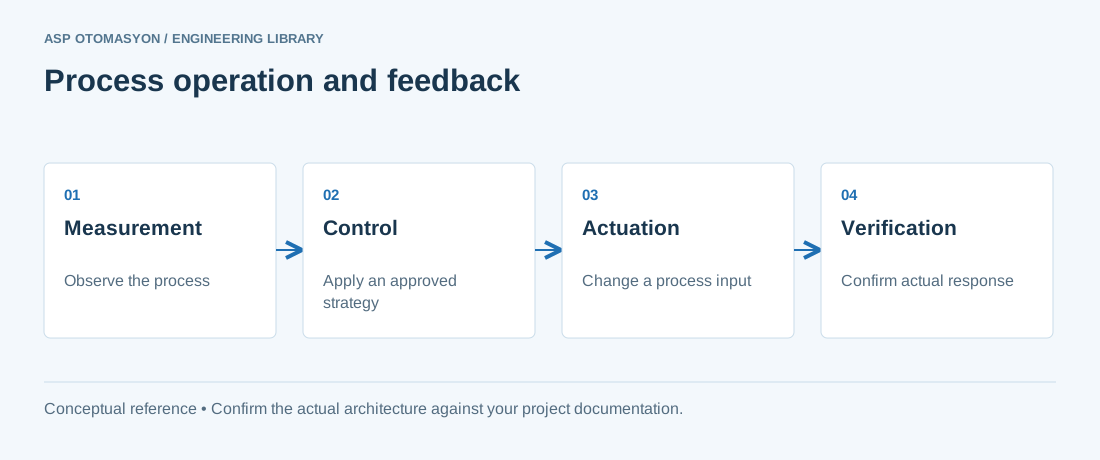
The control strategies build on the advanced structures described in the cascade/feedforward article; chemical plants are where those structures earn their keep.
Process Dynamics: Slow, Coupled, Nonlinear
Chemical processes have dynamics that shape every design decision:
- Dead time and long time constants — temperature and composition loops respond over minutes; the controller must be tuned for stability over speed, and feedforward (on feed changes, ambient, steam pressure) is usually essential.
- Coupling — changing one loop affects its neighbors (column pressure ↔ composition ↔ level); the pairing and tuning must account for interaction, and decoupling or model-based control (MPC) is justified on difficult units.
- Nonlinearity — gains change with operating point; gain scheduling, adaptive tuning, or models handle the operating range.
- Inferential measurement — composition analyzers are slow and costly; soft sensors (calculated from temperature/pressure/flow) provide the fast feedback, with the analyzer as the periodic truth.
Safety Layers: The Automation Stacks
Chemical plant automation follows the layer-of-protection model (IEC 61511):
- Basic Process Control System (BPCS/DCS) — normal regulation and sequencing; the first line.
- Alarms — the operator layer, managed per ISA-18.2 (see the alarm management article).
- Safety Instrumented Functions (SIS) — independent, certified layers that take the process to a safe state when limits are exceeded (see the SIS article); independence from the BPCS is engineered, not assumed.
- Physical protections — relief valves, rupture disks — beyond automation but part of the layer story.
The independence requirement drives architecture: separate safety controllers, separate field devices (where required), and testing regimes that keep the layers credible.
Automation Engineering in Chemicals
- Control narratives and functional specs — the engineering documents (loop descriptions, alarm lists, interlocks) are the contract between process engineering and automation; their quality decides the project's quality.
- Commissioning reality — loop checks, control tuning on the live process, and safety function proof tests follow the plant commissioning methodology (see the process plant commissioning article).
- Advanced control where it pays — MPC on the hard units (columns, reactors) delivers the classic 2–5% throughput/energy gains; the justification is the abatement curve of the unit, and the deployment requires an engineering team to maintain it (models drift with fouling, feed changes, and equipment changes).
- Data and analytics — the historian is the plant's memory: trends, alarm analytics, and the energy data (see the EMS articles) all come from the control layer; the historian's quality (tag naming, sampling, storage) determines the plant's analytical future.
Summary
Chemical plant automation is continuous-process control at scale: unit operation strategies (reactor cascades, column material balance, compressor anti-surge), dynamics-aware tuning with feedforward, layered safety per IEC 61511, and disciplined engineering documentation. The chemistry sets the problems; the control engineering solves them; and the safety layers ensure that every failure is a design consideration, not an incident. It is the deepest and most rewarding domain of process automation.
Apply this to your project
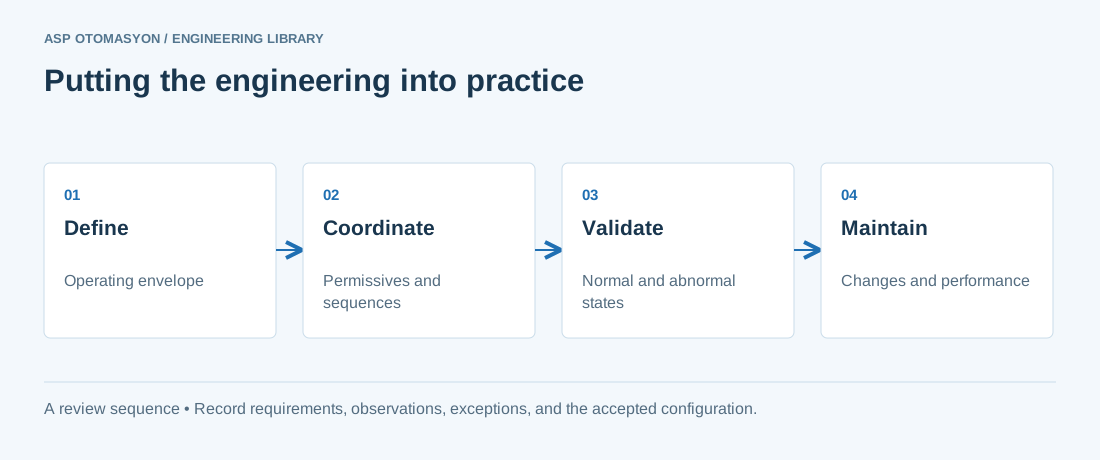
- Record process boundaries, required operating states, and interactions with independent protective systems.
- Check instrument quality, control authority, permissives, and operator responsibilities during state changes.
- Agree how tests, deviations, and configuration changes will be recorded within the facility's engineering procedures.
Follow an ASP project guide to connect the fundamentals with implementation and acceptance.
Primary references and further reading
Use the original specifications and product documentation for implementation details. The examples in this guide are illustrative engineering scenarios, not published project results.